Journey
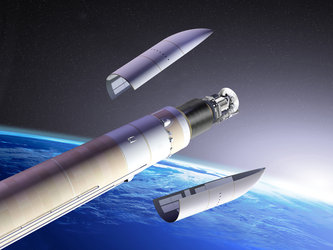
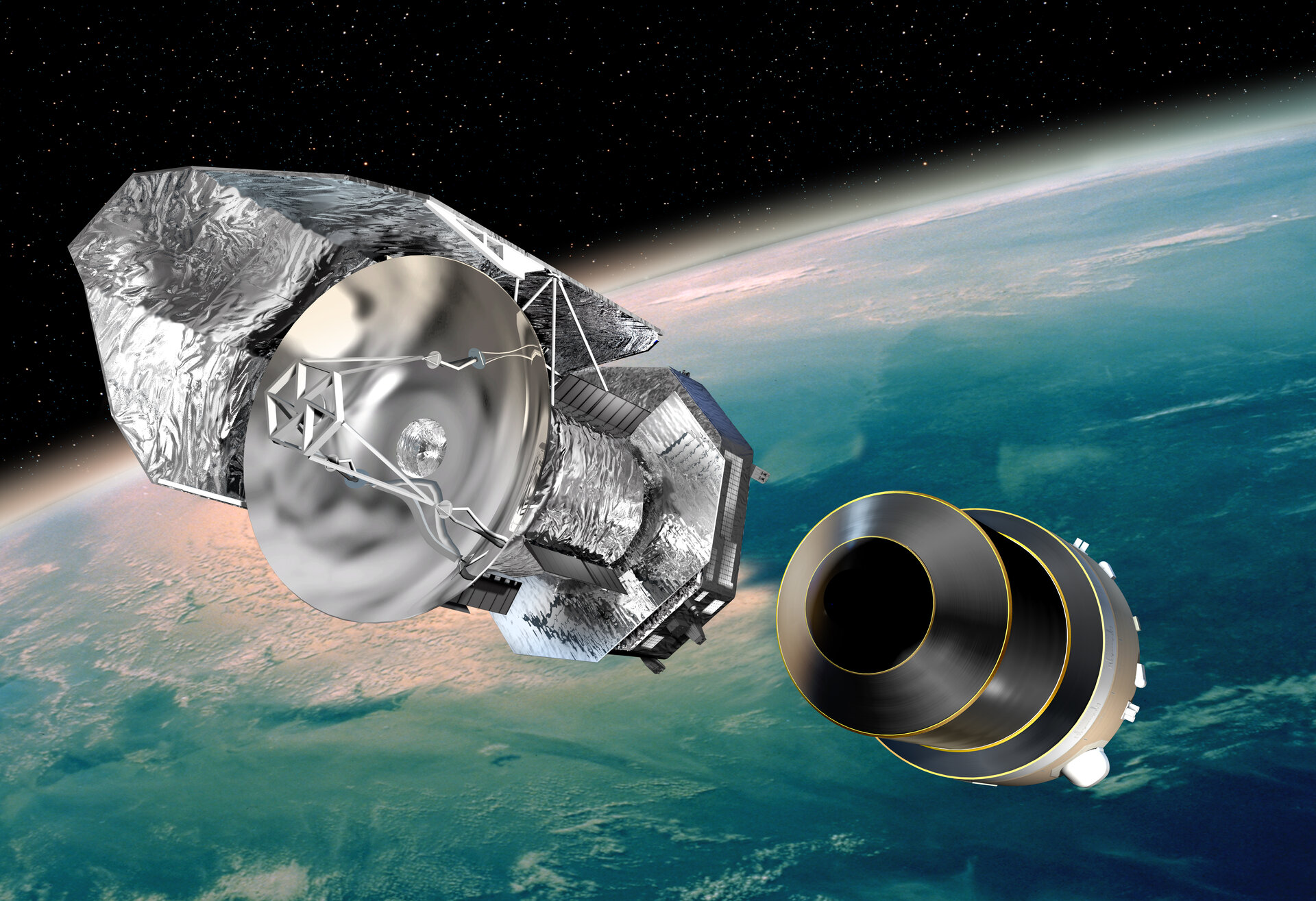
Herschel launched in spring 2009 on an Ariane 5 along with ESA’s Planck microwave observatory, which studied the Cosmic Microwave Background.
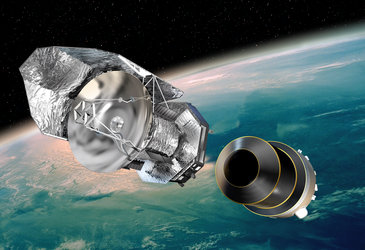
At launch, the Herschel-Planck combination measured approximately 11 m in height and 4.5 m in width, with a weight of about 5.7 tonnes. They separated soon after launch and headed into different orbits. The two spacecraft were operated independently.
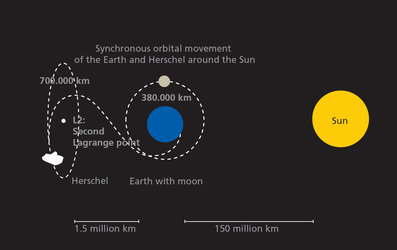
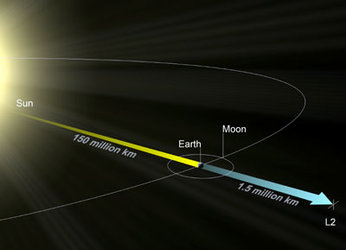
If Herschel were placed in orbit around Earth, heat from our planet, the Moon and the Sun would interfere with its instruments, reducing their sensitivity. Instead, the telescope orbited the second Lagrange point of the Earth-Sun system (L2), a point in space located 1.5 million km from Earth.
L2 is a local gravitationally-stable point that is fixed in the Earth-Sun system and is situated on Earth’s night-side. It was an excellent location for Herschel: the solar array and sunshade always faced the Sun, Earth and the Moon, sheltering the satellite from solar radiation and infrared emission from Earth and the Moon.
Because Earth and the Sun are in the same general direction, this orbit also offered good sky visibility for astronomical observations. In addition, it kept Herschel outside Earth’s radiation belts, which may have otherwise disturbed observations.
For more information, see L2, the second Lagrangian point.

It took Herschel about 60 days to enter its final operational orbit around L2. The observatory was in a quasi-halo orbit, i.e. an orbit that resembles a halo orbit, around L2 with an average amplitude of