Astronomers may have glimpsed tiny star’s surface
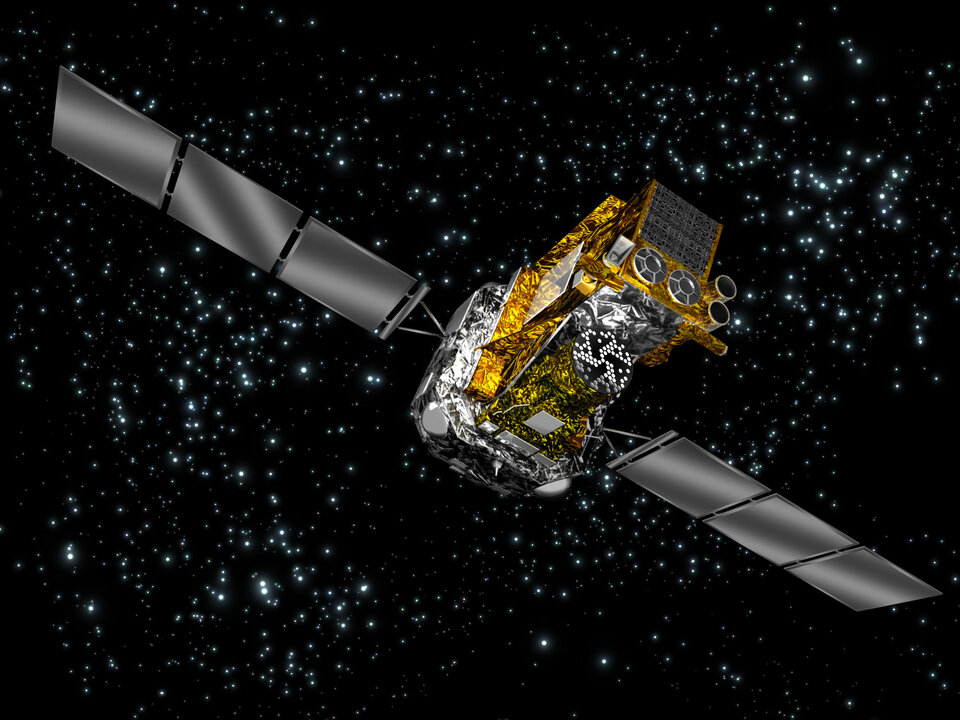
Astronomers have used ESA's gamma-ray observatory Integral to study a very special neutron star system: Hercules X-1. They may have detected individual X-ray emitting regions on the neutron star’s surface, resolving details on a celestial object only 20 km across at a distance of
Hercules X-1, a very peculiar and complicated stellar system, has been the subject of much investigation. It is seen by astronomers because it emits pulses of X-rays.
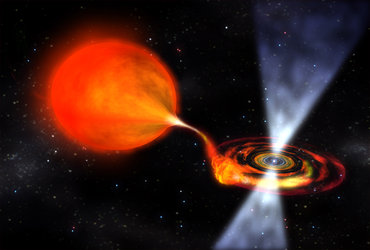
It consists of a fast-spinning neutron star or pulsar, the dead heart of a once massive star, ripping gas from a more ‘normal’ companion star. This gas spirals into a disc around the neutron star before settling on its surface.
It is known that the disc of Hercules X-1 is not flat and wobbles with a cycle of 35 days. As it wobbles, it periodically blocks the X-rays emitted by the neutron star from sight. But when the disc does not block these X-rays, they still change their characteristics in a repeating pattern that also lasts 35 days. The question is: what causes this variation?
Astronomers may have resolved surface details on a celestial object only 20 km in diameter at a distance of
15 000 light years.
To understand Hercules X-1 and the mechanism behind this peculiar behaviour, Dmitry Klochkov, Institut für Astronomie und Astrophysik, University of Tübingen, and colleagues used Integral to observe the system over the longest-ever continuous observation of this object, between 22 July and 3 August 2005.
According to astronomers, there are two possibilities that explain this variation in the X-ray (and low-energy gamma-ray) emission of Hercules X-1. Either the disc of gas surrounding the neutron star is moving and obscuring regions on the neutron star before it blocks our line of vision completely; or the neutron star itself is wobbling as it spins, presenting different faces to Earth.
Although the detailed set of data obtained by Integral does not rule out the disc option completely, it does make it unlikely, according to Klochkov. He points out that the inner edge of the accretion disc is 1000 km from the neutron star. “From that distance, the neutron star will look like a tiny point,” he says. So, blocking out just a part of the surface to change the emission characteristics will be a tall order.
This leaves the option that this tiny stellar corpse must wobble once every 35 days. As it does so, it moves different areas of emission into our view. These different regions on the neutron star’s surface emit different quantities of X-rays, causing the pulse shape to change.
If so, is it just a big coincidence that the neutron star wobbles in exactly the same time as the disc rotates? Klochkov believes not. The disc is joined to the neutron star by means of a complicated feedback mechanism where the neutron star's magnetosphere affecting the inner part of the disc plays an important role.
So, although Integral has moved the story on, it has not yet revealed the ending. “It is still not possible to say for certain that it is the wobbling of the neutron star rather than the accretion disc,” says Klochkov.
If it is the neutron star, then the astronomers have done something only rarely achieved in the past. They have resolved surface details on a celestial object only 20 km in diameter at a distance of
Notes for editors:
The article 'Integral observations of Her X-1' by D. Klochkov et al. has been published in Astronomy and Astrophysics in May 2008.
For more information:
Dmitry Klochkov, Institut für Astronomie und Astrophysik, University of Tübingen
Email: klochkov @ astro.uni-tuebingen.de
Christoph Winkler, ESA Integral Project Scientist
Email: Christoph.winkler @ esa.int