Dissecting a stellar explosion
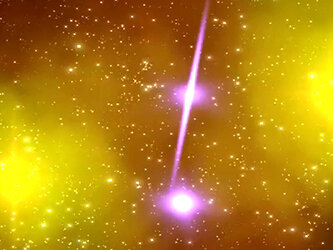
Integral has captured one of the brightest gamma-ray bursts ever seen. A meticulous analysis of the data has allowed astronomers to investigate the initial phases of this giant stellar explosion, which led to the ejection of matter at velocities close to the speed of light. In particular, the astronomers believe that the explosion lifted a piece of the central engine’s magnetic field into space.
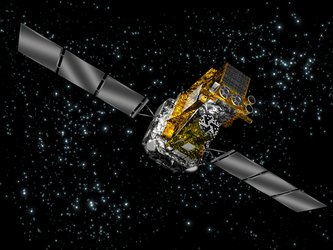
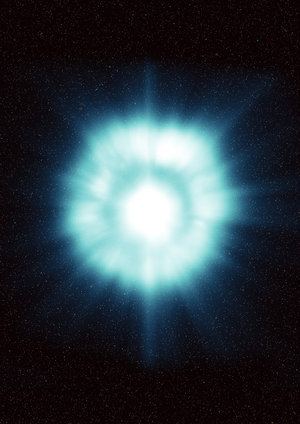
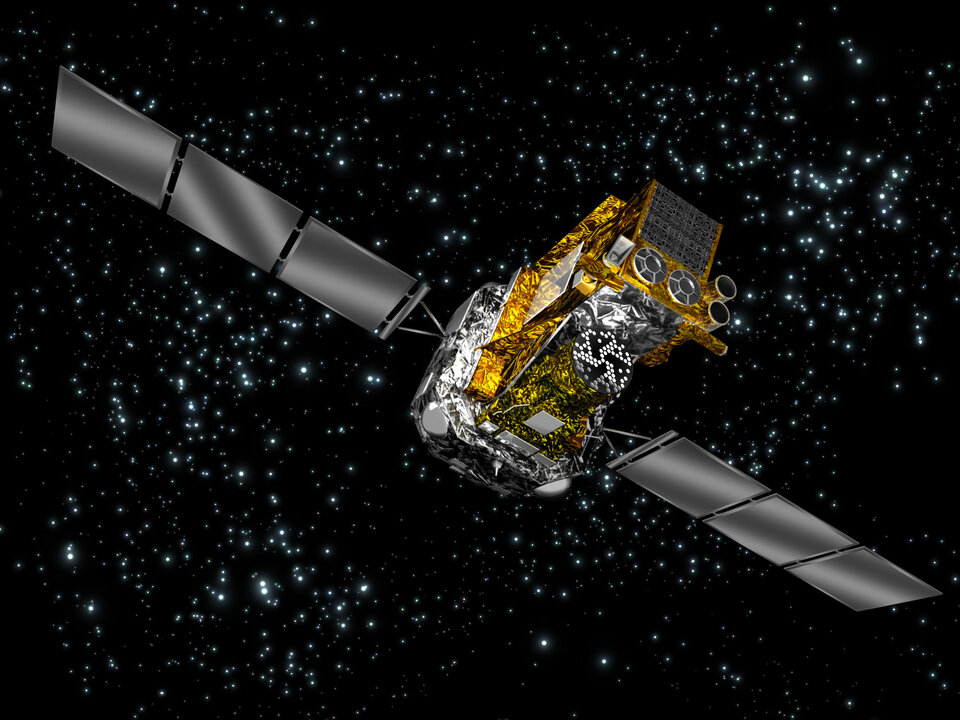
On 19 December 2004, the blast from an exploding star arrived at Earth. ESA’s Integral satellite, an orbiting gamma-ray observatory, recorded the entire event, providing information for what may prove to be one of the most important gamma-ray bursts (GRBs) seen in recent years. As the data was collected, astronomers saw the 500-second-long burst rise to extraordinary brilliance.
“It is in the top 1% of the brightest GRBs we have seen,” says Diego Götz, CEA Saclay, France, who headed the investigation.
The brightness of the event, known as GRB 041219A, has allowed the team to perform a painstaking investigation to extract a property known as the polarisation of the gamma rays. The team have shown that the gamma rays were highly polarised and varied tremendously in level and orientation.

Polarisation refers to the preferred direction in which the radiation wave oscillates. Polaroid sunglasses work with visible light by letting through only a single direction of polarisation, blocking most of the light from entering our eyes.
The blast from a GRB is thought to be produced by a jet of fast-moving gas bursting from near the central engine; probably a black hole created by the collapse of the massive star. The polarisation is directly related to the structure of the magnetic field in the jet. So it is one of the best ways for astronomers to investigate how the central engine produces the jet. There are a number of ways this might happen.
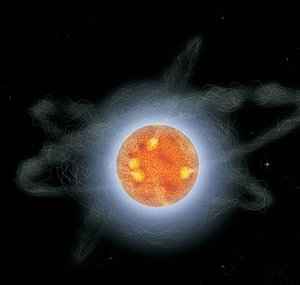
In the first scenario, the jet carries a portion of the central engine’s magnetic field into space. A second involves the jet generating the magnetic field far from the central engine. A third concerns the extreme case in which the jet contains no gas just magnetic energy, and a fourth scenario entails the jet moving through an existing field of radiation.
In each of the first three scenarios, the polarisation is generated by what is called synchrotron radiation. The magnetic field traps particles, known as electrons, and forces them to spiral, releasing polarised radiation. In the fourth scenario, the polarisation is imparted through interactions between the electrons in the jet and photons in the existing radiation field.
Götz believes that the Integral results favour a synchrotron model and, of those three, the most likely scenario is the first, in which the jet lifts the central engine’s magnetic field into space. “It is the only simple way to do it,” he says.
What Götz would most like to do is measure the polarisation for every GRB, to see whether the same mechanism applies to all. Unfortunately, many GRBs are too faint for the current instrumentation to succeed. Even the state-of-the-art IBIS instrument on Integral can only record the polarisation state of gamma rays if a celestial source is as bright as GRB 041219A.
“So, for now we just have to wait for the next big one,” he says.
Notes for editors:
The team members are from: Commissariat à l'énergie atomique (Astrophysique Interactions Multi-´echelles, Astroparticules et Cosmologie), and the Institut d’Astrophysique de Paris (CNRS), all based in France.
Variable Polarisation in the prompt emission of GRB 041219A using IBIS on board Integral by Diego Götz et al. will be published in the Astrophysical Journal Letters.