• → European Space Agency

      • Space for Europe
      • Space News
      • Space in Images
      • Space in Videos
    • About Us

      • Welcome to ESA
      • DG's News and Views
      • For Member State Delegations
      • Business with ESA
      • ESA Exhibitions
      • ESA Publications
      • Careers at ESA
    • Our Activities

      • Space News
      • Observing the Earth
      • Human Spaceflight
      • Launchers
      • Navigation
      • Space Science
      • Space Engineering
      • Operations
      • Technology
      • Telecommunications & Integrated Applications
    • For Public

    • For Media

      • Media
      • ESA TV
      • Videos for professionals
      • Photos
    • For Educators

    • For Kids

    • ESA

    • ESA Science

    • Mars Express

    • Europe goes to Mars

      • Europe reclaims a stake in Mars exploration
      • Space age transforms our knowledge about Mars
    • About Mars Express

      • Mars Express mission facts
      • Mars Express instruments
      • The mission
      • The spacecraft
      • The launcher
    • About Mars

      • Geography of Mars
      • Water on early Mars?
      • Signatures of life
      • Facts about Mars
    • Meet the team

      • International collaboration
      • Project Manager
      • Project Scientist
      • Mars Lead Scientist
      • Principal Investigators
      • Operations
      • Industry
    • Multimedia
    • VideoTalk
    • Mars Express images
    • Mars Express videos
    • HRSC videos
    • Animation in 11 languages
    • Download wallpapers
    • Download screensavers
    • 3D Flash 'model'
    • Make a model
    • Services
    • Comments

    ESA > Our Activities > Space Science > Mars Express

    Neighbouring volcanoes on Mars

    Neighbouring volcanoes on Mars

    1 April 2011

    ESA’s Mars Express has returned images of mist-capped volcanoes located in the northern hemisphere of the red planet. Long after volcanic activity ceased, the area was transformed by meteor impacts that deposited ejected material over the lower flanks of the volcanoes.

    Permanent and transient features are on display in this newly released image of Mars. The image is derived from data acquired during three orbits of ESA’s Mars Express between 25 November 2004 and 22 June 2006. In that time, these dead volcanoes were not expected to change but, during the middle orbit, Mars Express captured icy clouds drifting past the summit of Ceraunius Tholus.

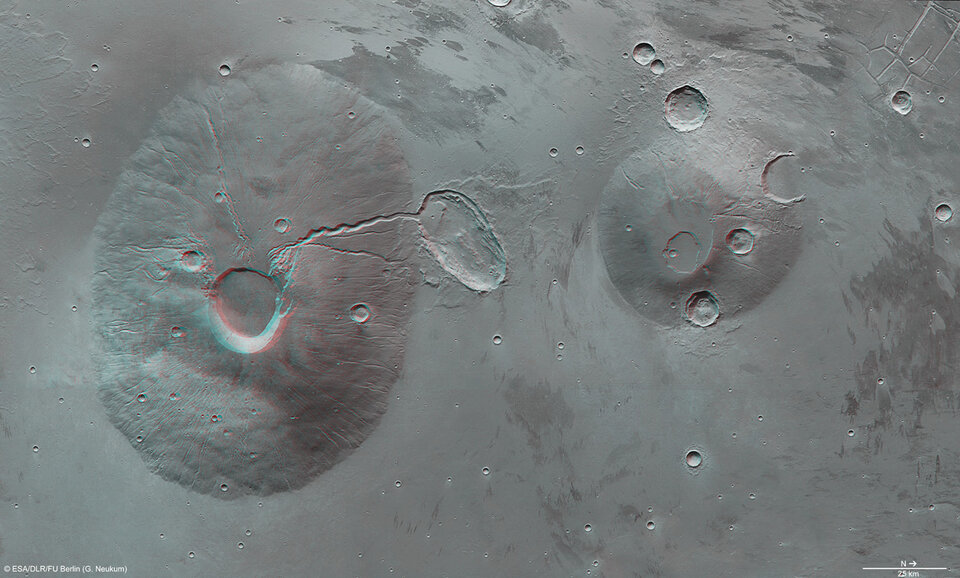
    Ceraunius Tholus and Uranius Tholus in context

    By the time Mars Express crossed again and took the final strip of data needed for this image, the clouds had long since dispersed and so there is a sharp line across them in the finished mosaic.

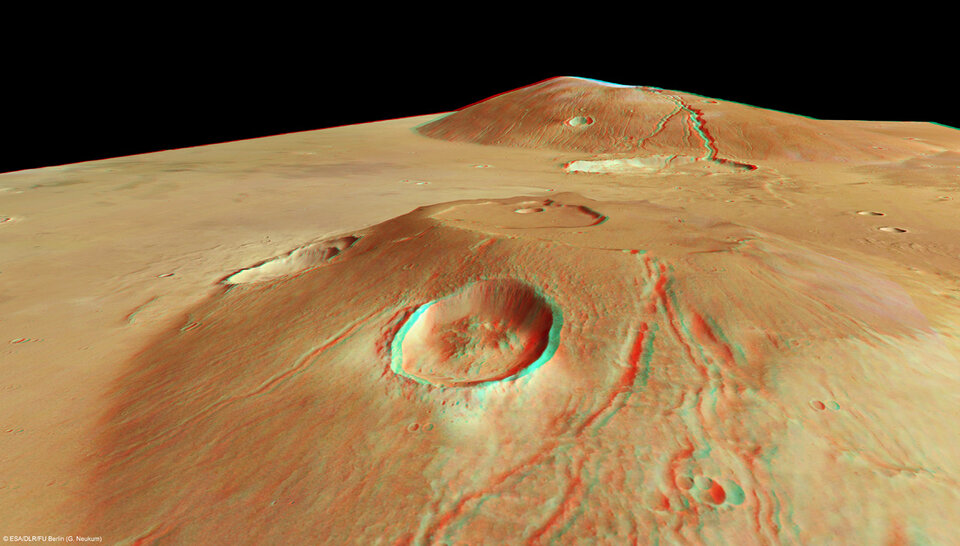
    The Latin word “tholus” means a conical dome and the base of Ceraunius Tholus is 130 km across, while the peak rises 5.5 km above the surrounding plains. At its summit is a large caldera 25 km across. With similar morphology to its neighbour and lying 60 km to the north, Uranius Tholus is a smaller volcano, with a base diameter of 62 km and a height of 4.5 km.


    Features around Ceraunius Tholus and Uranius Tholus

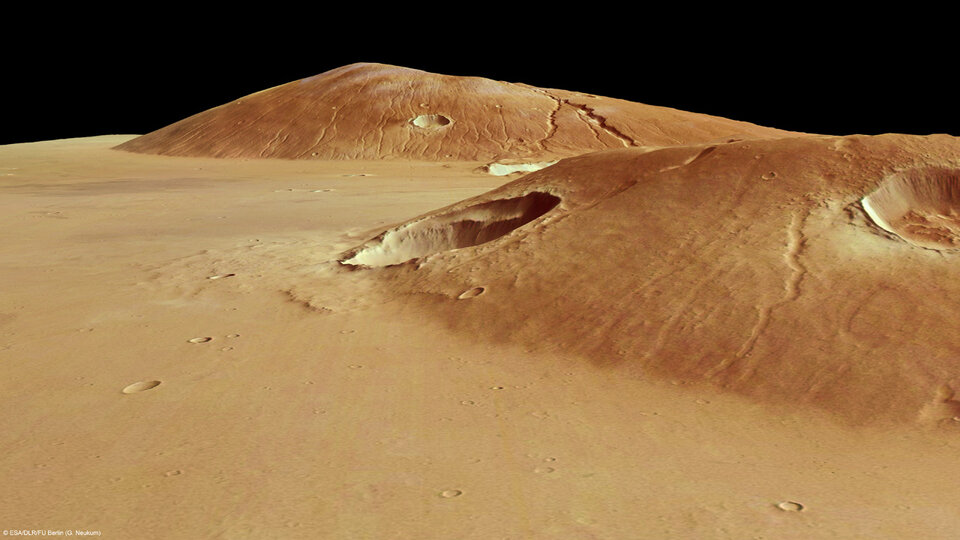
    The flanks of Ceraunius Tholus are relatively steep, at about 8° inclination, and are etched with valleys. They are deeply cut in many places, suggesting that soft and easily eroded material, such as layers of ash, were deposited during the volcano’s eruptions.

    The largest and deepest of these valleys is about 3.5 km wide and 300 m deep. It terminates inside an otherwise unrelated elongated impact crater that happens to lie between the two volcanoes, and has created a fascinating fan shape of deposits.

    Elevation of Ceraunius Tholus and Uranius Tholus

    Although the source of the fan is still being debated in scientific circles, it may have been formed when material from a lava channel or tube was washed downwards by a melting ice cap on the volcano.

    Certainly, the summit crater – the caldera – is flat and smooth, so it may have contained a lake early in Mars’ history when the atmosphere was denser. It is also possible that the water was produced when volcanic activity melted buried ice lenses. An ice lens forms when moisture seeps below the surface and forms a frozen layer between the top ‘soil’ and the rocky layer below.

    Ceraunius Tholus and Uranius Tholus in high resolution

    The elongated crater between the two volcanoes is called Rahe. It measures 35 km by 18 km and is the result of an oblique impact by a meteorite.

    A smaller impact crater 13 km across can be seen to the west of Uranius Tholus. This one also formed after all the volcanic activity ended and served to cover the lower flanks of the volcanoes with ejected material, with the result that only the upper regions of the original structures are now visible.

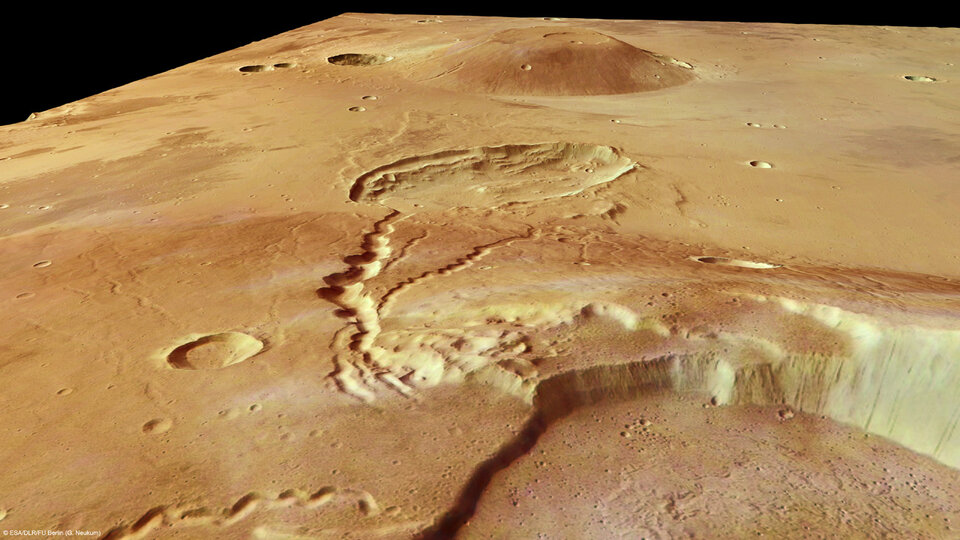
    Ceraunius Tholus in perspective
    Ceraunius Tholus and Uranius Tholus in perspective
    Ceraunius Tholus and Uranius Tholus in perspective
    Ceraunius Tholus and Uranius Tholus in 3D
    Ceraunius Tholus and Uranius Tholus in 3D

    Rate this

    Views

    Share

    • Currently 0 out of 5 Stars.
    • 1
    • 2
    • 3
    • 4
    • 5
    Rating: 0/5 (0 votes cast)

    Thank you for rating!

    You have already rated this page, you can only rate it once!

    Your rating has been changed, thanks for rating!

    248
    Tweet
    • Mars Express on YouTube
    • Traces of Martian life
    • Related articles
      • Rare martian lake delta spotted by Mars Express
        • Mars’ northern polar regions in transition
          • Phobos slips past Jupiter
            • Springtime at Mars’ south pole
              • Mars Express sees deep fractures on Mars
                • Neighbouring volcanoes on Mars
                  • The scars of impacts on Mars
                    • Mars Express puts craters on a pedestal
                      • Mars Express close flybys of martian moon Phobos
                        • Wind and water have shaped Schiaparelli on Mars
                          • Light and dark in the Phoenix Lake
                            • Mars: how low can you go?
                              • Mars’s mysterious elongated crater
                                • Rocky mounds and a plateau on Mars
                                  • Wet era on early Mars was global
                                    • Volcanic ash in Meridiani Planum
                                      • Craters young and old in Sirenum Fossae
                                        • Craters, lava flows and tectonic features near Ma'adim Vallis
                                          • Craters and channels in Hephaestus Fossae
                                            • Chaotic terrain in Ariadnes Colles
                                              • Ice-covered martian North Pole
                                                • The Euminedes Dorsum mountains on Mars
                                                  • Lava deposits in Mangala Fossae
                                                  • Related links
                                                  • High Resolution Stereo Camera
                                                    • Behind the lens...
                                                      • Frequently asked questions
                                                      • For specialists
                                                      • ESA Planetary Science archive (PSA)
                                                      • NASA Planetary Data System
                                                      • HRSC data viewer

    Connect with us

    • RSS
    • Youtube
    • Twitter
    • Flickr
    • G+
    • Facebook
    • Livestream
    • Subscribe
    • App Store
    • LATEST ARTICLES
    • · Earth Explorers take centre stage …
    • · The fast winds of Venus are gettin…
    • · ExoMars 2016 set to complete const…
    • · Herschel ends operations as orbiti…
    • · Europe’s largest spaceship reache…
    • FAQ

    • Jobs at ESA

    • Site Map

    • Contacts

    • Terms and conditions