• → European Space Agency

      • Space for Europe
      • Space News
      • Space in Images
      • Space in Videos
    • About Us

      • Welcome to ESA
      • DG's News and Views
      • For Member State Delegations
      • Business with ESA
      • ESA Exhibitions
      • ESA Publications
      • Careers at ESA
    • Our Activities

      • Space News
      • Observing the Earth
      • Human Spaceflight
      • Launchers
      • Navigation
      • Space Science
      • Space Engineering
      • Operations
      • Technology
      • Telecommunications & Integrated Applications
    • For Public

    • For Media

      • Media
      • ESA TV
      • Videos for professionals
      • Photos
    • For Educators

    • For Kids

    • ESA

    • ESA Science

    • Mars Express

    • Europe goes to Mars

      • Europe reclaims a stake in Mars exploration
      • Space age transforms our knowledge about Mars
    • About Mars Express

      • Mars Express mission facts
      • Mars Express instruments
      • The mission
      • The spacecraft
      • The launcher
    • About Mars

      • Geography of Mars
      • Water on early Mars?
      • Signatures of life
      • Facts about Mars
    • Meet the team

      • International collaboration
      • Project Manager
      • Project Scientist
      • Mars Lead Scientist
      • Principal Investigators
      • Operations
      • Industry
    • Multimedia
    • VideoTalk
    • Mars Express images
    • Mars Express videos
    • HRSC videos
    • Animation in 11 languages
    • Download wallpapers
    • Download screensavers
    • 3D Flash 'model'
    • Make a model
    • Services
    • Comments

    ESA > Our Activities > Space Science > Mars Express

    Animation of Phobos rotating

    Phobos flyby season starts again

    16 February 2010

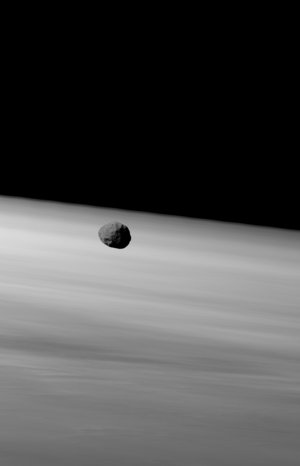
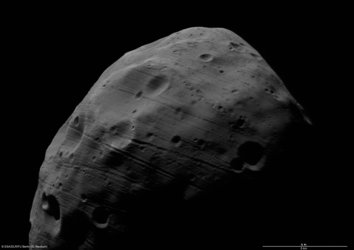
    Today Mars Express began a series of flybys of Phobos, the largest moon of Mars. The campaign will reach its crescendo on 3 March, when the spacecraft will set a new record for the closest pass to Phobos, skimming the surface at just 50 km. The data collected could help untangle the origin of this mysterious moon.

    The latest Phobos flyby campaign began today at 06:52 CET (05:52 UT), when Mars Express drew to within 991 km of Phobos’ airless surface. The flybys will continue at varying altitudes until 26 March when Phobos moves out of range. They offer prime chances for doing additional science with Mars Express, a spacecraft that was designed to study the red planet below rather than the grey moon alongside.
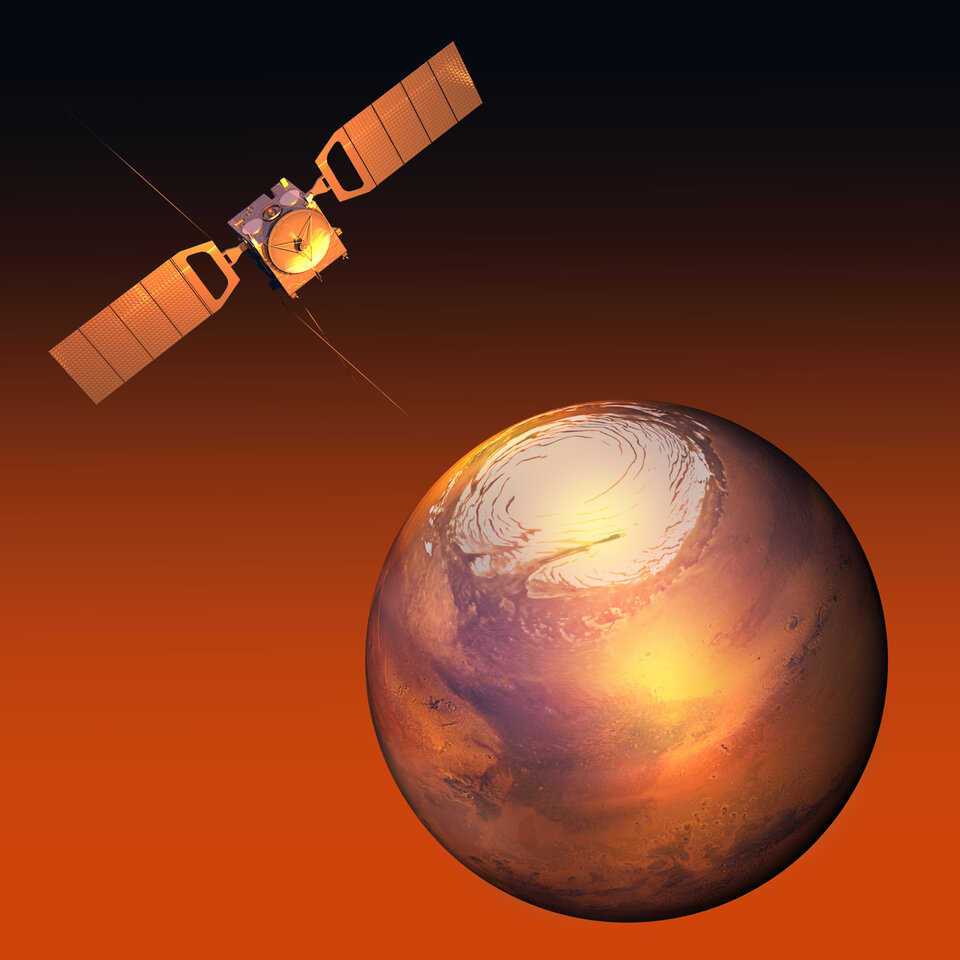
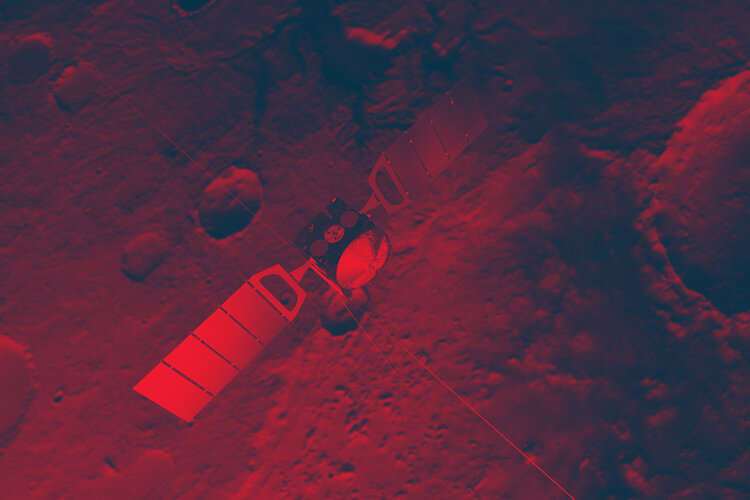
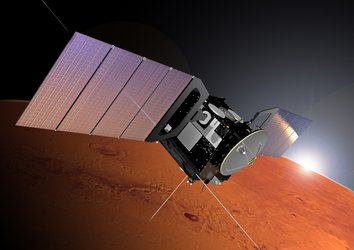
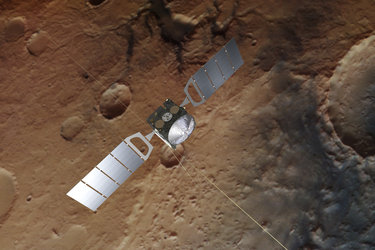
    Mars Express in its polar orbit

    “Because Mars Express is in an elliptical and polar orbit with a maximum distance from Mars of about 10 000 km, we regularly pass Phobos. This represents an excellent opportunity to perform extra science,” says Olivier Witasse, Mars Express Project Scientist.

    Back in 2009, the mission team decided that the orbit of Mars Express needed to be adjusted to prevent the closest approach of the spacecraft drifting onto the planet’s nightside. The flight control team at the European Space Operations Centre in Darmstadt, Germany, presented a number of possible scenarios, including one that would take the spacecraft to just 50 km above Phobos. “That was the closest they would let us fly to Phobos,” says Witasse.


    Precise gravity measurements

    Heavy emphasis is being placed upon the closest flyby because it is an unprecedented opportunity to map Phobos’ gravity field. At that range, Mars Express should feel differences in the pull from Phobos depending which part of the moon is closest at the time. This will allow scientists to infer the moon’s internal structure.

    Previous Mars Express flybys have already provided the most accurate mass yet for Phobos, and the High Resolution Stereo Camera (HRSC) has provided the volume. When calculating the density, this gives a surprising figure because it seems that parts of Phobos may be hollow. The science team aim to verify this preliminary conclusion.

    In particular, the MARSIS radar will operate in a special sequence to try to see inside the moon, looking for structures or some clue to the internal composition. “If we know more about how Phobos is built, we might know more about how it formed,” says Witasse.

    The High Resolution Stereo Camera (HRSC)

    The origin of Phobos is a mystery. Three scenarios are possible. The first is that the moon is a captured asteroid. The second is that it formed in situ as Mars formed below it. The third is that Phobos formed later than Mars, out of debris flung into Martian orbit when a large meteorite struck the red planet.

    All the instruments will be used during the campaign, including HRSC. Although no imaging will be possible during the first five flybys, including the closest one, because Mars Express approaches from the nightside, high-resolution pictures will be possible from 7 March onwards. One task for HRSC is to image the proposed landing sites for the Russian mission Phobos-Grunt.

    “It is always busy,” says Witasse about running the science mission. “The Phobos flybys make it even more exciting.”

    Real time updates of the flyby campaign can be followed at the Mars Express blog.

    Rate this

    Views

    Share

    • Currently 0 out of 5 Stars.
    • 1
    • 2
    • 3
    • 4
    • 5
    Rating: 0/5 (0 votes cast)

    Thank you for rating!

    You have already rated this page, you can only rate it once!

    Your rating has been changed, thanks for rating!

    371
    Tweet
    • Phobos up close
      Phobos up close
      Mars Express blog
    • Looking at Mars
    • Mars Express on YouTube
    • Traces of Martian life
    • See the Mars Webcam from ESA's Spacecraft Operations team
      See the Mars Webcam from ESA's Spacecraft Operations team
      Mars Webcam
    • Related articles
      • Phobos flyby success
        • Mars Express heading for closest flyby of Phobos
          • Phobos flyby season starts again
            • Auspicious orbit marks run-up to Phobos flyby
              • Craters young and old in Sirenum Fossae
                • Pioneering images of both martian moons
                  • Mars Express acquires sharpest images of martian moon Phobos
                    • ESA closes in on the origin of Mars’ larger moon
                      • Chaotic terrain between Kasei Valles and Sacra Fossae
                        • Lava flows in Daedalia Planum
                        • More information
                        • Mars Express in-depth
                          • Mars Express operations
                            • New Norcia - DSA 1
                              • Cebreros - DSA 2

    Connect with us

    • RSS
    • Youtube
    • Twitter
    • Flickr
    • G+
    • Facebook
    • Livestream
    • Subscribe
    • App Store
    • LATEST ARTICLES
    • · The fast winds of Venus are gettin…
    • · ExoMars 2016 set to complete const…
    • · Herschel ends operations as orbiti…
    • · Europe’s largest spaceship reache…
    • · ATV ready to nose up to Station
    • FAQ

    • Jobs at ESA

    • Site Map

    • Contacts

    • Terms and conditions