• → European Space Agency

      • Space for Europe
      • Space News
      • Space in Images
      • Space in Videos
    • About Us

      • Welcome to ESA
      • DG's News and Views
      • For Member State Delegations
      • Business with ESA
      • ESA Exhibitions
      • ESA Publications
      • Careers at ESA
    • Our Activities

      • Space News
      • Observing the Earth
      • Human Spaceflight
      • Launchers
      • Navigation
      • Space Science
      • Space Engineering
      • Operations
      • Technology
      • Telecommunications & Integrated Applications
    • For Public

    • For Media

    • For Educators

    • For Kids

    • ESA

    • ESA Science

    • Mars Express

    • Europe goes to Mars

      • Europe reclaims a stake in Mars exploration
      • Space age transforms our knowledge about Mars
    • About Mars Express

      • Mars Express mission facts
      • Mars Express instruments
      • The mission
      • The spacecraft
      • The launcher
    • About Mars

      • Geography of Mars
      • Water on early Mars?
      • Signatures of life
      • Facts about Mars
    • Meet the team

      • International collaboration
      • Project Manager
      • Project Scientist
      • Mars Lead Scientist
      • Principal Investigators
      • Operations
      • Industry
    • Multimedia
    • VideoTalk
    • Mars Express images
    • Mars Express videos
    • HRSC videos
    • Animation in 11 languages
    • Download wallpapers
    • Download screensavers
    • 3D Flash 'model'
    • Make a model
    • Services
    • Comments

    ESA > Our Activities > Space Science > Mars Express

    Phobos and Deimos

    Pioneering images of both martian moons

    11 December 2009

    For the very first time, the martian moons Phobos and Deimos have been caught on camera together. ESA's Mars Express orbiter took these pioneering images last month. Apart from their ‘wow’ factor, these unique images will help the HRSC team validate and refine existing orbit models of the two moons.

    Phobos up close
    Phobos up close

    The images were acquired with the Super Resolution Channel (SRC) of the High Resolution Stereo Camera (HRSC). The camera took 130 images of the moons on 5 November at 9:14 CET over period of 1.5 minutes at intervals of 1s, speeding up to 0.5-s intervals toward the end. The image resolution is 110 m/pixel for Phobos and 240 m/pixel for Deimos — Deimos was more than twice as far from the camera.

    The Super Resolution Channel of the HRSC uses an additional lens, which has a very narrow field of view of just 0.5°, providing four times the resolution of the HRSC colour stereo channel.


    Raw and processed images

    Phobos, the larger of the two moons, orbits closer to the Red Planet, circling it every 7 hours and 39 minutes. It travels faster relative to Mars than the Moon relative to Earth. It was 11 800 km from Mars Express when the images were taken. Deimos was 26 200 km away.

    It is not often that both martian moons are located directly in front of the camera, lined up one behind the other. The chance to image both moons together came on 5 November 2009 when the viewing geometry was especially favourable.

    The plan to image both moons at once was years in the making and was made possible by the unique elliptical orbit of Mars Express, precise knowledge of the orbits of the planet, the moons and the spacecraft, as well as fortuitous viewing geometry, and perfect planning by the ESA and HRSC teams.

    Exploration of Phobos: a scientific priority for Mars Express

    Exposure geometry
    Exposure geometry

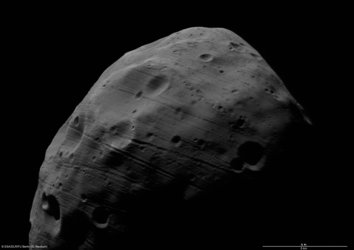
    In addition to producing high-resolution maps of the surface of Mars in colour and in 3D, the exploration of Phobos is a scientific priority for the HRSC team. The potato-shaped, 27 × 22 × 18 km moon has already been photographed 127 times by the HRSC, improving our knowledge of the topography of the moon, and providing insight into its origins and development.

    For more information:

    Gerhard Neukum, HRSC Principal Investigator, FU Berlin, Germany
    Email: Gneukum @ zedat.fu-berlin.de

    Ralf Jaumann, HRSC Co-Investigator
    Email: Ralf.Jaumann @ dlr.de

    Agustin Chicarro, ESA
    Email: Agustin.Chicarro @ esa.int

    Olivier Witasse, ESA Mars Express Project Scientist
    Email: Olivier.Witasse @ esa.int

    Fred Jansen, ESA Mars Express Mission Manager
    Email: Fred.Jansen @ esa.int
    Rate this

    Views

    Share

    • Currently 0 out of 5 Stars.
    • 1
    • 2
    • 3
    • 4
    • 5
    Rating: 0/5 (0 votes cast)

    Thank you for rating!

    You have already rated this page, you can only rate it once!

    Your rating has been changed, thanks for rating!

    262
    Tweet
    • Mars Express image browser
    • Mars Express on YouTube
    • Traces of Martian life
    • Related articles
      • Mars Express acquires sharpest images of martian moon Phobos
        • ESA closes in on the origin of Mars’ larger moon
          • Chaotic terrain between Kasei Valles and Sacra Fossae
            • Lava flows in Daedalia Planum
              • Craters, lava flows and tectonic features near Ma'adim Vallis
                • Craters and channels in Hephaestus Fossae
                  • Chaotic terrain in Ariadnes Colles
                    • Ice-covered martian North Pole
                      • The Euminedes Dorsum mountains on Mars

    Connect with us

    • RSS
    • Youtube
    • Twitter
    • Flickr
    • G+
    • Facebook
    • Livestream
    • Subscribe
    • App Store
    • LATEST ARTICLES
    • · Proba-V opens its eyes
    • · First new Galileo satellite arrive…
    • · Next destination: space
    • · Leak repaired on International Spa…
    • · After Chelyabinsk: European expert…
    • FAQ

    • Jobs at ESA

    • Site Map

    • Contacts

    • Terms and conditions