• → European Space Agency

      • Space for Europe
      • Space News
      • Space in Images
      • Space in Videos
    • About Us

      • Welcome to ESA
      • DG's News and Views
      • For Member State Delegations
      • Business with ESA
      • ESA Exhibitions
      • ESA Publications
      • Careers at ESA
    • Our Activities

      • Space News
      • Observing the Earth
      • Human Spaceflight
      • Launchers
      • Navigation
      • Space Science
      • Space Engineering
      • Operations
      • Technology
      • Telecommunications & Integrated Applications
    • For Public

    • For Media

    • For Educators

    • For Kids

    • ESA

    • ESA Science

    • Mars Express

    • Europe goes to Mars

      • Europe reclaims a stake in Mars exploration
      • Space age transforms our knowledge about Mars
    • About Mars Express

      • Mars Express mission facts
      • Mars Express instruments
      • The mission
      • The spacecraft
      • The launcher
    • About Mars

      • Geography of Mars
      • Water on early Mars?
      • Signatures of life
      • Facts about Mars
    • Meet the team

      • International collaboration
      • Project Manager
      • Project Scientist
      • Mars Lead Scientist
      • Principal Investigators
      • Operations
      • Industry
    • Multimedia
    • VideoTalk
    • Mars Express images
    • Mars Express videos
    • HRSC videos
    • Animation in 11 languages
    • Download wallpapers
    • Download screensavers
    • 3D Flash 'model'
    • Make a model
    • Services
    • Comments

    ESA > Our Activities > Space Science > Mars Express

    Acidalia Planitia and Tempe Terra transition

    Signs of ancient flowing water on Mars

    4 May 2012

    ESA’s Mars Express has returned images of a region on the Red Planet that appears to have been sculpted in part by flowing liquid. This again adds to the growing evidence that Mars had large volumes of water on its surface in the distant past.

    On 21 June last year, Mars Express pointed its high-resolution stereo camera at the western part of Acidalia Planitia, a gigantic basin in the planet’s northern lowlands, at the interface with Tempe Terra, an older, higher terrain.

    Acidalia Planitia is a region so vast that it can be seen from Earth by amateur astronomers.

    The famous observer Giovanni Schiaparelli named this large dark feature on his map of Mars after the mythical Acidalian (or Venusian) fountain in Boeotia, where the three graces of ancient Greek myth bathed.

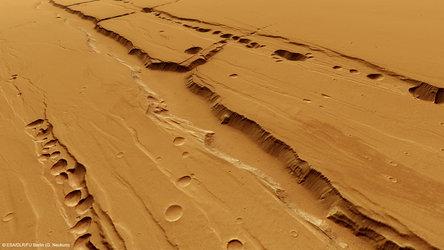
    Perspective view of Acidalia Planitia and Tempe Terra

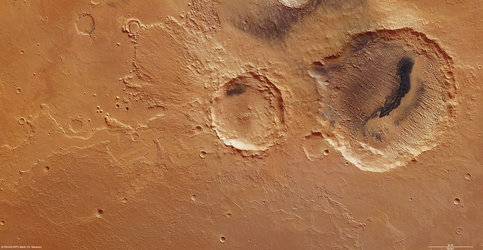
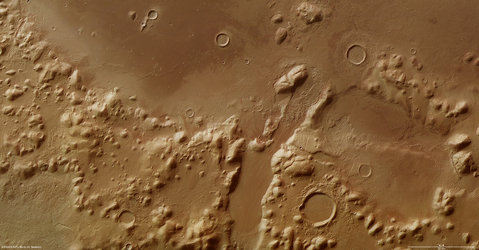
    The images taken cover part of the western edge of the region, where some of the numerous valleys descending from Tempe Terra show subtle evidence for ‘dendritic’ drainage patterns emanating from them.

    The word dendritic comes from the Greek for tree and the channels in the images are believed to have been formed by the surface run-off of flowing water from rain or melting snow during some distant martian epoch.

    The presence of deep valleys, with very few tributaries in the form of smaller valleys further downstream, shows that the region itself probably formed by a process called ‘sapping’ or ‘undermining’, which occurs when erosion along the base of a cliff wears away softer layers of material.


    3D view of Acidalia Planitia and Tempe Terra

    Sapping removes support for the upper harder rock which breaks off into large blocks, and falls from the cliff face.

    This way, deep valleys can erode progressively upwards, as can be seen in the Colorado Plateau on Earth.

    The lower-left part of the image appears to be in shadow, but this darkening is in fact is due to differences in surface material: the left-hand side is covered with dark sand, probably of volcanic origin, while the right side is covered with brighter dust.

    The images also show faults in the martian crust, extending towards the Idaeus Fossae region. They are believed to have played a vital role in releasing water by exposing subsurface reservoirs, possibly forming lakes in nearby craters.

    Apparent sediments covering the floors of some of the older, more eroded craters are of particular interest for scientists, as they again point to the existence of surface water at some stage.

    In some cases, valleys start at the rim of the craters, suggesting that water was released from them into the surrounding terrain.

    Some newer craters are seen in the central areas of the image. Their relatively young age is demonstrated by the lack of erosion and the fact that they lie on top of older features.

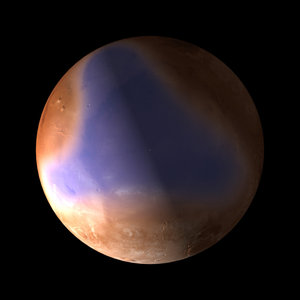
    Acidalia Planitia in context

    These Mars Express images give scientists yet more evidence of a watery past for the Red Planet, and will help them to decode how the water ebbed, flowed and eroded the surface at different times.
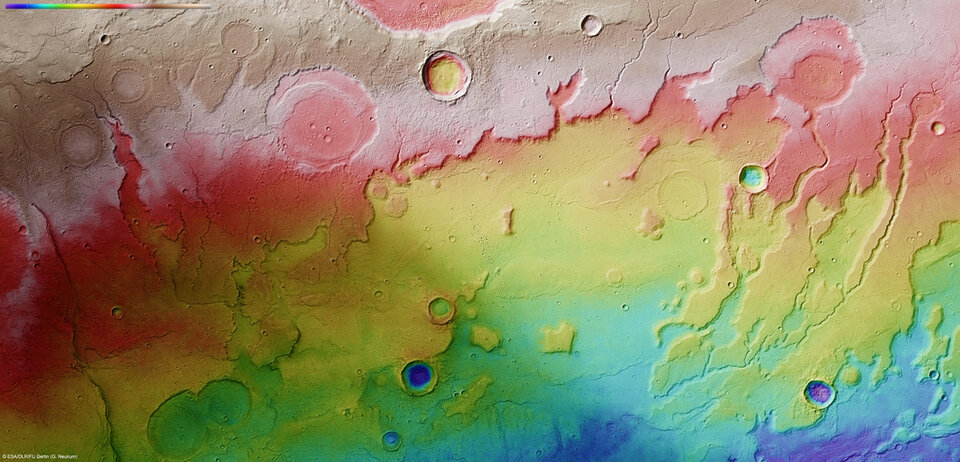

    Topographical view of Acidalia Planitia

    Rate this

    Views

    Share

    • Currently 5 out of 5 Stars.
    • 1
    • 2
    • 3
    • 4
    • 5
    Rating: 5/5 (1 votes cast)

    Thank you for rating!

    You have already rated this page, you can only rate it once!

    Your rating has been changed, thanks for rating!

    335
    Tweet
    • Mars Express
    • Phobos up close
      Phobos up close
      Mars Express blog
    • See the Mars Webcam from ESA's Spacecraft Operations team
      See the Mars Webcam from ESA's Spacecraft Operations team
      Mars Webcam
    • Mars Express on YouTube
    • Traces of Martian life
    • Related articles
      • Mars crater shows evidence for climate evolution
        • Signs of ancient flowing water on Mars
          • First Mars Express gravity results plot volcanic history
            • The pit-chains of Mars – a possible place for life?
              • ESA's Mars Express radar gives strong evidence for former Mars ocean
                • Mars Express reveals wind-blown deposits on Mars
                  • Mountains and buried ice on Mars
                    • Battered Tharsis Tholus volcano on Mars
                      • Mars Express observes clusters of recent craters in Ares Vallis
                        • Rare martian lake delta spotted by Mars Express
                          • Mars’ northern polar regions in transition
                            • Phobos slips past Jupiter
                              • Springtime at Mars’ south pole
                                • Mars Express sees deep fractures on Mars
                                • Related links
                                • High Resolution Stereo Camera
                                  • Behind the lens...
                                    • Frequently asked questions
                                    • For specialists
                                    • ESA Planetary Science archive (PSA)
                                    • NASA Planetary Data System
                                    • HRSC data viewer
                                    • In depth
                                    • This article in depth
                                    • Mars Express in depth

    Connect with us

    • RSS
    • Youtube
    • Twitter
    • Flickr
    • G+
    • Facebook
    • Livestream
    • Subscribe
    • App Store
    • LATEST ARTICLES
    • · Rare merger reveals secrets of gal…
    • · Watching for hazards: ESA opens as…
    • · ESA astronaut Timothy Peake set fo…
    • · Space drives e-mobility
    • · Proba-V opens its eyes
    • FAQ

    • Jobs at ESA

    • Site Map

    • Contacts

    • Terms and conditions