Massive stellar winds are made of tiny pieces
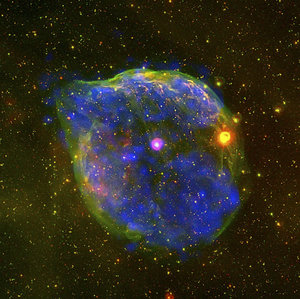
ESA’s XMM-Newton space observatory has completed the most detailed study ever of the fierce wind from a giant star, showing for the first time that it is not a uniform breeze but is fragmented into hundreds of thousands of pieces.
Massive stars are relatively rare, but play a very important role in recycling materials in the Universe. They burn their nuclear fuel much more rapidly than stars like the Sun, living only for millions of years before exploding as a supernova and returning most of their matter to space.
But even during their brief lives, they lose a significant fraction of their mass through fierce winds of gas driven off their surfaces by the intense light emitted from the star.
The winds from massive stars are at least a hundred million times stronger than the solar wind emitted by our own Sun and can significantly shape their surrounding environment.
They might trigger the collapse of surrounding clouds of gas and dust to form new stars or, conversely, blast the clouds away before they have the chance to get started.
Despite their important role, however, the detailed structure of the winds from massive stars remains poorly understood. Are they steady and uniform, or broken up and gusty?
Astronomers have now gained a detailed glimpse into this wind structure by taking observations with XMM-Newton spread over a decade to study variability in the X-ray emission from zeta Puppis. One of the nearest massive stars to Earth, it is bright enough to be seen with the naked eye in the constellation of Puppis, in the southern hemisphere.
The X-rays arise from collisions between slow- and fast-moving clumps in the wind, which heats them to a few million degrees. As individual colliding clumps in the wind are heated and cooled, the strength and energy of the emitted X-rays vary.
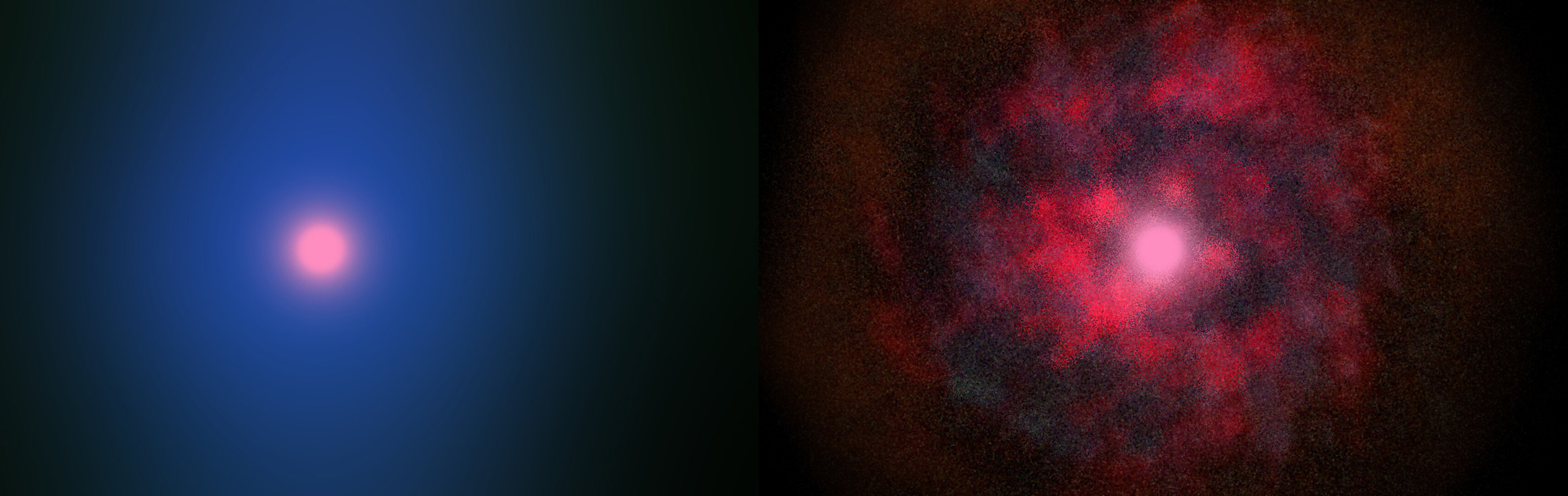
If only a small number of large fragments are present, variations in the combined emission could be large. Conversely, as the number of fragments grows, a change in the X-ray emission from any given fragment becomes less important, and the overall variability decreases.
In zeta Puppis, the X-ray emission was found to be remarkably stable over short timescales of just a few hours, pointing to a very large number of fragments. There must still be clumps in the wind to make X-rays in the first place, but there must be many of them to yield such low variability.
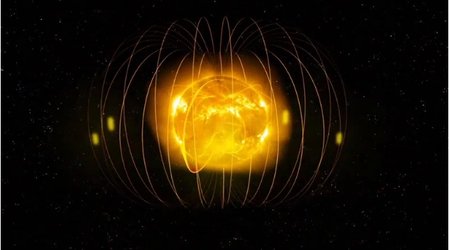
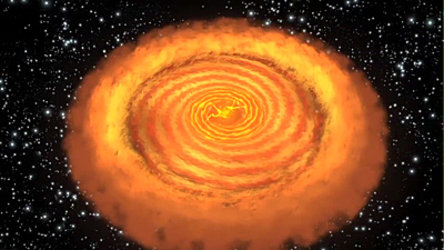
However, unexpected variation in the emission was seen on the order of several days, implying the presence of a few very large structures in the wind, possibly spiral-arm-like features superimposed on the highly fragmented wind co-rotating with the star.
“Studies at other wavelengths had already hinted that the winds from massive stars are not simply a uniform breeze, and the new XMM-Newton data confirm this, but also reveal hundreds of thousands of individual hot and cool pieces,” says Yaël Nazé, Université de Liège, Belgium, who led the study’s analysis.
“This is the first time constraints have been placed on the number of fragments in a stellar wind of an adult massive star, a number which far exceeds theoretical predictions.”
To fully understand these observations, improved models of stellar winds will be needed, taking into account both the large-scale emission structures and the highly fragmented wind, in order to understand how they affect mass-loss in stellar giants.
“Zeta Puppis also goes by the name Naos, which in antiquity was the name given to the innermost sanctuary of a temple, accessible to only a few people; thanks to XMM-Newton, scientists have been able to unlock the secrets of this mysterious stellar object,” adds Dr Nazé.
“This long-term XMM-Newton study of zeta Puppis has provided the first constraints on the number of fragments in a stellar wind from a massive star – there is no dataset with comparable sensitivity or time and or spectral coverage currently available for any other massive star,” says Norbert Schartel, ESA’s XMM-Newton project scientist.
Notes to Editors:
The study is based on a series of three papers:
“A detailed X-ray investigation of zeta Pup I. The dataset and some preliminary results,” by Y. Nazé et al is published in Astronomy & Astrophysics 538, A22, 2012; arXiv:1112.0862
“A detailed X-ray investigation of zeta Pup II: The variability on short and long timescales”, by Y. Nazé et al is published in the Astrophysical Journal 763, 143, 2013; arXiv:1212.1554
“A detailed X-ray investigation of zeta Pup III. A spectroscopic analysis of the whole XMM-Newton RGS spectrum,” by A. Hervé et al, is accepted for publication in Astronomy & Astrophysics; arxiv.org/abs/1301.5090
For further information, please contact:
Markus Bauer
ESA Science and Robotic Exploration Communication Officer
Tel: +31 71 565 6799
Mob: +31 61 594 3 954
Email: markus.bauer@esa.int
Yaël Nazé
Université de Liège, Belgium
Email: naze@astro.ulg.ac.be
Norbert Schartel
XMM-Newton Project Scientist
Tel: +34 91 8131 184
Email: Norbert.Schartel@sciops.esa.int