• → European Space Agency

      • Space for Europe
      • Space News
      • Space in Images
      • Space in Videos
    • About Us

      • Welcome to ESA
      • DG's News and Views
      • For Member State Delegations
      • Business with ESA
      • ESA Exhibitions
      • ESA Publications
      • Careers at ESA
    • Our Activities

      • Space News
      • Observing the Earth
      • Human Spaceflight
      • Launchers
      • Navigation
      • Space Science
      • Space Engineering
      • Operations
      • Technology
      • Telecommunications & Integrated Applications
    • For Public

    • For Media

    • For Educators

    • For Kids

    • ESA

    • Space Science

    • Our Universe
    • About Space Science
    • ESA's 'Cosmic Vision'
    • Science missions
    • Mission navigator
    • Target groups
    • For Media
    • For Scientists
    • For Kids
    • Multimedia
    • Science images
    • Science videos
    • Animations
    • Downloads
    • Sounds from space
    • Resources
    • Reference section
    • Services
    • FAQs
    • Glossary
    • Help
    • Portal terms of use
    • Comments
    • Follow us
    • RSS feeds
    • ESA Sci on Twitter
    • ESA Space Science Images on Flickr
    • ESA 3D on Flickr

    ESA > Our Activities > Space Science

    Old cycle spots
    Old cycle spots

    Old solar cycle returns

    31 March 2008

    Barely three months after forecasters announced the beginning of the new solar cycle (cycle 24), the old solar cycle (cycle 23) has returned. In fact, it never left.

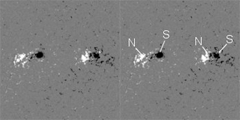
    Last week, three big sunspots appeared and they are all old cycle spots. Scientists know this because of their magnetic polarity. On March 28th the Solar and Heliospheric Observatory (SOHO) obtained a magnetic map of the sun which shows the north and south magnetic poles of sunspots oriented according to the patterns of solar cycle 23.

    ESA’s SOHO Project Scientist, Bernhard Fleck says, “If cycle 24 had already begun, the magnetic polarity of the spots would be reversed.”

    NASA solar physicist David Hathaway at Marshall Space Flight Center explains, "We have two solar cycles in progress at the same time. Solar Cycle 24 has begun (the first new-cycle spot appeared in January 2008), but solar cycle 23 has not ended."

    Strange as it sounds, this is perfectly normal. Around the time of solar minimum - which is now - old-cycle spots and new-cycle spots frequently intermingle. Eventually Cycle 23 will fade to zero, giving way in full to Solar Cycle 24, but not yet.
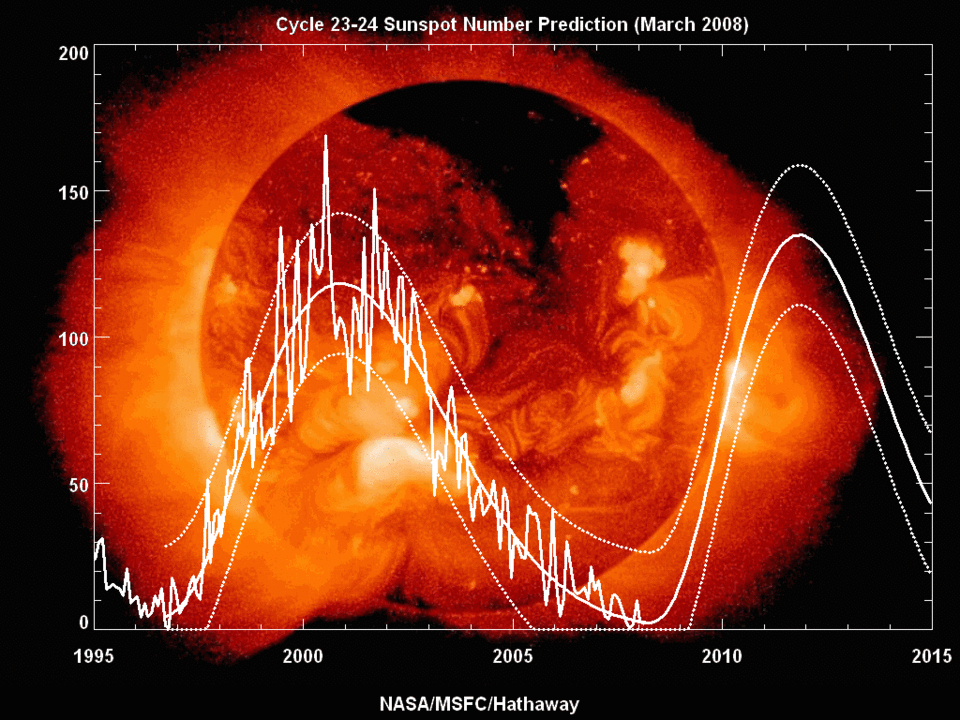
    Sunspot count versus year

    Meanwhile, on 25 March, sunspot 989, the smallest of the three sunspots, unleashed an M2-class solar flare. Flares are measured on a scale ranging from A-class (weak) to X-class (powerful). M-class flares are of medium intensity. This one hurled a coronal mass ejection or "CME" into space, but the thousand million-ton cloud missed Earth.

    While the CME was still plowing through the sun's atmosphere, amateur radio astronomer Thomas Ashcraft heard "a heaving sound" coming from the loudspeaker of his 21 MHz shortwave receiver in New Mexico. It was a Type II solar radio burst generated by shock waves at the leading edge of the CME. A thousand miles away in Virginia, David Thomas recorded the same emissions on a chart recorder he connected to his 20 MHz ham rig. "What a pleasant surprise," says Thomas.

    We could get more of this kind of activity in the next 4 to 7 days. The sun's rotation has turned the spots toward Earth, which means the next CME, if there is one, might not miss. CME strikes do no physical harm to Earth but they can cause aurorae, satellite glitches and, in extreme cases, power outages.

    The real significance of these spots is what they say about the solar cycle, says Hathaway. "Solar cycle 24 has begun, but we won't be through solar minimum until the number of cycle 24 spots rises above the declining number of cycle 23 spots." Based on this latest spate of ‘old’ activity, he thinks the next solar maximum probably won't arrive until 2012.


    For more information:

    Bernhard Fleck, ESA SOHO Project Scientist
    Email: Bfleck @ esa.nascom.nasa.gov

    Rate this

    Views

    Share

    • Currently 5 out of 5 Stars.
    • 1
    • 2
    • 3
    • 4
    • 5
    Rating: 5/5 (1 votes cast)

    Thank you for rating!

    You have already rated this page, you can only rate it once!

    Your rating has been changed, thanks for rating!

    159
    Tweet
    • More about...
      • SOHO overview
      • Polar plumes as seen by SOHO
        Polar plumes as seen by SOHO
        SOHO 10-year special
      • Related articles
        • SOHO: the new solar cycle starts with a ‘bang’
          • SOHO data used for real-time space radiation forecasting
            • SOHO - keeping an eye on the Sun for 12 years
              • SOHO's new catch: its first officially periodic comet
                • Has SOHO ended a 30-year quest for solar ripples?
                  • SOHO prepares for comet McNaught
                    • ESA’s SOHO will lead a fleet of solar observatories
                      • Nowhere to hide from SOHO
                        • History’s greatest comet hunter approaches major milestone
                        • Read more
                          • How we see the far side of the Sun
                            • What are solar flares?
                              • How the Sun affects us on Earth

    Connect with us

    • RSS
    • Youtube
    • Twitter
    • Flickr
    • G+
    • Facebook
    • Livestream
    • Subscribe
    • App Store
    • ESA Science Twitter

    Follow ESA science

    • LATEST ARTICLES
    • · ESA astronaut Timothy Peake set fo…
    • · Space drives e-mobility
    • · Proba-V opens its eyes
    • · First new Galileo satellite arrive…
    • · Next destination: space
    • FAQ

    • Jobs at ESA

    • Site Map

    • Contacts

    • Terms and conditions