• → European Space Agency

      • Space for Europe
      • Space News
      • Space in Images
      • Space in Videos
    • About Us

      • Welcome to ESA
      • DG's News and Views
      • For Member State Delegations
      • Business with ESA
      • ESA Exhibitions
      • ESA Publications
      • Careers at ESA
    • Our Activities

      • Space News
      • Observing the Earth
      • Human Spaceflight
      • Launchers
      • Navigation
      • Space Science
      • Space Engineering
      • Operations
      • Technology
      • Telecommunications & Integrated Applications
    • For Public

    • For Media

      • Media
      • ESA TV
      • Videos for professionals
      • Photos
    • For Educators

    • For Kids

    • ESA

    • Rosetta

    • ESA Science

    • About Rosetta

      • Europe's comet chaser
      • Why 'Rosetta'?
    • About the spacecraft

      • The Rosetta orbiter
      • Orbiter: Instruments
      • The Rosetta lander
      • Lander: Instruments
    • About the journey

      • The long trek
      • Debris of the Solar System: Asteroids
      • Asteroid (2867) Steins: a portrait
      • Life and survival in deep space
      • Long-distance communication
      • The Rosetta ground segment
    • About the arrival

      • Comets - an introduction
      • Comet 67P/Churyumov- Gerasimenko
      • Comet rendezvous
      • Giotto - ESA's first comet mission
    • Meet the team
    • Mission Manager
    • Project Scientist
    • Multimedia
    • VideoTalk
    • 3D Flash 'model'
    • Rosetta images
    • Rosetta videos
    • Rosetta Animations
    • Rosetta wallpaper
    • Life of a comet
    • Services
    • Frequently asked questions

    ESA > Our Activities > Space Science > Rosetta

    Read further

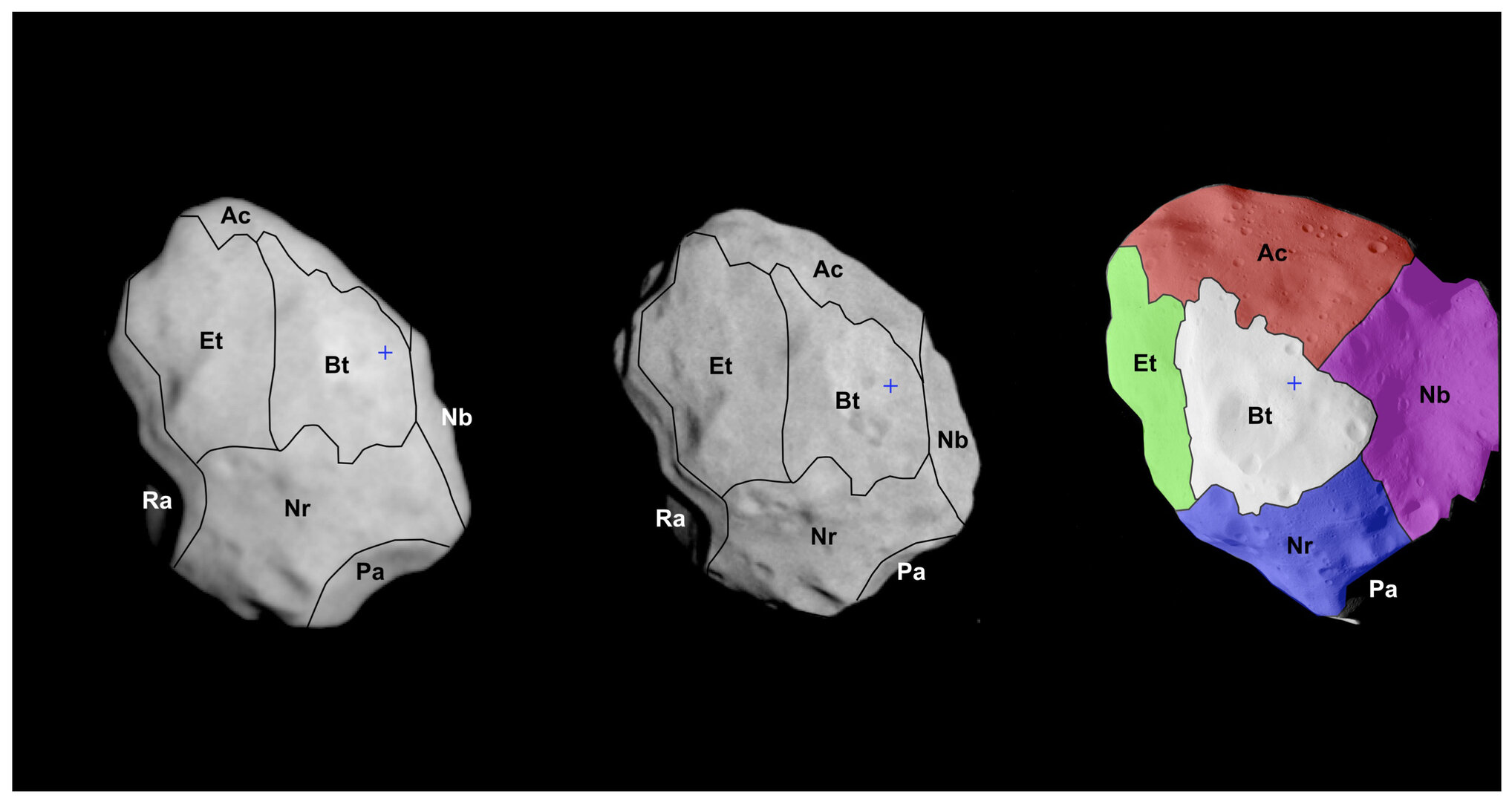
    Lutetia regions

    Rosetta also let scientists investigate beneath the asteroid's surface. It appears that Lutetia tried to grow an iron core like a bona-fide planet when it formed.

    During the encounter, Lutetia's weak gravity tugged on Rosetta. The slight change in Rosetta's path was reflected in radio signals received back at Earth, indicating a mass of 1.7 million billion tonnes.

    This was a surprise.

    "The mass was lower than expected. Ground-based observations had suggested much higher values," says Martin Pätzold, Universität zu Köln, Germany, leader of the radio science team.

    Nevertheless, when combined with its volume, Lutetia still turns out to have one of the highest densities of any known asteroid: 3400 kg per cubic metre. The density implies that Lutetia contains significant quantities of iron, but not necessarily in a fully formed core.

    To form an iron core, Lutetia would have had to melt as a result of heat released by radioactive isotopes in its rocks. The dense iron would then sink to the centre and the rocky material would float to the top.
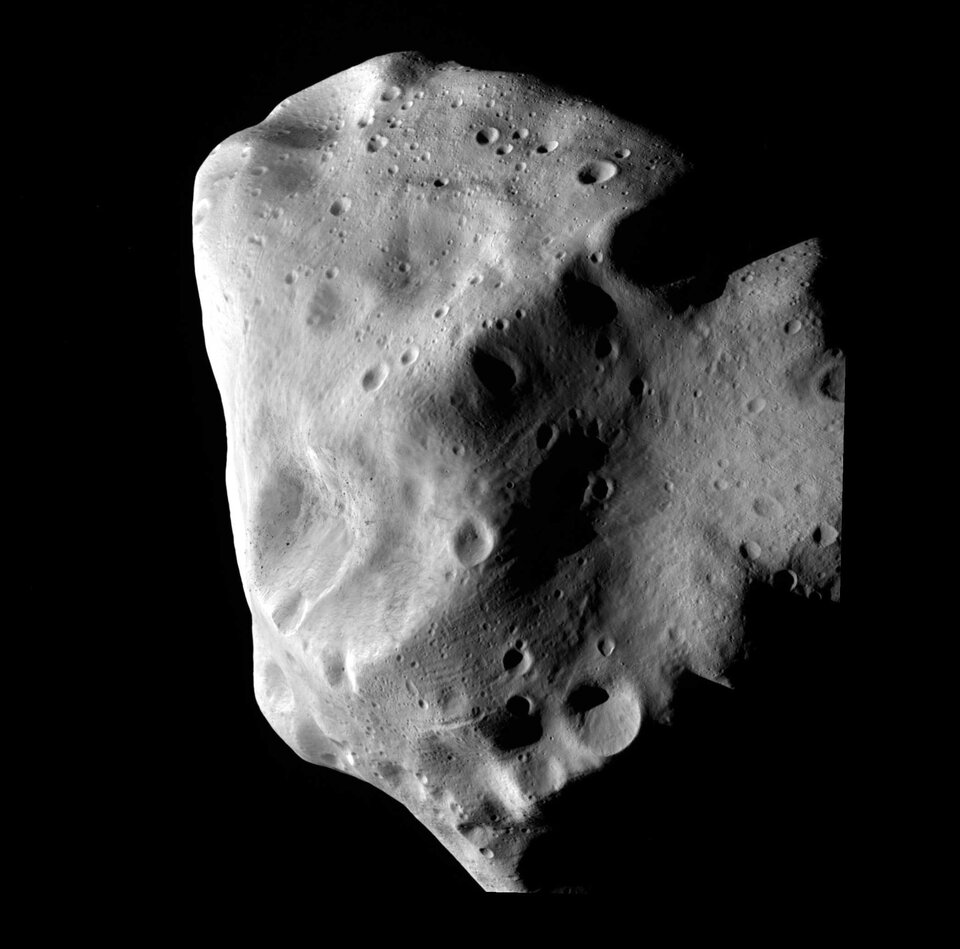
    Lutetia at Closest approach

    However, VIRTIS indicates that Lutetia's surface composition remains entirely primordial, displaying none of the rocky material expected to form during such a molten phase.

    The only explanation appears to be that Lutetia was subjected to some internal heating early in its history but did not melt completely and so did not end up with a well-defined iron core.

    These results, all gathered during just a short flyby, make Lutetia a unique asteroid and an invaluable postcard from the past, at a time when Earth was forming.

    "We picked a most important member of the asteroid belt," said Rita Schulz, ESA's Rosetta Project Scientist.

    "All the asteroids encountered so far were different from each other, but Lutetia is the only one in which both primordial and differentiation features have been found.

    "These unexpected results clearly show that there is still much more to investigate before we understand the belt fully."

    Having now left Lutetia far behind, Rosetta is in hibernation and en route to its 2014 rendezvous with comet Churyumov–Gerasimenko.

    Contact for further information

    Rate this

    Views

    Share

    • Currently 0 out of 5 Stars.
    • 1
    • 2
    • 3
    • 4
    • 5
    Rating: 0/5 (0 votes cast)

    Thank you for rating!

    You have already rated this page, you can only rate it once!

    Your rating has been changed, thanks for rating!

    72
    Tweet
    • ESA's ATV blog direct from ATV mission control
      ESA's ATV blog direct from ATV mission control
      Rosetta Blog
    • ESA's comet chaser: Rosetta
    • Related articles
      • When is a comet not a comet? Rosetta finds out
        • ESA’s Rosetta comet-chaser goes LEGO®
          • Rosetta’s blind date with asteroid Lutetia
            • Swirling clouds over the South Pacific
              • Rosetta sees a living planet
                • Rosetta bound for outer Solar System after final Earth swingby
                  • Rosetta darting across the night
                    • First view of Earth as Rosetta approaches home
                      • ESA spacecraft may help unravel cosmic mystery
                        • Rosetta approach on schedule
                          • Follow Rosetta’s final Earth boost
                            • Rosetta lined up nicely for Earth approach
                              • Last visit home for ESA’s comet chaser
                              • In depth
                              • Rosetta in depth
                              • Max Planck Institute for Solar System Research

    Connect with us

    • RSS
    • Youtube
    • Twitter
    • Flickr
    • G+
    • Facebook
    • Livestream
    • Subscribe
    • App Store
    • LATEST ARTICLES
    • · Earth Explorers take centre stage …
    • · The fast winds of Venus are gettin…
    • · ExoMars 2016 set to complete const…
    • · Herschel ends operations as orbiti…
    • · Europe’s largest spaceship reache…
    • FAQ

    • Jobs at ESA

    • Site Map

    • Contacts

    • Terms and conditions