• → European Space Agency

      • Space for Europe
      • Space News
      • Space in Images
      • Space in Videos
    • About Us

      • Welcome to ESA
      • DG's News and Views
      • For Member State Delegations
      • Business with ESA
      • ESA Exhibitions
      • ESA Publications
      • Careers at ESA
    • Our Activities

      • Space News
      • Observing the Earth
      • Human Spaceflight
      • Launchers
      • Navigation
      • Space Science
      • Space Engineering
      • Operations
      • Technology
      • Telecommunications & Integrated Applications
    • For Public

    • For Media

      • Media
      • ESA TV
      • Videos for professionals
      • Photos
    • For Educators

    • For Kids

    • ESA

    • Space Science

    • Our Universe
    • About Space Science
    • ESA's 'Cosmic Vision'
    • Science missions
    • Mission navigator
    • Target groups
    • For Media
    • For Scientists
    • For Kids
    • Multimedia
    • Science images
    • Science videos
    • Animations
    • Downloads
    • Sounds from space
    • Resources
    • Reference section
    • Services
    • FAQs
    • Glossary
    • Help
    • Portal terms of use
    • Comments
    • Follow us
    • RSS feeds
    • ESA Sci on Twitter
    • ESA Space Science Images on Flickr
    • ESA 3D on Flickr

    ESA > Our Activities > Space Science

    Solar flares set the Sun quaking

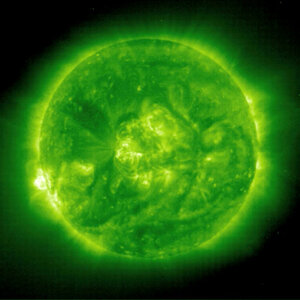
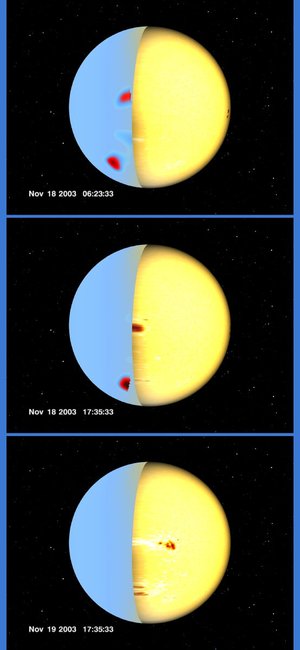
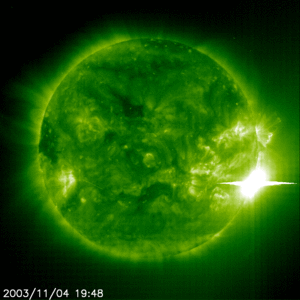
    Solar flare caught by SOHO
    Solar flare caught by SOHO
    18 April 2008

    Data from the ESA/NASA spacecraft SOHO shows clearly that powerful starquakes ripple around the Sun in the wake of mighty solar flares that explode above its surface. The observations give solar physicists new insight into a long-running solar mystery and may even provide a way of studying other stars.

    The outermost quarter of the Sun’s interior is a constantly churning maelstrom of hot gas. Turbulence in this region causes ripples that criss-cross the solar surface, making it heave up and down in a patchwork pattern of peaks and troughs.

    The joint ESA-NASA Solar and Heliospheric Observatory (SOHO) has proved to be an exceptional spacecraft for studying this phenomenon. Discovering how the ripples move around the Sun has provided valuable information about the Sun’s interior conditions. A class of oscillations called the 5-minute oscillations with a frequency of around 3 millihertz have proven particularly useful.

    According to conventional thinking, the 5-minute oscillations can be thought of as the sound you would get from a bell sitting in the middle of the desert and constantly being touched by random sand grains, blown on the wind. But what Christoffer Karoff and Hans Kjeldsen, both at the University of Aarhus, Denmark, saw in the data, was very different.
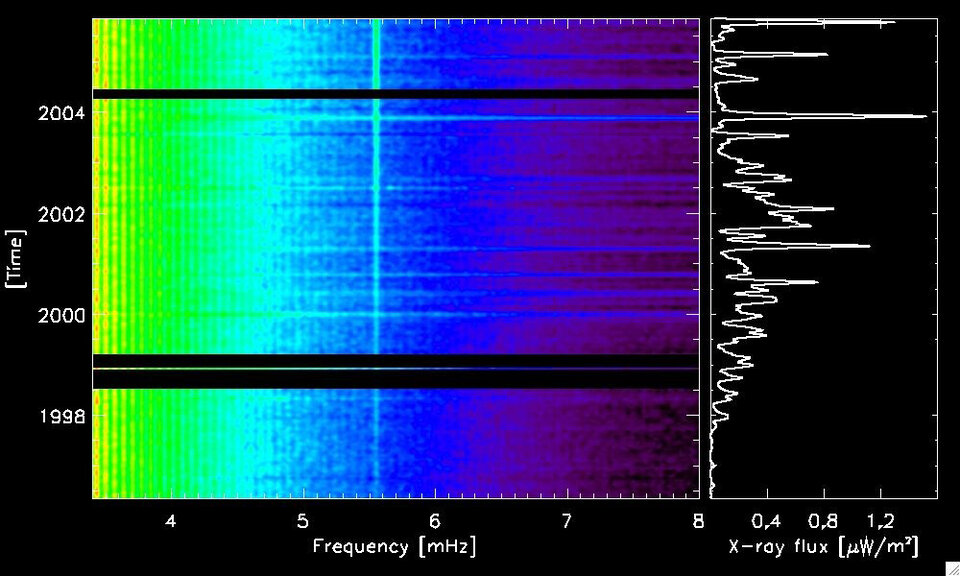
    Solar flares set the Sun quaking

    “The signal we saw was like someone occasionally walking up to the bell and striking it, which told us that there was something missing from our understanding of how the Sun works,” Karoff says.

    So they began looking for the culprit and discovered an unexpected correlation with solar flares. It seemed that when the number of solar flares went up, so did the strength of the 5-minute oscillations.

    “The strength of the correlation was so strong that there can be no doubt about it,” says Karoff.

    A similar phenomenon is known on Earth in the aftermath of large earthquakes. For example, after the 2004 Sumatra-Andaman Earthquake, the whole Earth rang with seismic waves like a vibrating bell for several weeks.

    The correlation is not the end of the story. Now the researchers have to work to understand the mechanism by which the flares cause the oscillations. “We are not completely sure how the solar flares excite the global oscillations,” says Karoff.


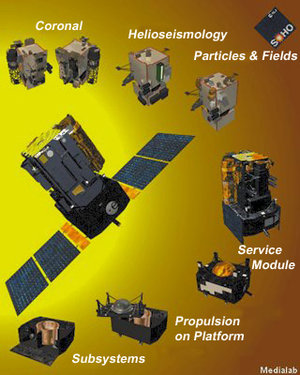
    SOHO
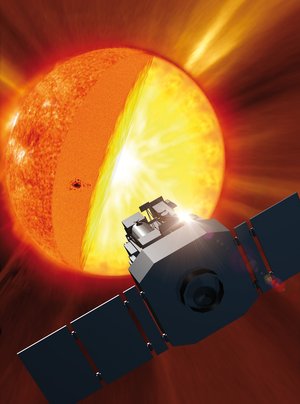
    Artist's impression of the SOHO spacecraft

    In a broader context, the correlation suggests that, by looking for similar oscillations within other stars, astronomers can monitor them for flares. Already, Karoff has used high-technology instruments at major ground-based telescopes to look at other Sun-like stars. In several cases, he detected the tell-tale signs of oscillations that might originate from flares.

    “Now we need to monitor these stars for hundreds of days,” he says. That will require dedicated spacecraft, such as the CNES mission with ESA participation, COROT. The hard work, it seems, is just starting.

    Notes for editors:

    ‘Evidence that solar flares drive global oscillations in the Sun’ by C. Karoff & H. Kjeldsen will be published in The Astrophysical Journal letters on 1 May 2008.

    For more information:

    Christoffer Karoff , University of Aarhus, Denmark
    Email: Karoff @ phys.au.dk

    Bernhard Fleck, ESA SOHO Project Scientist
    Email: Bfleck @ esa.nascom.nasa.gov

    Rate this

    Views

    Share

    • Currently 0 out of 5 Stars.
    • 1
    • 2
    • 3
    • 4
    • 5
    Rating: 0/5 (0 votes cast)

    Thank you for rating!

    You have already rated this page, you can only rate it once!

    Your rating has been changed, thanks for rating!

    197
    Tweet
    • More about...
      • SOHO overview
        • SOHO 10-year special
        • Polar plumes as seen by SOHO
          Polar plumes as seen by SOHO
          Download JHelioviewer
        • Related articles
          • The beginning of the end for comet Lovejoy
            • ESA makes the Sun available to everyone
              • The Sun comes back to life
                • Solar flares set the Sun quaking
                  • Old solar cycle returns
                    • SOHO: the new solar cycle starts with a ‘bang’
                      • SOHO data used for real-time space radiation forecasting
                        • SOHO - keeping an eye on the Sun for 12 years
                          • SOHO's new catch: its first officially periodic comet
                            • Has SOHO ended a 30-year quest for solar ripples?
                              • SOHO prepares for comet McNaught
                                • ESA’s SOHO will lead a fleet of solar observatories
                                  • Nowhere to hide from SOHO
                                  • Read more
                                    • How we see the far side of the Sun
                                      • What are solar flares?
                                        • How the Sun affects us on Earth
                                        • Related links
                                        • Related SOHO hotshot

    Connect with us

    • RSS
    • Youtube
    • Twitter
    • Flickr
    • G+
    • Facebook
    • Livestream
    • Subscribe
    • App Store
    • ESA Science Twitter

    Follow ESA science

    • LATEST ARTICLES
    • · Rare merger reveals secrets of gal…
    • · Watching for hazards: ESA opens as…
    • · ESA astronaut Timothy Peake set fo…
    • · Space drives e-mobility
    • · Proba-V opens its eyes
    • FAQ

    • Jobs at ESA

    • Site Map

    • Contacts

    • Terms and conditions