Surprises from the Sun’s South Pole
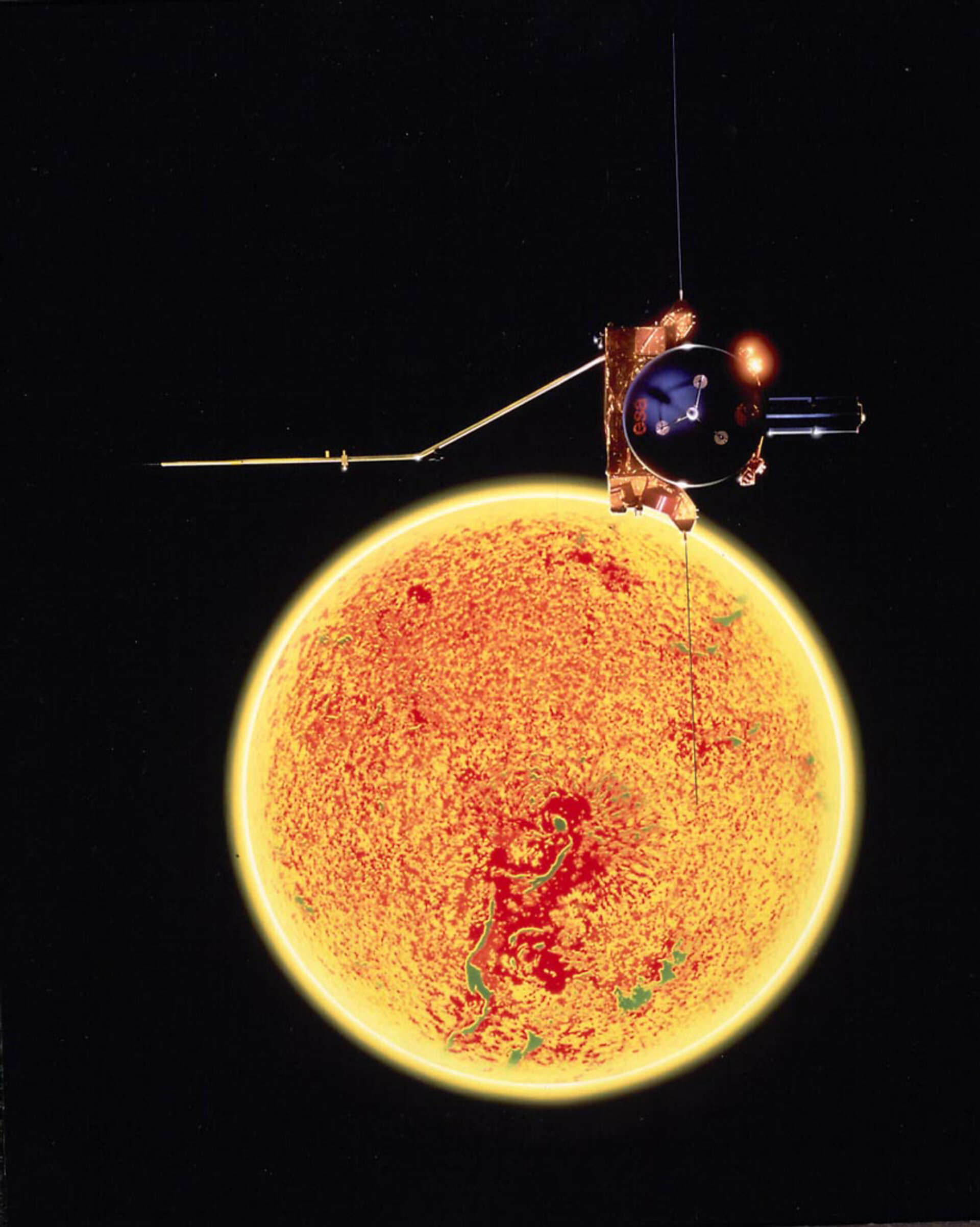
Although very close to the minimum of its 11-year sunspot cycle, the Sun showed that it is still capable of producing a series of remarkably energetic outbursts - ESA-NASA Ulysses mission revealed.
In keeping with the first and second south polar passes (in 1994 and 2000), the latest high-latitude excursion of the joint ESA-NASA Ulysses mission has already produced some surprises. In mid-December 2006, although very close to the minimum of its 11-year sunspot cycle, the Sun showed that it is still capable of producing a series of remarkably energetic outbursts.
The solar storms, which were confined to the equatorial regions, produced quite intense bursts of particle radiation that were clearly observed by near-Earth satellites. Surprisingly, similar increases in radiation were detected by the instruments on board Ulysses, even though it was three times as far away and almost over the south solar pole. "Particle events of this kind were seen during the second polar passes in 2000 and 2001, at solar maximum," said Richard Marsden, ESA's Ulysses Project Scientist and Mission Manager. "We certainly didn't expect to see them at high latitudes at solar minimum!"
Scientists are busy trying to understand how the charged particles made it all the way to the poles. "Charged particles have to follow magnetic field lines, and the magnetic field pattern of the Sun near solar minimum ought to make it much more difficult for the particles to move in latitude," said Marsden.
One of the puzzles remaining from the first high-latitude passes in 1994 and 1995 has to do with the temperature of the Sun's poles. When Ulysses first passed over the south and then the north solar pole near solar minimum, it measured the temperatures of the large polar coronal holes.
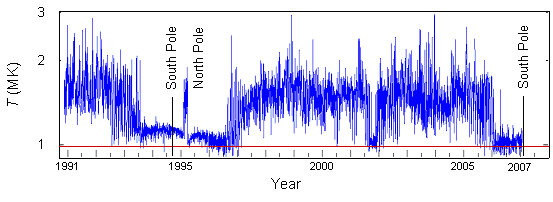
"Surprisingly, the temperature in the north polar coronal hole was about 7 to 8 percent lower compared with the south polar coronal hole," said Professor George Gloeckler, Principal Investigator for the Solar Wind Ion Composition Spectrometer (SWICS) on board Ulysses.
"We couldn't tell then whether this was simply due to progressive cooling of both polar coronal holes as the Sun was approaching its minimum level of activity in 1996, or whether this was an indication of a permanently cooler north pole."
Now, as Ulysses again passes over the large polar coronal holes of the Sun at solar minimum we will finally have the answer. Recent SWICS observations show that the average temperature of the southern polar coronal hole at the current solar minimum is as low as it was 10 years ago in the northern polar coronal hole. "This implies that the asymmetry between north and south has switched with the change of the magnetic polarity of the Sun," said Gloeckler. The definitive proof will come when Ulysses measures the temperature of the north polar coronal during the next 15 months.
For more information
George Gloeckler, Ulysses SWICS Principal Investigator, University of Maryland, USA
Email: gg10 @ umail.umd.edu