• → European Space Agency

      • Space for Europe
      • Space News
      • Space in Images
      • Space in Videos
    • About Us

      • Welcome to ESA
      • DG's News and Views
      • For Member State Delegations
      • Business with ESA
      • ESA Exhibitions
      • ESA Publications
      • Careers at ESA
    • Our Activities

      • Space News
      • Observing the Earth
      • Human Spaceflight
      • Launchers
      • Navigation
      • Space Science
      • Space Engineering
      • Operations
      • Technology
      • Telecommunications & Integrated Applications
    • For Public

    • For Media

    • For Educators

    • For Kids

    • ESA

    • Space Science

    • Our Universe
    • About Space Science
    • ESA's 'Cosmic Vision'
    • Science missions
    • Mission navigator
    • Target groups
    • For Media
    • For Scientists
    • For Kids
    • Multimedia
    • Science images
    • Science videos
    • Animations
    • Downloads
    • Sounds from space
    • Resources
    • Reference section
    • Services
    • FAQs
    • Glossary
    • Help
    • Portal terms of use
    • Comments
    • ESA Press Releases
    • Follow us
    • RSS feeds
    • ESA Sci on Twitter
    • ESA Space Science Images on Flickr
    • ESA 3D on Flickr

    ESA > Our Activities > Space Science

    The solar wind is swirly

    Tiny turbulent swirls in the solar wind
    18 December 2012

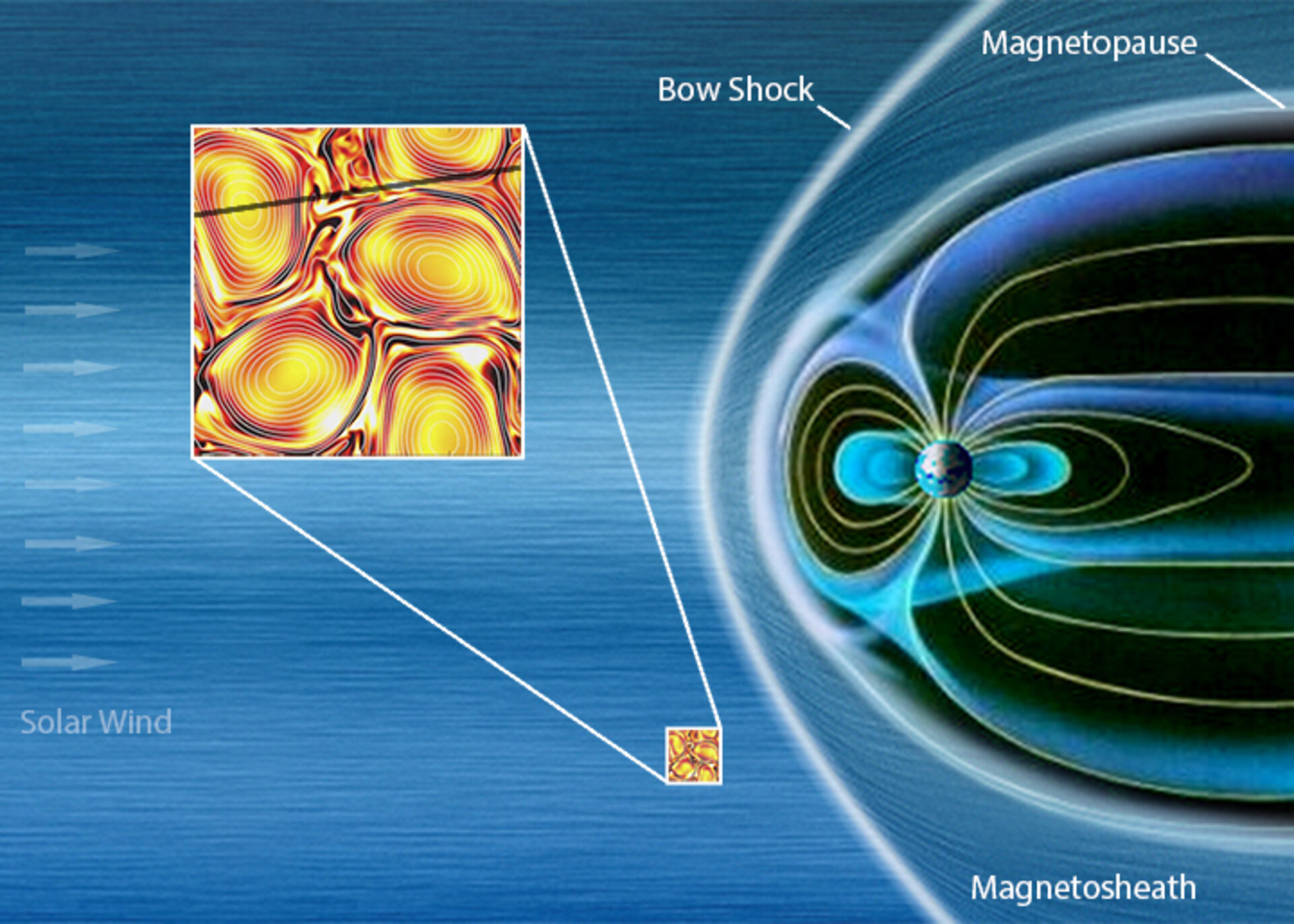
    Using ESA’s Cluster quartet of satellites as a space plasma microscope, scientists have zoomed in on the solar wind to reveal the finest detail yet, finding tiny turbulent swirls that could play a big role in heating it.

    Turbulence is highly complex and all around us, evident in water flowing from a tap, around an aircraft wing, in experimental fusion reactors on Earth, and also in space.

    In the stream of charged particles emitted by the Sun – the solar wind – turbulence is thought to play a key part in maintaining its heat as it streams away and races across the Solar System.

    As the solar wind expands, it cools down, but to a much smaller extent than would be expected if the flow were smooth.

    Turbulence arises from irregularities in the flow of particles and magnetic field lines, but understanding how this energy is transferred from the large scales where it originates, to the small scales where it is dissipated, is like trying to trace energy as it is transferred from the smooth, laminar flow of a river down to the small turbulent eddies formed at the bottom of a waterfall.

    In a new study, two of the four Cluster satellites have made extremely detailed observations of plasma turbulence in the solar wind.

    They were separated by just 20 km along the direction of the plasma flow and operated in ‘burst mode’ to take 450 measurements per second.

    By comparing the results with computer simulations, scientists confirmed the existence of sheets of electric current just 20 km across, on the borders of turbulent swirls.

    “This shows for the first time that the solar wind plasma is extremely structured at this high resolution,” says Silvia Perri of the Universita della Calabria, Italy, and lead author of the paper reporting the result.

    Cluster previously detected current sheets on much larger scales of 100 km in the magnetosheath, the region sandwiched between Earth’s magnetic bubble – the magnetosphere – and the bow shock that is created as it meets the solar wind.

    At the borders of these turbulent eddies the process of ‘magnetic reconnection’ was detected, whereby oppositely directed field lines spontaneously break and reconnect with other nearby field lines, thus releasing their energy.

    “Although we haven’t yet detected reconnection occurring at these new, smaller scales, it is clear that we are seeing a cascade of energy which may contribute to the overall heating of the solar wind,” said Dr Perri.  

    Future missions such as ESA’s Solar Orbiter and NASA’s Solar Probe Plus will be able to determine whether similar processes are also in play closer to the Sun, while NASA’s Magnetospheric Multiscale mission will specifically probe the small-scale regions where reconnection can occur.

    “This Cluster result demonstrates the mission’s unique capability to probe universal physical phenomena, in this case pushing the mission’s instrument measurement capabilities to their limit to unlock features at small scales,” comments Matt Taylor, ESA’s Cluster Project Scientist.

    “Future multi-spacecraft missions will make very detailed studies of these small-scale plasma phenomena and provide further context to our Cluster measurements.”


    Notes for Editors:

    “Detection of small scale structures in the dissipation regime of solar wind turbulence,” by S. Perri et al, is published in Physical Review Letters, 8 November, 2012.

    For further information, please contact:

    Markus Bauer
    ESA Science and Robotic Exploration Communication Officer
    Tel: +31 71 565 6799
    Mob: +31 61 594 3 954
    Email: markus.bauer@esa.int

    Silvia Perri
    Universita della Calabria, Italy
    Email: silvia.perri@fis.unical.it

    Matt Taylor
    ESA Cluster Project Scientist
    Email: matt.taylor@esa.int
    Rate this

    Views

    Share

    • Currently 4.5 out of 5 Stars.
    • 1
    • 2
    • 3
    • 4
    • 5
    Rating: 4.6/5 (25 votes cast)

    Thank you for rating!

    You have already rated this page, you can only rate it once!

    Your rating has been changed, thanks for rating!

    9547
    facebook
    twitter
    reddit
    google plus
    digg
    tumbler
    digg
    blogger
    myspace

    Related articles

    Solar wind entry at low latitudes

    Earth’s magnetosphere behaves like a sieve24 October 2012

    Solar wind entry at low latitudes

    Earth’s magnetosphere behaves like a sieve24 October 2012 ESA’s quartet of satellites studying Earth’s magnetosphere, Cluster, has discovered that our protective magnetic bubble lets the solar wind in under a wider range of conditions than previously believed.

    Earth’s magnetic field provides vital protection08 March 2012

    Earth’s magnetic field provides vital protection08 March 2012 A chance alignment of planets during a passing gust of the solar wind has allowed scientists to compare the protective effects of Earth’s magnetic field with that of Mars’ naked atmosphere. The result is clear: Earth’s magnetic field is vital for keep...

    Cut-away view of Earth’s magnetosphere

    Magnetic whirlpools feed Earth’s magnetosphere06 December 2006

    Cut-away view of Earth’s magnetosphere

    Magnetic whirlpools feed Earth’s magnetosphere06 December 2006 Giant whirlpools of electrically charged gas, some 40 000 kilometres across, have been witnessed above the Earth by a team of European and American scientists. Using data from ESA's Cluster quartet of spacecraft, the researchers have shown that these...

    Cluster and Double Star orbits on 8 May 2004

    Details of solar particles penetrating the Earth’s environment revealed03 October 2006

    Cluster and Double Star orbits on 8 May 2004

    Details of solar particles penetrating the Earth’s environment revealed03 October 2006 Co-ordinated efforts by China/ESA’s Double Star and ESA’s Cluster spacecraft have allowed scientists to zero in on an area where energetic particles from the Sun are blasting their way through the Earth’s magnetic shield. Solar material penetrating th...

    Micro turbulence seen by Cluster

    From ‘macro’ to ‘micro’ – turbulence seen by Cluster10 August 2005

    Micro turbulence seen by Cluster

    From ‘macro’ to ‘micro’ – turbulence seen by Cluster10 August 2005 Thanks to measurements by ESA’s Cluster mission, a team of European scientists have identified ‘micro’-vortices in Earth’s magnetosphere.

    Cluster finds giant gas vortices at the edge of Earth’s magnetic bubble12 August 2004

    Cluster finds giant gas vortices at the edge of Earth’s magnetic bubble12 August 2004 ESA’s quartet of space-weather watchers, Cluster, has discovered vortices of ejected solar material high above the Earth. The superheated gases trapped in these structures are probably tunnelling their way into the Earth’s magnetic ‘bubble’, the magne...

    • An artist's impression of the Cluster quartet
      An artist's impression of the Cluster quartet
      Exploring the Sun-Earth connection
    • More about...
      • Cluster overview
      • Cluster brochure
      • In depth
      • This article in depth
      • Cluster in depth
      • Follow us
      • ESA Sci on Twitter
      • ESA on Flickr

    Connect with us

    • RSS
    • Youtube
    • Twitter
    • Flickr
    • Google Buzz
    • Subscribe
    • App Store
    • ESA Science Twitter

    Follow ESA science

    • LATEST ARTICLES
    • · CryoSat hits land
    • · Ariane 5 completes seven launches …
    • · Measuring skull pressure without t…
    • · Malargüe station inauguration
    • · The solar wind is swirly
    • FAQ

    • Jobs at ESA

    • Site Map

    • Contacts

    • Terms and conditions