• → European Space Agency

      • Space for Europe
      • Space News
      • Space in Images
      • Space in Videos
    • About Us

      • Welcome to ESA
      • DG's News and Views
      • For Member State Delegations
      • Business with ESA
      • ESA Exhibitions
      • ESA Publications
      • Careers at ESA
    • Our Activities

      • Space News
      • Observing the Earth
      • Human Spaceflight
      • Launchers
      • Navigation
      • Space Science
      • Space Engineering
      • Operations
      • Technology
      • Telecommunications & Integrated Applications
    • For Public

    • For Media

      • Media
      • ESA TV
      • Videos for professionals
      • Photos
    • For Educators

    • For Kids

    • ESA

    • Venus Express

    • ESA Science

    • Europe goes to Venus

      • Tribute to the cryptic planet
      • Penetrating an impenetrable world
      • Past missions to Venus
    • About Venus Express

      • Venus Express mission facts
      • Venus Express objectives
      • The spacecraft
      • Orbiter instruments
      • The launcher
      • Operating Venus Express
    • About Venus

      • Venusian geography
      • The surface
      • Acid clouds and lightning
      • Greenhouse effect, clouds and winds
      • Venus compared to Earth
    • Meet the team

      • International collaboration
      • Project Manager: An interview with Don McCoy
      • Project Scientist: An interview with Håkan Svedhem
      • Launch Campaign Manager: An interview with Michael Witting
      • Spacecraft Operations Manager: An interview with Andrea Accomazzo
      • Venus Express Flight Control Team
      • Principal Investigators
    • Multimedia
    • Venus Express images
    • Venus Express videos
    • VideoTalk
    • 3D Flash 'model'
    • Build a model (pdf)
    • Wallpapers
    • Screensavers
    • Services
    • Comments

    ESA > Our Activities > Space Science > Venus Express

    New isotope molecule may add to Venus’ greenhouse effect

    Venus Express
    10 October 2007

    Planetary scientists on both sides of the Atlantic have tracked down a rare molecule in the atmospheres of both Mars and Venus. The molecule, an exotic form of carbon dioxide, could affect the way the greenhouse mechanism works on Venus.

    The discovery is being announced today at the annual meeting of the American Astronomical Society’s Division of Planetary Sciences in Orlando, Florida. Its presence could affect the way the greenhouse mechanism works on Venus.

    The mystery began back in April 2006, soon after ESA’s Venus Express arrived at the second planet in the Solar System.

    A European team including members from France, Belgium and Russia lead by Jean-Loup Bertaux, Service d'Aeronomie du CNRS, France and Ann-Carine Vandaele, Institut d'Aeronomie Spatiale de Belgique, were using their Infrared Atmospheric Spectrometer (SOIR) instrument to measure solar occultations.

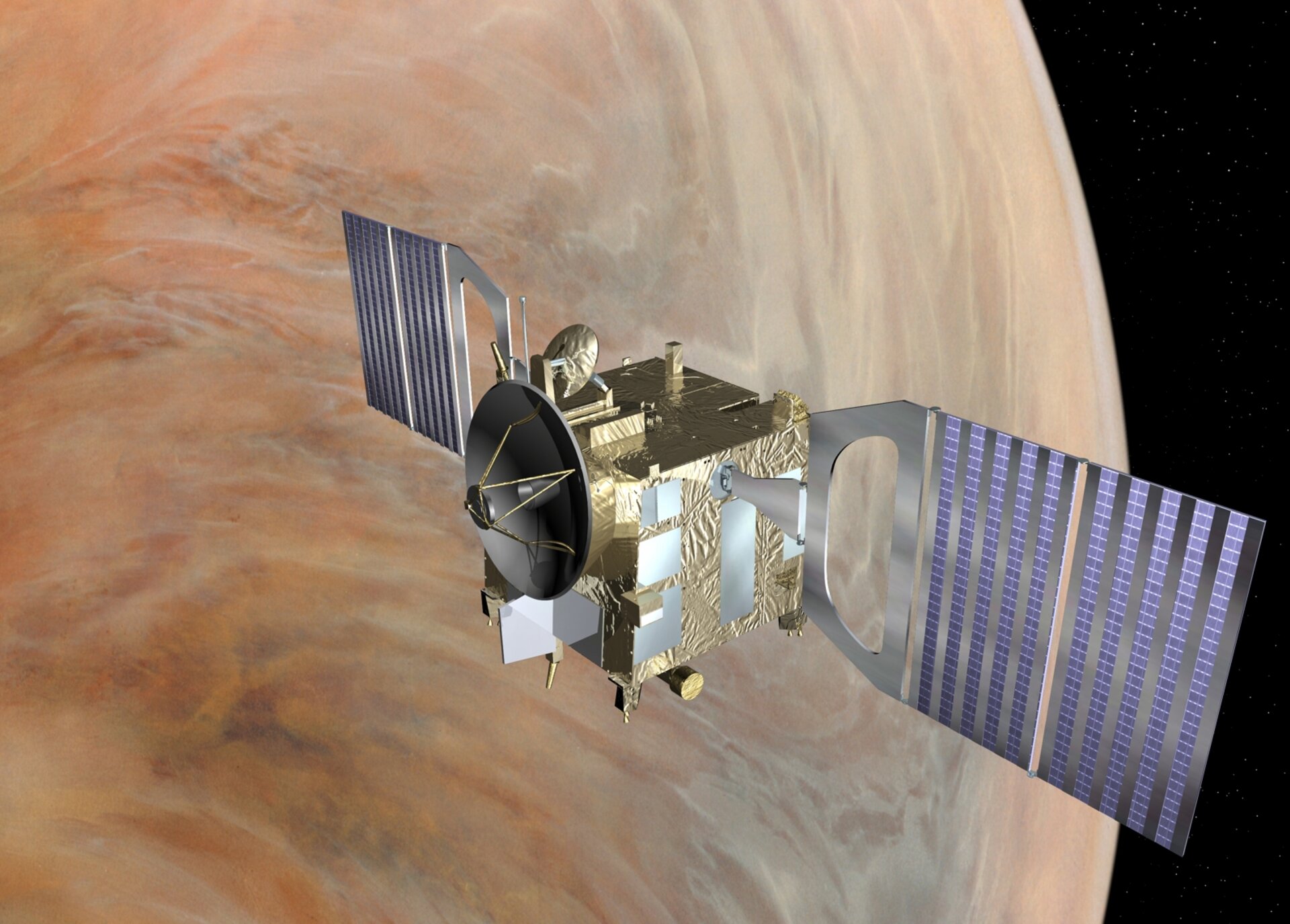
    To do this, the instrument watches the Sun set behind Venus, allowing the scientists to study the way specific wavelengths of light are absorbed by the planet’s atmosphere. These wavelengths and the level of absorption then give away the identity and amount of gases in the atmosphere.

    The team saw an unidentified signature at 3.3 micrometres in the mid-infrared region of the spectrum. “It was conspicuous and systematic, increasing with depth in the atmosphere during the occultation, so we knew it was real,” says Bertaux.

    Solar occultation at Venus
    Solar occultation at Venus

    The team kept their discovery confidential as they attempted to identify the molecule responsible. They thought at first that it must be an organic molecule. These molecules contain carbon and hydrogen. However, none of the known organic molecules fitted well with the observations.

    Then, in December 2006, Mike Mumma of NASA’s Goddard Space Flight Center, Maryland, enquired whether the SOIR team was seeing anything special on Venus at 3.3 microns. He had discovered an unidentified spectral signature at that wavelength using telescopes on Hawaii pointing at Mars. The two teams compared the absorption signatures: they were identical.

    This was a big clue. Both the atmospheres of Mars and Venus are composed of 95% carbon dioxide, although Venus’s atmosphere is much thicker than the one at Mars. The American team suggested that the signature could be coming from an isotope of carbon dioxide, where one oxygen atom is ‘normal’, with eight protons and eight neutrons, while the other has eight protons and ten neutrons. Such an isotope makes up about 1% of carbon dioxide on Earth, the rest contains two normal oxygen atoms.

    However, no one had previously seen the molecule absorb at 3.3 micrometres. An investigation by three independent groups, one led by Mumma in America, Sergei Tashkun and Valery Perevalov at Tomsk State University, Russia, and Richard Dahoo at Service d'Aéronomie du CNRS, France, all came to the same conclusion. The signature could be caused by a rare transition only possible in the isotope.

    The different weights of the oxygen atoms allow the molecule to alter its vibration in two ways simultaneously, whereas normal molecules can only change one state at a time.

    This rare transition allows it to absorb even more energy and so contribute even more to the greenhouse effect on Venus. On Earth, however, there is 250 000 times less carbon dioxide so its additional contribution to our greenhouse effect will be small.


    Notes for Editors:

    The findings appear in: ‘First Observation of 628 CO2 isotopologue band at 3.3 micrometres in the atmosphere of Venus by solar occultation from Venus Express’ by J-L Bertaux, A. C. Vandaele, V. Wilquet, F. Montmessin, R. Dahoo, E. Villard, O. Korablev, A. Fedorova.

    For more information:

    Jean-Loup Bertaux, Service d'Aéronomie du CNRS, France
    Email: Jean-Loup.Bertaux @ aerov.jussieu.fr

    Ann Carine Vandaele, The Belgian Institute for Space Aeronomy
    Email: A-C.Vandaele @ aeronomie.be

    Michael Mumma, NASA Goddard Space Flight Center, USA
    Email: Michael.J.Mumma @ nasa.gov

    Rate this

    Views

    Share

    • Currently 0 out of 5 Stars.
    • 1
    • 2
    • 3
    • 4
    • 5
    Rating: 0/5 (0 votes cast)

    Thank you for rating!

    You have already rated this page, you can only rate it once!

    Your rating has been changed, thanks for rating!

    81
    Tweet
    • Looking at Venus
    • ESApod: Venus Express
    • Related articles
      • 500 days at Venus, and the surprises keep coming
        • Venusian rendezvous results: chapter one
          • Venus Express and MESSENGER to look at Venus in tandem
            • Ground-based observatories join forces with Venus Express
              • Join ESA on the Venus observation campaign
                • One year at Venus, and going strong
                  • Tracking alien turbulences with Venus Express
                    • Hot stuff on Venus! Venus Express sees right down to the hell-hot surface
                      • Happy birthday, Venus Express!
                        • Complex meteorology at Venus
                          • Flying over the cloudy world – science updates from Venus Express
                            • Double vortex at Venus South Pole unveiled!
                              • Venus Express has reached final orbit
                                • Unexpected detail in first-ever Venus south pole images
                                • In depth
                                • Venus Express in-depth
                                • Status reports

    Connect with us

    • RSS
    • Youtube
    • Twitter
    • Flickr
    • G+
    • Facebook
    • Livestream
    • Subscribe
    • App Store
    • LATEST ARTICLES
    • · Rare merger reveals secrets of gal…
    • · Watching for hazards: ESA opens as…
    • · ESA astronaut Timothy Peake set fo…
    • · Space drives e-mobility
    • · Proba-V opens its eyes
    • FAQ

    • Jobs at ESA

    • Site Map

    • Contacts

    • Terms and conditions