• → European Space Agency

      • Space for Europe
      • Space News
      • Space in Images
      • Space in Videos
    • About Us

      • Welcome to ESA
      • DG's News and Views
      • For Member State Delegations
      • Business with ESA
      • ESA Exhibitions
      • ESA Publications
      • Careers at ESA
    • Our Activities

      • Space News
      • Observing the Earth
      • Human Spaceflight
      • Launchers
      • Navigation
      • Space Science
      • Space Engineering
      • Operations
      • Technology
      • Telecommunications & Integrated Applications
    • For Public

    • For Media

      • Media
      • ESA TV
      • Videos for professionals
      • Photos
    • For Educators

    • For Kids

    • ESA

    • Venus Express

    • ESA Science

    • Europe goes to Venus

      • Tribute to the cryptic planet
      • Penetrating an impenetrable world
      • Past missions to Venus
    • About Venus Express

      • Venus Express mission facts
      • Venus Express objectives
      • The spacecraft
      • Orbiter instruments
      • The launcher
      • Operating Venus Express
    • About Venus

      • Venusian geography
      • The surface
      • Acid clouds and lightning
      • Greenhouse effect, clouds and winds
      • Venus compared to Earth
    • Meet the team

      • International collaboration
      • Project Manager: An interview with Don McCoy
      • Project Scientist: An interview with Håkan Svedhem
      • Launch Campaign Manager: An interview with Michael Witting
      • Spacecraft Operations Manager: An interview with Andrea Accomazzo
      • Venus Express Flight Control Team
      • Principal Investigators
    • Multimedia
    • Venus Express images
    • Venus Express videos
    • VideoTalk
    • 3D Flash 'model'
    • Build a model (pdf)
    • Wallpapers
    • Screensavers
    • Services
    • Comments

    ESA > Our Activities > Space Science > Venus Express

    The puzzling 'eye of a hurricane' on Venus

    Venus’s dynamic vortex
    The eye of the hurricane
    13 March 2008

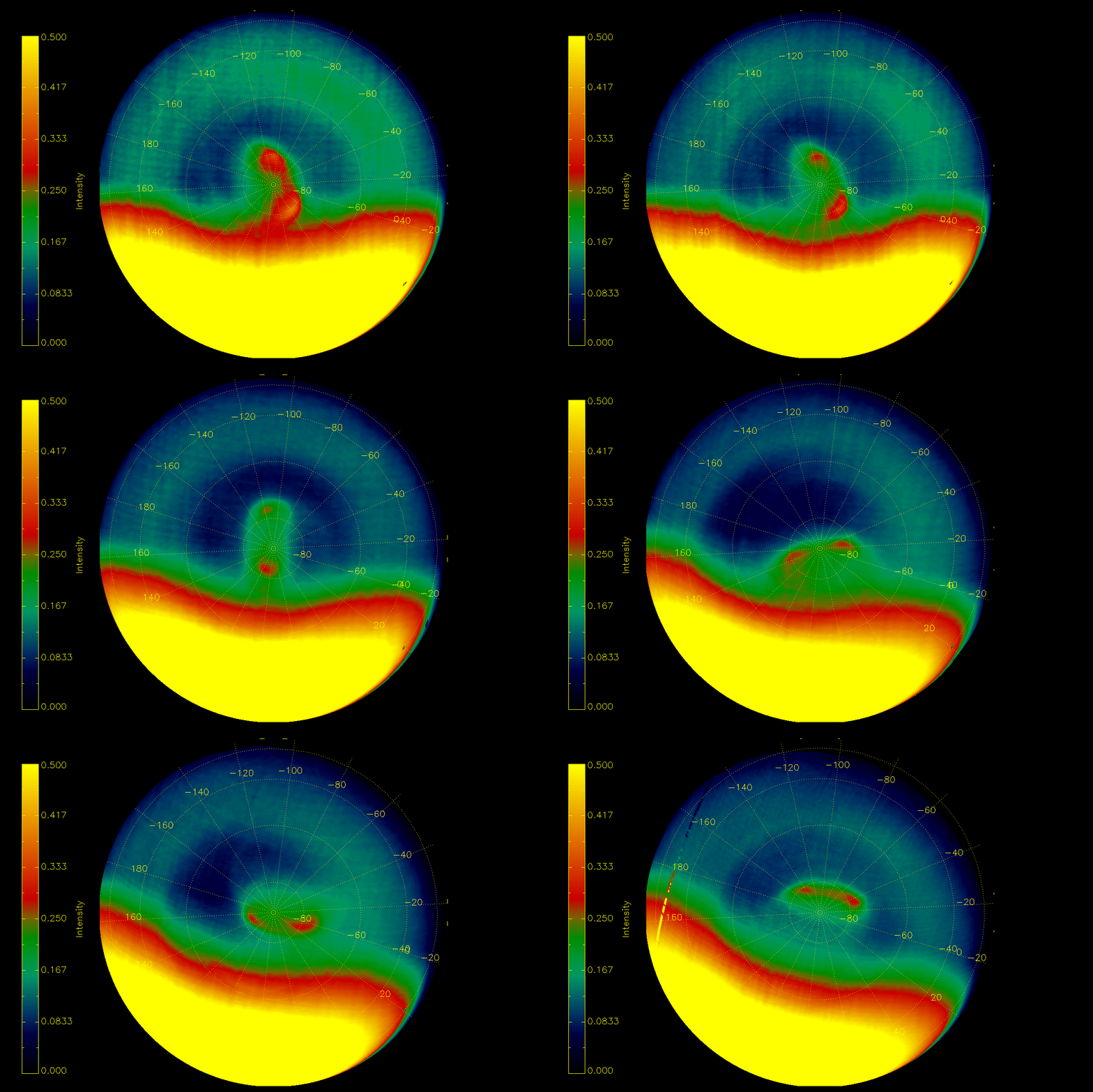
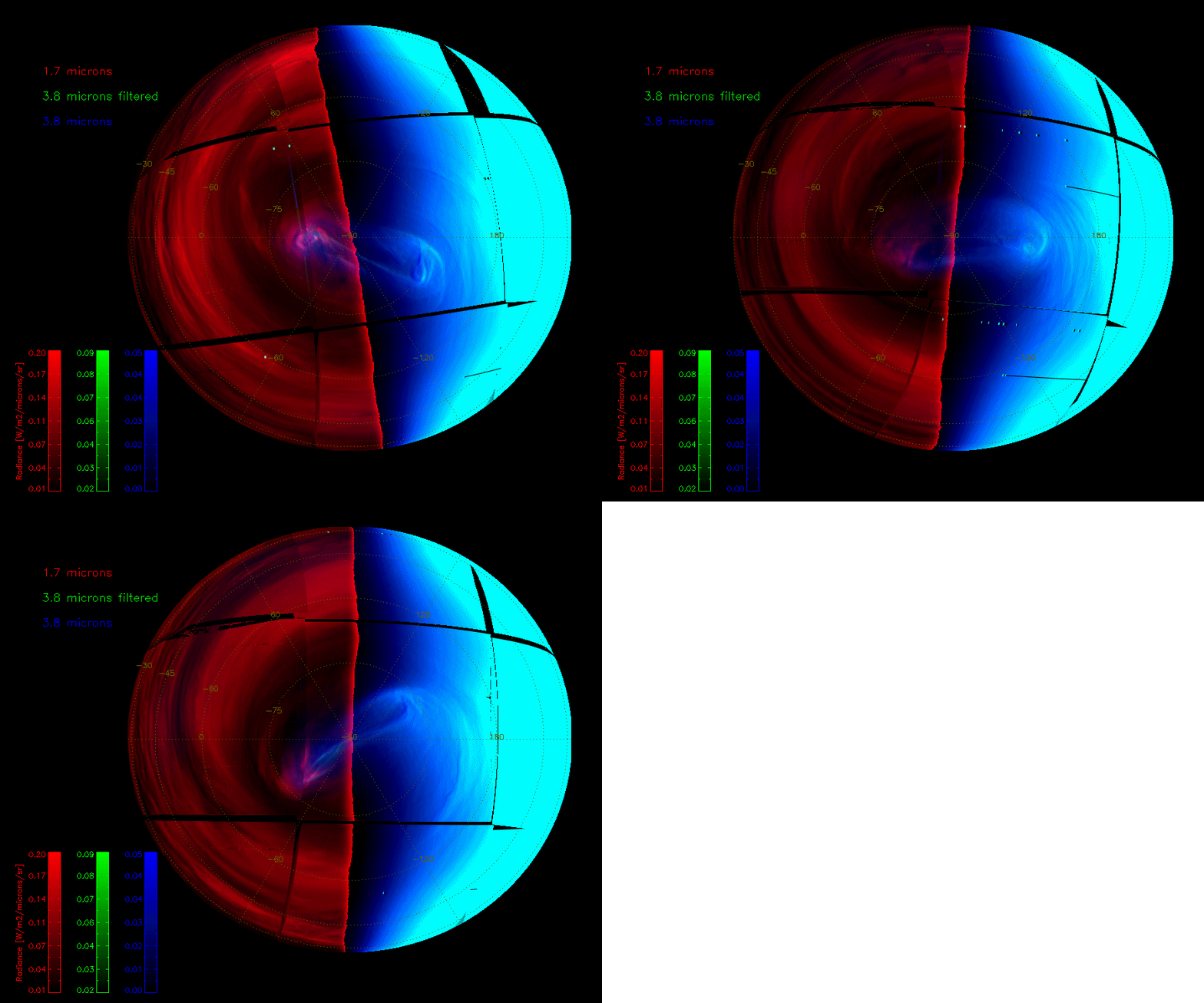
    Venus Express has constantly been observing the south pole of Venus and has found it to be surprisingly fickle. An enormous structure with a central part that looks like the eye of a hurricane, morphs and changes shape within a matter of days, leaving scientists puzzled.

    The eye of the hurricane is at the centre of a 2000 km-wide vortex. It was discovered in 1974 by the Mariner 10 spacecraft. There is a similar structure on the planet’s north pole, which was observed by the Pioneer Venus mission in 1979.

    Venus Express scientists have been studying the structure in the thermal infrared, the wavelength range which reveals the temperature at the cloud-tops. Seen in this wavelength, the core of the vortex appears very bright, probably indicating that a lot of atmospheric gases are moving downward in the region, which creates a depression at the cloud-tops, making the region hotter.
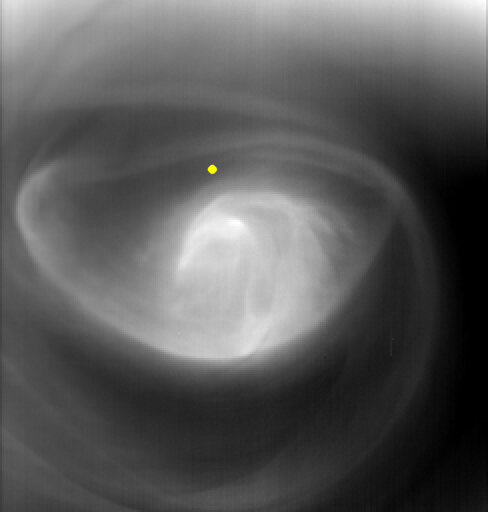
    Venus's polar vortex
    Venus's polar vortex

    “Simply put, the enormous vortex is similar to what you might see in your bathtub once you have pulled out the plug” says Giuseppe Piccioni, co-Principal Investigator for the Visible and Infrared Thermal Imaging Spectrometer (VIRTIS) on Venus Express, at IASF-INAF, Rome, Italy.


    The fickle puzzle

    Four hours later...
    Four hours later...

    In June 2006, the vortex appeared hourglass-shaped, closely matching observations in the north polar region by Pioneer Venus. Now we know that it changes its shape within a matter of days, from orbit to orbit. The image taken on 26 February 2007 shows the 'classic' dipole shape at the centre of the vortex, similar to that which has been observed previously. But an image taken a mere 24 hours earlier shows the centre of the vortex to be almost circular, indicating that the shape of this feature can change very fast. At other times, it is typically oval.

    The dynamic nature of the vortex can be seen clearly in the video. It shows that the vortex is very complex, with atmospheric gases flowing in different directions at different altitudes.

    What creates the puzzle?

    24 hours after the first
    24 hours after the first image

    Scientists are not sure what actually creates the vortex. Colin Wilson, at the University of Oxford, says, “One explanation is that atmospheric gases heated by the Sun at the equator, rise and then move poleward. In the polar regions, they converge and sink again. As the gases move towards the poles, they are deflected sideways because of the planet’s rotation.”

    The dynamic nature of this vortex is similar to behaviour observed in other vortices on Earth, including those observed at the centre of hurricanes.
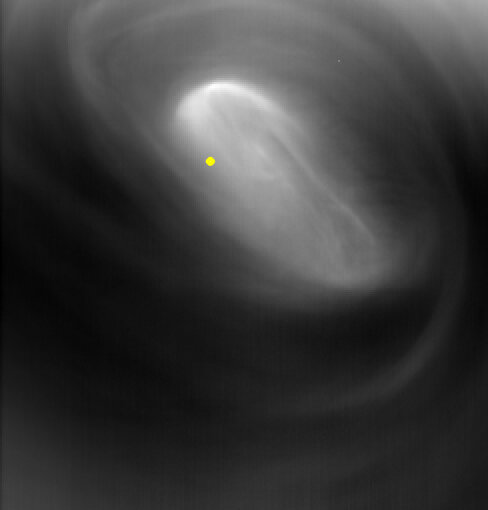
    Another day later
    Another day later

    Investigators will keep a close watch on the polar region and its variability, in order to gain a better understanding of how it works.

    Notes for editors:

    The light and dark of Venus
    Enormous, spiral cloud features

    The discovery was reported in ‘South-polar features on Venus similar to those near the north pole’ by G. Piccioni et al. published in Nature on 29 November 2007.

    For more information:

    Giuseppe Piccioni, VIRTIS co-Principal Investigator, IASF-INAF, Rome, Italy
    Email: Giuseppe.Piccioni @ iasf-roma.inaf.it

    Pierre Drossart, VIRTIS co-Principal Investigator, Observatoire de Paris, France
    Email: Pierre.Drossart @ obspm.fr

    Håkan Svedhem, ESA Venus Express Project Scientist
    Email: Hakan.Svedhem @ esa.int
    Rate this

    Views

    Share

    • Currently 0 out of 5 Stars.
    • 1
    • 2
    • 3
    • 4
    • 5
    Rating: 0/5 (0 votes cast)

    Thank you for rating!

    You have already rated this page, you can only rate it once!

    Your rating has been changed, thanks for rating!

    188
    Tweet
    • Looking at Venus
    • ESApod: Venus Express
    • Related articles
      • Double vortex at Venus South Pole unveiled!
        • The restless atmosphere of Venus
          • Mars and Venus are surprisingly similar
            • Venus Express seeks out gases below the clouds
            • Venus Express educational film
            • Interviews: the martian water cycle and climate
              • ESA to present the latest Venus Express results to the media
                • Lifting the Venusian veil, two years since launch
                  • Setting stars reveal planetary secrets
                    • 500 days at Venus, and the surprises keep coming
                    • In depth
                    • Venus Express in-depth

    Connect with us

    • RSS
    • Youtube
    • Twitter
    • Flickr
    • G+
    • Facebook
    • Livestream
    • Subscribe
    • App Store
    • LATEST ARTICLES
    • · Earth Explorers take centre stage …
    • · The fast winds of Venus are gettin…
    • · ExoMars 2016 set to complete const…
    • · Herschel ends operations as orbiti…
    • · Europe’s largest spaceship reache…
    • FAQ

    • Jobs at ESA

    • Site Map

    • Contacts

    • Terms and conditions