• → European Space Agency

      • Space for Europe
      • Space News
      • Space in Images
      • Space in Videos
    • About Us

      • Welcome to ESA
      • DG's News and Views
      • For Member State Delegations
      • Business with ESA
      • ESA Exhibitions
      • ESA Publications
      • Careers at ESA
    • Our Activities

      • Space News
      • Observing the Earth
      • Human Spaceflight
      • Launchers
      • Navigation
      • Space Science
      • Space Engineering
      • Operations
      • Technology
      • Telecommunications & Integrated Applications
    • For Public

    • For Media

      • Media
      • ESA TV
      • Videos for professionals
      • Photos
    • For Educators

    • For Kids

    • ESA

    • Space Science

    • Our Universe
    • About Space Science
    • ESA's 'Cosmic Vision'
    • Science missions
    • Mission navigator
    • Target groups
    • For Media
    • For Scientists
    • For Kids
    • Multimedia
    • Science images
    • Science videos
    • Animations
    • Downloads
    • Sounds from space
    • Resources
    • Reference section
    • Services
    • FAQs
    • Glossary
    • Help
    • Portal terms of use
    • Comments
    • Follow us
    • RSS feeds
    • ESA Sci on Twitter
    • ESA Space Science Images on Flickr
    • ESA 3D on Flickr

    ESA > Our Activities > Space Science

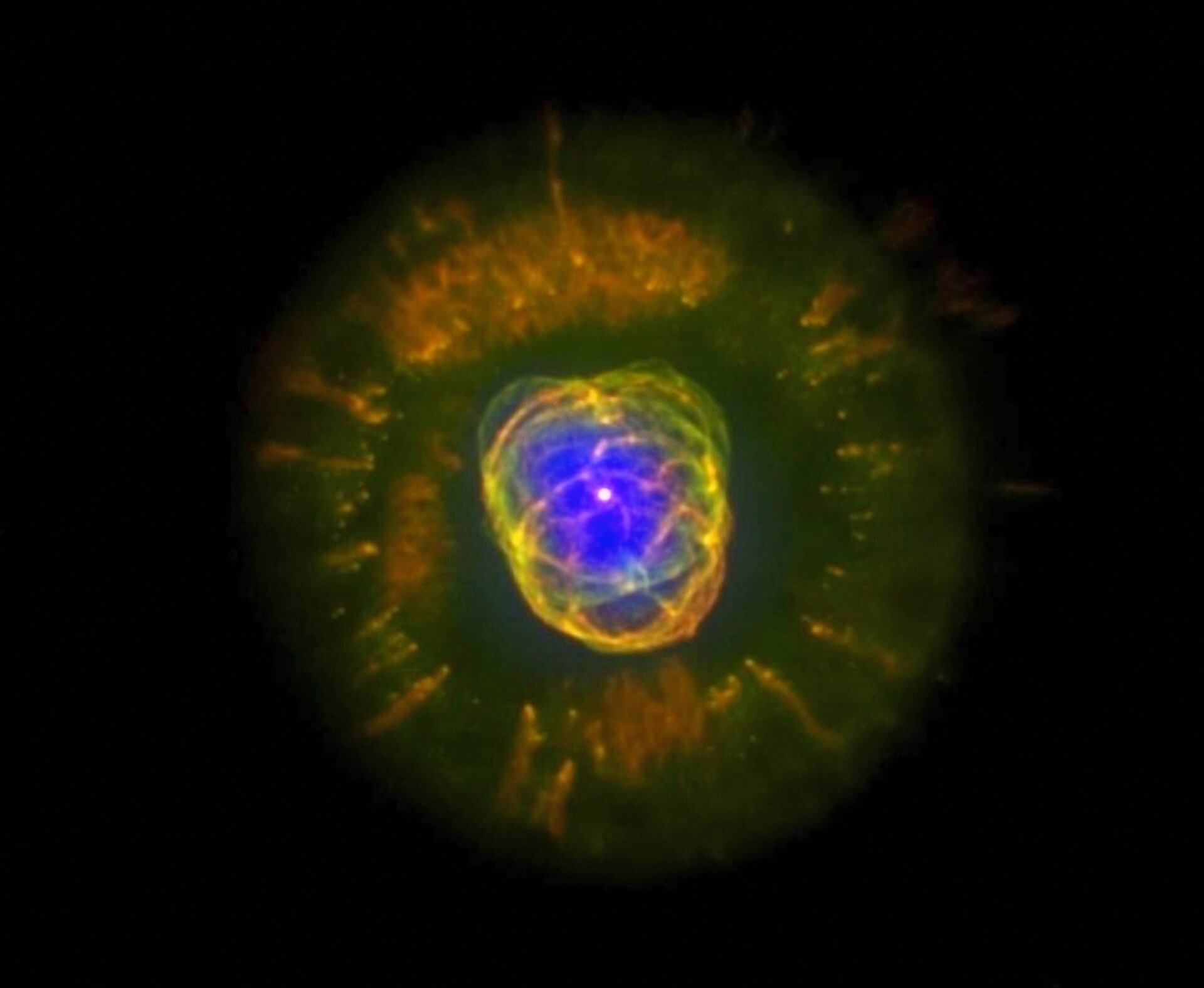
    Hot interior of Eskimo Nebula

    X-raying the Eskimo

    11 February 2013

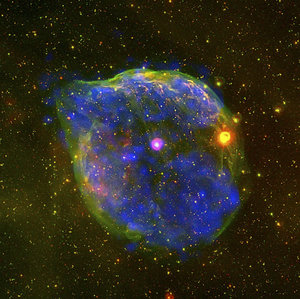
    Peering inside the fur-lined hood of the Eskimo Nebula with ESA’s XMM-Newton space observatory reveals a hot face of X-ray-emitting gas blazing at 2 million degrees.

    The image is a composite of XMM-Newton (blue) and Hubble Space Telescope (red and green) data and reveals the complex nature of planetary nebula – the end points of dying Sun-like stars.

    As such a star evolves, it sheds its outer layers to expose the hot core. The intricate pattern of a planetary nebula emerges when the star’s ultraviolet radiation ionises the ejected material, making it visible at optical wavelengths.

    The Eskimo Nebula, located about 4000 light-years from Earth in the constellation of Gemini, was discovered by William Herschel in 1787. It started forming about 10 000 years ago when the central star began blasting out an intense high-speed wind.

    This broken ring of material comprises multiple comet-shaped objects, their tails streaming away from the central star and stretching up to a light-year out into space. These features form the Eskimo’s fur-lined hood, framing a small heart-shaped face buried inside.

    A few thousand years ago the dying star puffed away its outer layers, forming the complex network of shells lit up in yellow in this image.

    The Eskimo’s face is hot in X-rays, a result of interactions between the star’s fast winds colliding with the shell of the nebula. Here, temperatures reach some 2 million degrees Celsius, much hotter than the surrounding ejected material that glows at around 14 000ºC.

    This image is taken from our archives, and was first published in the XMM-Newton image gallery in 2004.

    Rate this

    Views

    Share

    • Currently 5 out of 5 Stars.
    • 1
    • 2
    • 3
    • 4
    • 5
    Rating: 5/5 (7 votes cast)

    Thank you for rating!

    You have already rated this page, you can only rate it once!

    Your rating has been changed, thanks for rating!

    966
    Tweet

    Related articles

    Massive stellar winds are made of tiny pieces05 February 2013

    Massive stellar winds are made of tiny pieces05 February 2013 ESA’s XMM-Newton space observatory has completed the most detailed study ever of the fierce wind from a giant star, showing for the first time that it is not a uniform breeze but is fragmented into hundreds of thousands of pieces.

    Abell 30: a born-again planetary nebula

    Born-again star foreshadows fate of Solar System15 November 2012

    Abell 30: a born-again planetary nebula

    Born-again star foreshadows fate of Solar System15 November 2012 Astronomers have found evidence for a dying Sun-like star coming briefly back to life after casting its gassy shells out into space, mimicking the possible fate our own Solar System faces in a few billion years.

    Wolf-Rayet bubble

    Fire burn and cauldron bubble29 October 2012

    Wolf-Rayet bubble

    Fire burn and cauldron bubble29 October 2012

    X-raying stellar winds in a high-speed collision12 October 2012

    X-raying stellar winds in a high-speed collision12 October 2012 Two massive stars racing in orbit around each other have had their colliding stellar winds X-rayed for the first time, thanks to the combined efforts of ESA’s XMM-Newton and NASA’s Swift space telescopes.

    Supernova remnant

    Aftermath of a stellar explosion13 August 2012

    Supernova remnant

    Aftermath of a stellar explosion13 August 2012

    A magnetic monster’s dual personality16 July 2012

    A magnetic monster’s dual personality16 July 2012

    • Space Science Image of the Week Archive
    • Space Live
      Space Live
      Space science image gallery
    • Hubble's Universe
    • More about...
      • XMM-Newton overview
      • XMM-Newton image gallery
      • In depth
      • XMM-Newton in-depth

    Connect with us

    • RSS
    • Youtube
    • Twitter
    • Flickr
    • G+
    • Facebook
    • Livestream
    • Subscribe
    • App Store
    • ESA Science Twitter

    Follow ESA science

    • LATEST ARTICLES
    • · The fast winds of Venus are gettin…
    • · ExoMars 2016 set to complete const…
    • · Herschel ends operations as orbiti…
    • · Europe’s largest spaceship reache…
    • · ATV ready to nose up to Station
    • FAQ

    • Jobs at ESA

    • Site Map

    • Contacts

    • Terms and conditions