The Large Diameter Centrifuge
In order to understand and describe the influence of gravity in systems the observation of behaviour in microgravity and at 1 g (where g is the gravitational acceleration at the surface of the Earth) is not sufficient. A broad gravity spectrum has to be explored to complete the scientific picture of how gravity has an impact on a system: samples have to be exposed to a variety of acceleration values above 1 g (hypergravity).
A Large Diameter Centrifuge (LDC) has been developed by ESA allowing the acquisition of measurement points in the range from 1 to 20 g. This instrument can provide a hypergravity environment for cells, plants and small animals, as well as physical science and technological experiments. The LDC is part of the Life and Physical Sciences Instrumentation and Life Support Laboratory (LIS) at ESTEC (the Netherlands), dedicated to serve the science and technology user communities throughout Europe.
A wide range of hypergravity experiments can be undertaken in the LDC facility, in particular biology, biochemistry, microbiology, optical physics, material sciences, fluid dynamics, geology and plasma physics investigations can be performed.
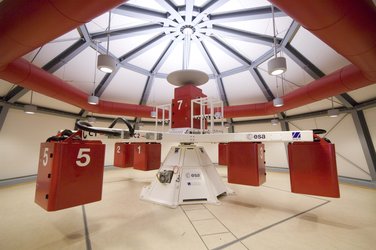
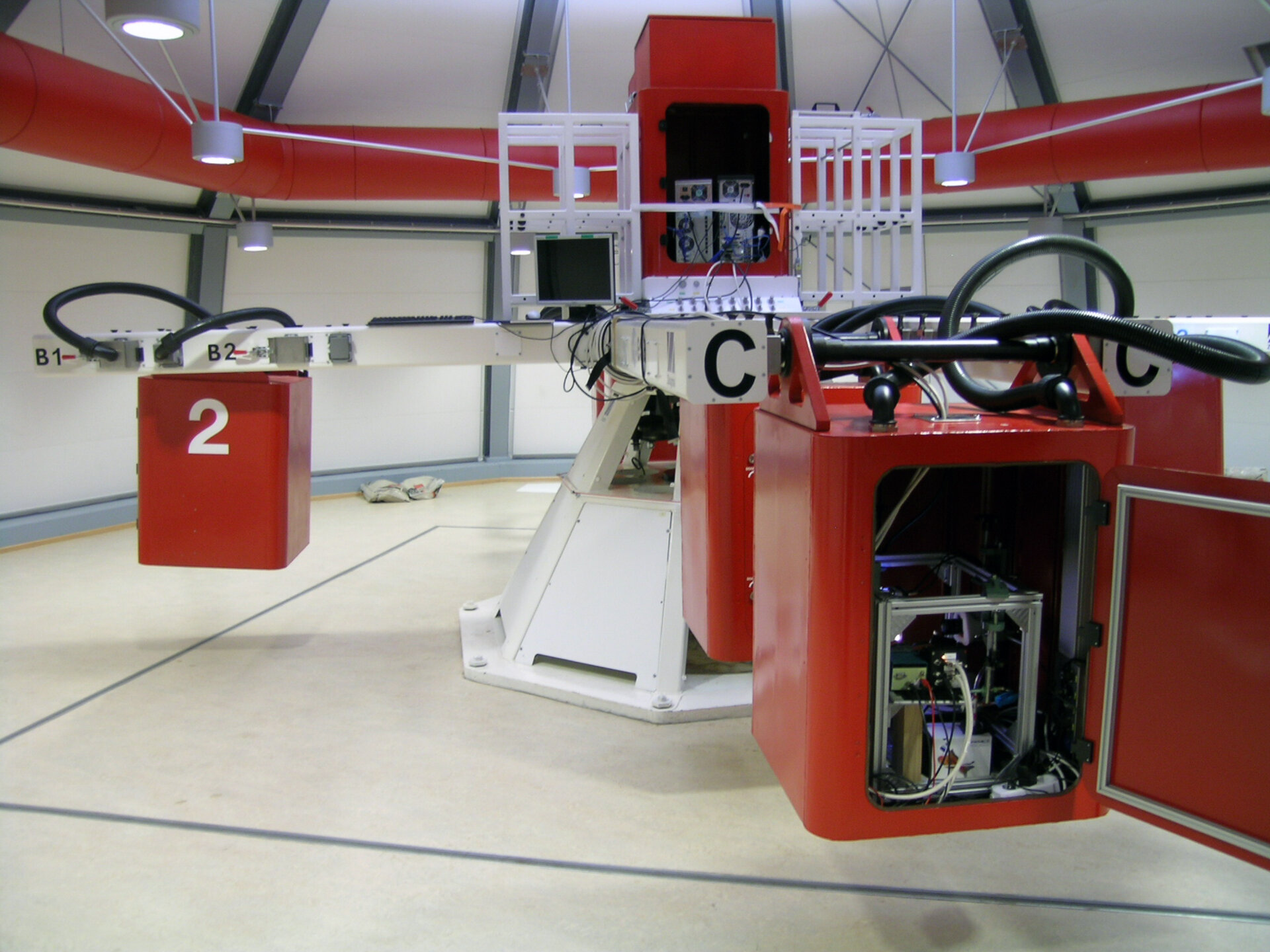
The diameter of the LDC is eight metres. It has four arms each of which can support two gondolas with a maximum payload of 80 kg per gondola. In practice however, up to six gondolas can be used for an experiment plus one additional gondola in the centre for control or reference purposes. The hypergravity field inside the gondolas is simulated by the centripetal forces due to rotation.
The LDC is flexible in terms of experiment scenarios, duration and possible equipment to use. This means that the system is able to execute and manage experiments that last from one minute up to six months, without stopping.
More detailed information can be found in the LDC Experimenter User Manual (list of documents).