ESALaunch SpecialHerschelPlanckESA Science
   
About Herschel
The infrared Universe
Spacecraft and telescope
The mission
Meet the team
Multimedia
Herschel imagesHerschel videos
Follow me!
 Herschel on Twitter


Bookmark and Share


Article Images
Herschel views deep-space pearls on a cosmic string
 
2 October 2009

Download:
 HI-RES JPEG (Size: 896 kb)
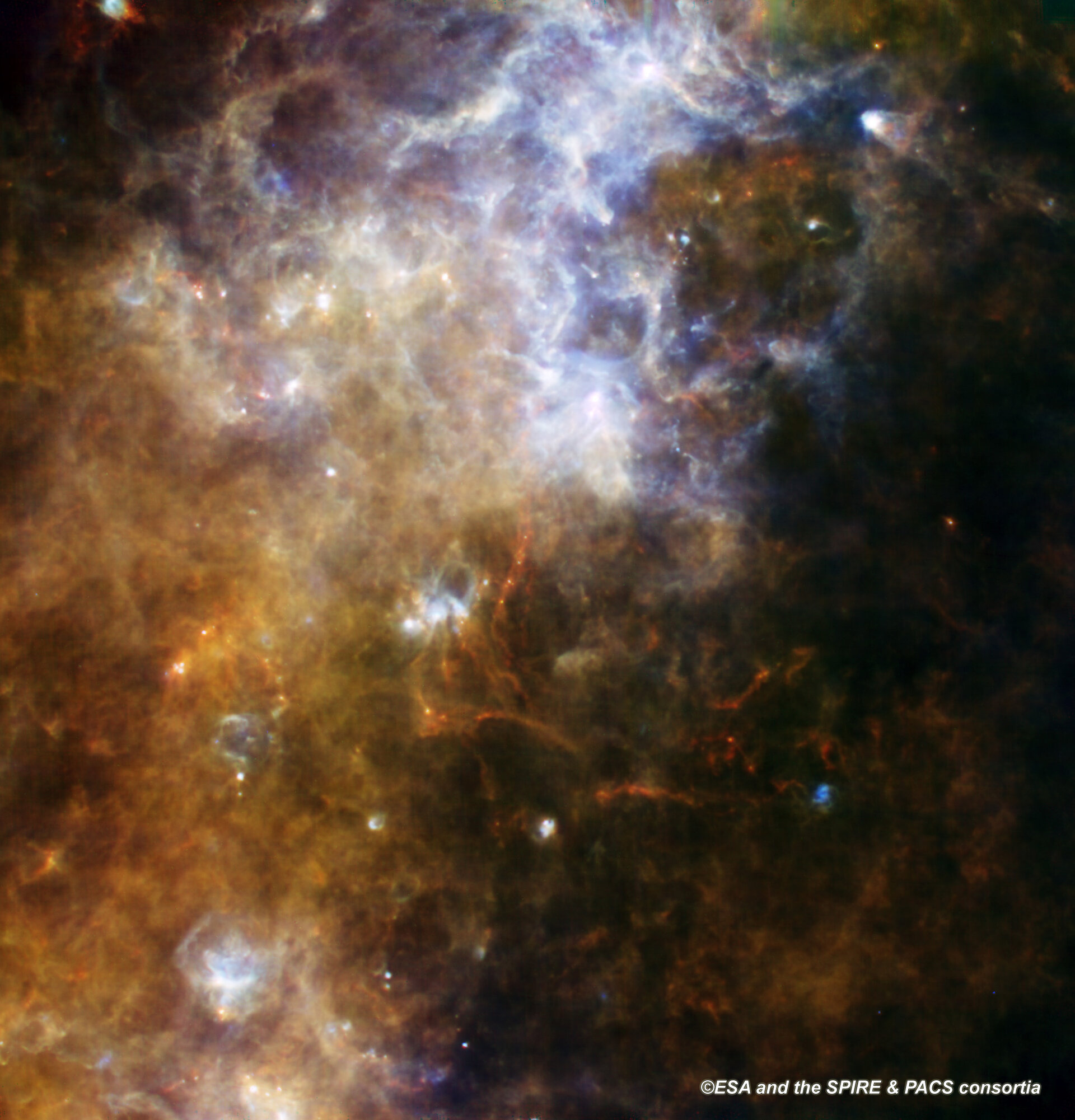
Five-colour infrared image of a reservoir of cold gas in the constellation of the Southern Cross. The region is located about 60° from the Galactic Centre, thousands of light-years from Earth. The images cover an area of 2°x2° on the sky.

The images taken on 3 September reveal structure in cold material in our Galaxy, as we have never seen it before. Even before a detailed analysis, scientists have gleaned information on the quantity of the material, its mass, temperature, composition and whether it is collapsing to form new stars.

That a dark, cool area such as this would be bustling with activity, was unexpected. But the images reveal a surprising amount of turmoil: the interstellar material is condensing into continuous and interconnected filaments glowing from the light emitted by new-born stars at various stages of development. Ours is a tireless Galaxy constantly forging new generations of stars.

Stars form in cold, dense environments, and in these images it is easy to locate the star-forming filaments that would be very difficult to isolate in a single-wavelength image.

Traditionally, in a crowded region like this, situated in the plane of our Galaxy and containing many molecular clouds along the line of sight, astronomers have had a difficult time resolving details. But Herschel’s sophisticated infrared instruments made short work of the task, seeing through the dust that is opaque to visible light, and seeing the glow from the dust itself. These observations are not possible from ground.

The result is a view of an incredible network of filamentary structures, and features indicating a chain of near-simultaneous star-formation events, glittering like strings of pearls deep in our Galaxy.
The five original infrared wavelengths have been colour-coded to allow scientists to differentiate extremely cold material (red) from the surrounding warm stuff (blue).

The SPIRE and PACS images have been combined to a single composite; here blue denotes 70 micron and green 160 micron emission, while red is the combination of the emission from all three SPIRE bands at 250, 350 and 500 microns.

Credits: ESA and the SPIRE & PACS consortia
 
 
Reservoir of cold gas in the constellation of the Southern Cross
Download:
 HI-RES JPEG (Size: 341 kb)
`Five-colour infrared images of a reservoir of cold gas in the constellation of the Southern Cross. The region is located about 60° from the Galactic Centre, thousands of light-years from Earth. The images cover an area of 2°x2° on the sky.

The images taken on 3 September reveal structure in cold material in our Galaxy, as we have never seen it before. Even before a detailed analysis, scientists have gleaned information on the quantity of the material, its mass, temperature, composition and whether it is collapsing to form new stars.

That a dark, cool area such as this would be bustling with activity, was unexpected. But the images reveal a surprising amount of turmoil: the interstellar material is condensing into continuous and interconnected filaments glowing from the light emitted by new-born stars at various stages of development. Ours is a tireless Galaxy constantly forging new generations of stars.

Stars form in cold, dense environments, and in these images it is easy to locate the star-forming filaments that would be very difficult to isolate in a single-wavelength image.

Traditionally, in a crowded region like this, situated in the plane of our Galaxy and containing many molecular clouds along the line of sight, astronomers have had a difficult time resolving details. But Herschel’s sophisticated infrared instruments made short work of the task, seeing through the dust that is opaque to visible light, and seeing the glow from the dust itself. These observations are not possible from ground.

The result is a view of an incredible network of filamentary structures, and features indicating a chain of near-simultaneous star-formation events, glittering like strings of pearls deep in our Galaxy. The five original infrared wavelengths have been colour-coded to allow scientists to differentiate extremely cold material (red) from the surrounding warm stuff (blue).

SPIRE (left) and PACS (right) images were constructed by colour-coding the different observing wavelengths, and creating composite false-colour images. In the SPIRE image blue denotes 250 microns, green 350 microns, and red 500 microns emission, while in the PACS image cyan denotes 70 microns and red 160 microns emission.

Credits: Left panel: ESA and the SPIRE consortium, Right panel: ESA and the PACS consortium
 
 
Cold gas in the Milky Way
Download:
 HI-RES JPEG (Size: 969 kb)
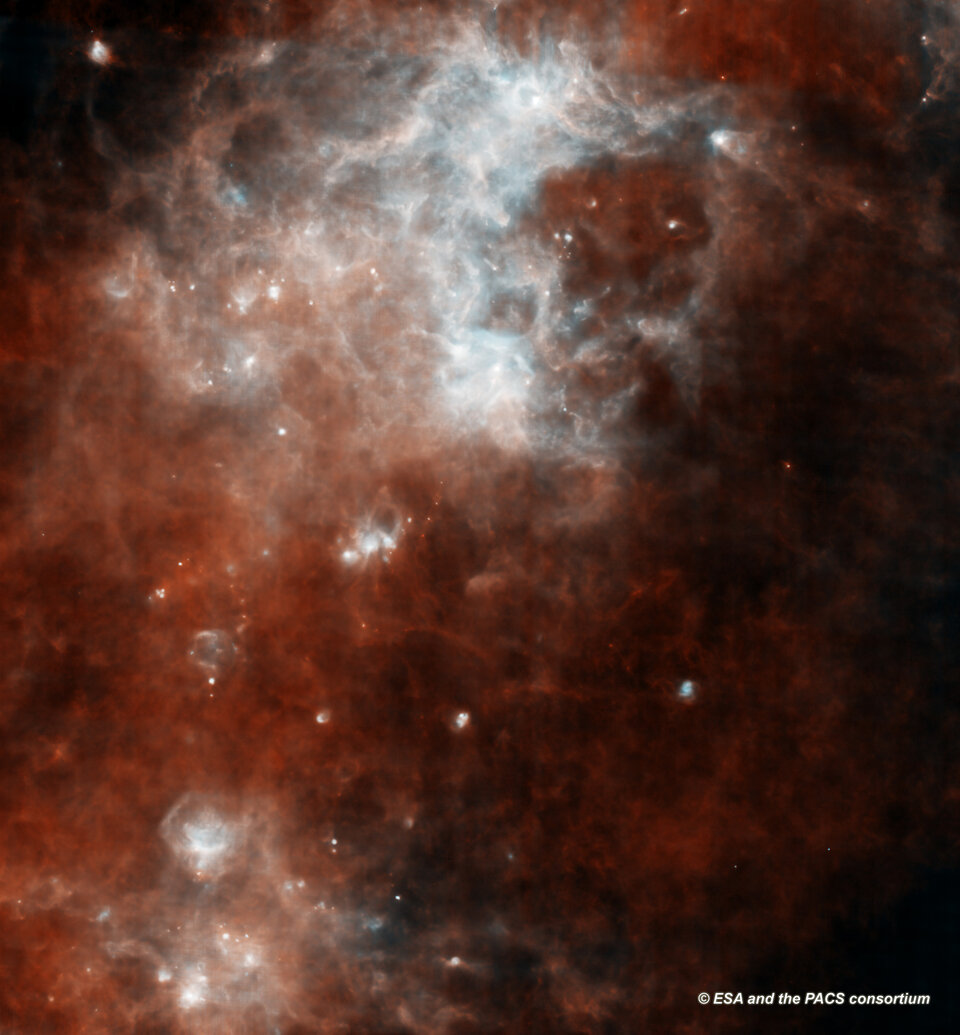
Herschel infrared image of a reservoir of cold gas in the constellation of the Southern Cross. The region is located about 60° from the Galactic Centre, thousands of light-years from Earth. The images cover an area of 2°x2° on the sky.

The images taken on 3 September reveal structure in cold material in our Galaxy, as we have never seen it before. Even before a detailed analysis, scientists have gleaned information on the quantity of the material, its mass, temperature, composition and whether it is collapsing to form new stars.

That a dark, cool area such as this would be bustling with activity, was unexpected. But the images reveal a surprising amount of turmoil: the interstellar material is condensing into continuous and interconnected filaments glowing from the light emitted by new-born stars at various stages of development. Ours is a tireless Galaxy constantly forging new generations of stars.

Stars form in cold, dense environments, and in these images it is easy to locate the star-forming filaments that would be very difficult to isolate in a single-wavelength image.

Traditionally, in a crowded region like this, situated in the plane of our Galaxy and containing many molecular clouds along the line of sight, astronomers have had a difficult time resolving details. But Herschel’s sophisticated infrared instruments made short work of the task, seeing through the dust that is opaque to visible light, and seeing the glow from the dust itself. These observations are not possible from ground.

The result is a view of an incredible network of filamentary structures, and features indicating a chain of near-simultaneous star-formation events, glittering like strings of pearls deep in our Galaxy.

The image was constructed by colour-coding the different observing wavelengths, and creating composite false-colour images. In the SPIRE image blue denotes 250 microns, green 350 microns, and red 500 microns emission, while in the PACS image cyan denotes 70 microns and red 160 microns emission.

Credits: ESA and the PACS consortium
 
 
Cold gas in the Milky Way
Download:
 HI-RES JPEG (Size: 345 kb)
SPIRE infrared image of a reservoir of cold gas in the constellation of the Southern Cross. The region is located about 60° from the Galactic Centre, thousands of light-years from Earth. The images cover an area of 2°x2° on the sky.

The images taken on 3 September reveal structure in cold material in our Galaxy, as we have never seen it before. Even before a detailed analysis, scientists have gleaned information on the quantity of the material, its mass, temperature, composition and whether it is collapsing to form new stars.

That a dark, cool area such as this would be bustling with activity, was unexpected. But the images reveal a surprising amount of turmoil: the interstellar material is condensing into continuous and interconnected filaments glowing from the light emitted by new-born stars at various stages of development. Ours is a tireless Galaxy constantly forging new generations of stars.

Stars form in cold, dense environments, and in these images it is easy to locate the star-forming filaments that would be very difficult to isolate in a single-wavelength image.

Traditionally, in a crowded region like this, situated in the plane of our Galaxy and containing many molecular clouds along the line of sight, astronomers have had a difficult time resolving details. But Herschel’s sophisticated infrared instruments made short work of the task, seeing through the dust that is opaque to visible light, and seeing the glow from the dust itself. These observations are not possible from ground.

The result is a view of an incredible network of filamentary structures, and features indicating a chain of near-simultaneous star-formation events, glittering like strings of pearls deep in our Galaxy.
The image was constructed by colour-coding the different observing wavelengths, and creating composite false-colour images. Cyan denotes 70 microns and red 160 microns emission.

Credits: ESA and the SPIRE consortium


Herschel: ESA's giant infrared observatoryHerschel in space, close up on its mirror
Space Operations & Situational AwarenessSpacecraft Operations
Herschel on YouTube
Inside Herschel Herschel mission objectives
Related articles
Herschel and Planck pass in-orbit 'exam'Herschel images promise bright futureHerschel’s daring test: a glimpse of things to comeHerschel cryocover is open
Read more
Observations: Seeing in infrared wavelengthsWhy infrared astronomy is a hot topicL2, the second Lagrangian Point
In depth
This article in depthHerschel in depthHerschel Science Centre


   Copyright 2000 - 2012 © European Space Agency. All rights reserved.