ESA's Herschel calls home using mobile phone technology
For the first time in spaceflight history, a satellite has used mobile phone technology to radio back to Earth. The transmission took place on 16 May when Herschel used the same technology as used in GSM mobile phone networks to send test data to ESA's deep space tracking station at New Norcia, Australia.
At 14:00 CEST on 16 May - just under two days after launch - Herschel switched its telemetry downlink to 'high rate mode' and began transmitting, marking the first-ever use of Gaussian Minimum Shift Keying (GMSK) modulation in space. GMSK is commonly used in Global System for mobile Communication (GSM) mobile phone networks due to its very efficient use of bandwidth and power.
"Herschel's 1.5-Mbps test transmission - roughly the same data rate provided by a home broadband Internet connection - was picked up at ESA's ESTRACK station at New Norcia, Australia, on Saturday, as the satellite was travelling some 280 000 km from Earth," said John Dodsworth, the Herschel-Planck Flight Operations Director speaking in the Main Control Room at ESOC, ESA's European Space Operations Centre, Darmstadt, Germany.

In a typical GSM mobile phone network, the same technology transmits data at a somewhat lower speed. Herschel's sister spacecraft Planck also uses GMSK technology, and its transmission capability will be tested later during the satellite's commissioning phase.
During their missions, the GMSK-based radio links will be used by both spacecraft to transfer data gathered by their scientific instruments and on-board subsystems, providing information on flight status and overall health.
Herschel's successful operational test confirms results obtained during mathematical simulations and ground tests conducted since 2001, when the GMSK implementation on Herschel and Planck was first planned.

The development was driven by the need to use bandwidth more efficiently in view of the growing number of ESA missions that require X-band communications via the Agency's deep space ground stations. Gaia, scheduled for launch in the 2011 timeframe, will also use GMSK-based communication.
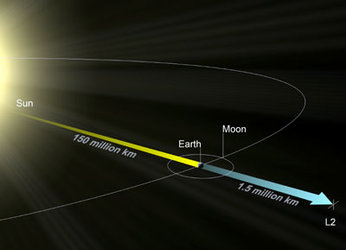
The GSM standard is the most popular modulation standard for mobile phone networks in the world. According to the GSM Association, terrestrial GSM networks now cover more than 80% of the world's population in more than 212 countries and territories - and will soon extend 1.5 million kms further to L2, Herschel and Plank's final orbital destination.