ESASSAESOCSpacecraft OperationsGround Systems EngineeringSpace DebrisESOC History
   
Background
About usProfile: The Right Stuff
SSA programme
Space Situational Awareness
Multimedia (click)
Ground Systems Engineering
Ground Systems team at ESOC
Mission families
Solar & planetaryAstronomy & Fundamental PhysicsEarth ObservationHuman SpaceflightTechnology DemonstrationPast missionsESA mission history- Find a mission: A...Z
Mission control centres
ATV Control Centre (ATV-CC)Columbus Control Centre (Col-CC)
Worldwide ground station network
ESTRACK tracking stationsESTRACK Control Centre- Find a station: A...Z
OPS Community
Advanced Mission Concepts & Technologies OfficeHSO ExchangeKnowledge ManagementESA Ground Operation System (EGOS)
Services
PublicationsESA-sponsored conferencesHelpSubscribe


Bookmark and Share


Article Images
Pioneering images of both martian moons
 
11 December 2009

Download:
 HI-RES MOV (Size: 10 040 kb)
In a first, ESA’s Mars Express orbiter imaged the martian moons Phobos and Deimos together on 5 November 2009. Apart from their ‘wow’ factor, these unique images will help the HRSC team validate and refine existing orbit models of the two moons.

The images were acquired with the Super Resolution Channel (SRC) of the High Resolution Stereo Camera (HRSC). The camera took 130 images of the moons on 5 November at 9:14 CET in a span of 1.5 minutes at intervals of 1s, speeding up to 0.5-s intervals toward the end. The image resolution is 110 m/pixel for Phobos and 240 m/pixel for Deimos — Deimos was more than twice as far from the camera.

The Super Resolution Channel of the HRSC uses an additional lens, which has a very narrow field of view of just 0.5°, providing four times the magnification than otherwise providing four times the resolution of the HRSC colour stereo channel. Phobos, the larger of the two moons, orbits closer to the Red Planet, circling it every 7 hours and 39 minutes. It travels faster relative to Mars than the Moon relative to Earth. It was 11800 km from Mars Express when the images were taken. Deimos was 26200 kilometres away.

Credits: ESA/DLR/FU Berlin (G. Neukum)
 
 
Phobos up close
Download:
 HI-RES JPEG (Size: 666 kb)  HI-RES TIFF (Size: 1438 kb)
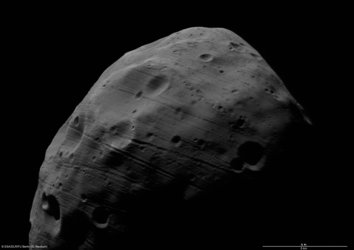
Close-up of Phobos, acquired on 28 July 2008

In addition to producing high-resolution maps of the surface of Mars in colour and in 3D, the exploration of Phobos is a scientific priority for the HRSC team. The potato-shaped, 27 × 22 × 18 km moon has already been photographed 127 times by the HRSC, improving our knowledge of the topography of the moon, and providing insight into its origins and development.

This particular image was acquired on 28 July 2008 with the nadir channel of the HRSC. Mars Express was 351 km from Phobos at the time of exposure and the resolution is 14/pixel. The image shows the northern hemisphere of Phobos marked with innumerable meteor craters. The sign N indicates the location of the North Pole.

Mars Express has come as close as 93 kilometres to the moon which circles the planet in an almost circular equatorial orbit at a distance of 6000 kilometres.

Credits: ESA/DLR/FU Berlin (G. Neukum)
 
 
Raw and processed images of Phobos and Deimos
Download:
 HI-RES JPEG (Size: 219 kb)  HI-RES TIFF (Size: 1911 kb)
Phobos and Deimos raw (left panel) and processed images (right panel).

In a first, ESA’s Mars Express orbiter imaged the martian moons Phobos and Deimos together on 5 November 2009. Apart from their ‘wow’ factor, these unique images will help the HRSC team validate and refine existing orbit models of the two moons. The images were acquired with the Super Resolution Channel (SRC) of the High Resolution Stereo Camera (HRSC). The camera took 130 images of the moons on 5 November at 9:14 CET in a span of 1.5 minutes at intervals of 1s, speeding up to 0.5-s intervals toward the end. The image resolution is 110 m/pixel for Phobos and 240 m/pixel for Deimos — Deimos was more than twice as far from the camera.

The Super Resolution Channel of the HRSC uses an additional lens, which has a very narrow field of view of just 0.5°, providing four times the magnification than otherwise providing four times the resolution of the HRSC colour stereo channel. Phobos, the larger of the two moons, orbits closer to the Red Planet, circling it every 7 hours and 39 minutes. It travels faster relative to Mars than the Moon relative to Earth. It was 11800 km from Mars Express when the images were taken. Deimos was 26200 kilometres away.

Credits: ESA/DLR/FU Berlin (G. Neukum)
 
  Exploration of Phobos: a scientific priority for Mars Express
 
Exposure geometry
Download:
 HI-RES JPEG (Size: 77 kb)  HI-RES TIFF (Size: 143 kb)
The locations of Mars, its moons and Mars Express when the images were taken.

ESA’s Mars Express has been circling Mars in an elliptical polar orbit since 25 December 2003 at an angle of roughly 87° to the equatorial plane. This orbit brings the spacecraft just 240 kilometres from the planet’s surface thrice a day. The furthest distance of the orbiter from Mars is about 10,000 kilometres.

Phobos is a potato-shaped moon, 26.8 × 22.4 × 18.4 km in size. It circles the planet in an almost circular equatorial orbit at a distance of 6000 km. Deimos, which has dimensions of 15.0 × 12.2 × 10.4 km, is the smaller of the two moons. It orbits Mars at a distance of roughly 20 000 km.

During the almost six-year long Mars Express mission, the geometrical configuration of the two moons relative to the probe on 5 November 2009 presented a unique opportunity to capture the moons in a sequence of images. Phobos and Deimos were directly in the field of view of the orbiter’s HRSC (High Resolution Stereo Camera).

Credits: FU Berlin


Mars Express image browser
Mars Express on YouTube
Traces of Martian life
Related articles
Mars Express acquires sharpest images of martian moon PhobosESA closes in on the origin of Mars’ larger moonChaotic terrain between Kasei Valles and Sacra FossaeLava flows in Daedalia PlanumCraters, lava flows and tectonic features near Ma'adim VallisCraters and channels in Hephaestus FossaeChaotic terrain in Ariadnes CollesIce-covered martian North PoleThe Euminedes Dorsum mountains on Mars


   Copyright 2000 - 2012 © European Space Agency. All rights reserved.