ESASSASpace DebrisESOCSpacecraft OperationsGround Systems EngineeringESOC History
   
Background
About usProfile: The Right Stuff
SSA programme
Space Situational Awareness
Multimedia (click)
Mission families
Solar & planetaryAstronomy & Fundamental PhysicsEarth ObservationHuman SpaceflightTechnology DemonstrationPast missionsESA mission history- Find a mission: A...Z
Mission control centres
ATV Control Centre (ATV-CC)Columbus Control Centre (Col-CC)
Worldwide ground station network
ESTRACK tracking stationsESTRACK Control Centre- Find a station: A...Z
OPS Community
Advanced Mission Concepts & Technologies OfficeHSO ExchangeKnowledge ManagementESA Ground Operation System (EGOS)
Services
PublicationsESA-sponsored conferencesHelpSubscribe


Bookmark and Share


News
 
printer friendly page
Launcher fairing ejection
Herschel and Planck talk to Earth
 
14 May 2009
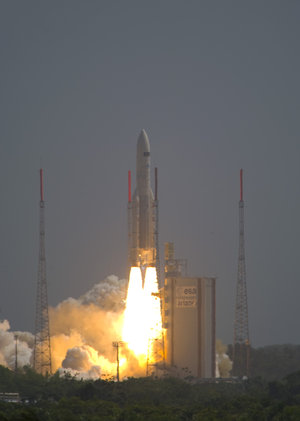
At 15:49 CEST today, just under 40 minutes after liftoff, Herschel and Planck sent their first radio signals to Earth, confirming that they separated successfully from the launcher and are alive.
 
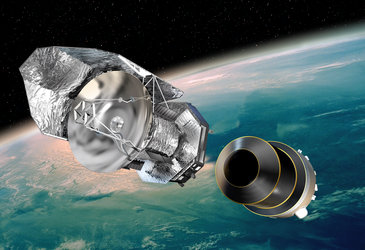
Herschel, the upper passenger, was the first to separate from the upper stage of the Ariane 5 at 15:38 CEST at an altitude of about 1150 km over the east coast of Africa. About 1.5 minutes later, the Sylda support structure that enclosed Planck came off and separated. It was followed by Planck at 15:40 CEST at an altitude of about 1700 km slightly East of the east coast of Africa.

The satellites switched on their attitude control and telecommunications systems right after separation, to re-orient themselves and establish contact with Earth for the first time from space. The signals were received by ESA’s 35-m deep space antenna at New Norcia in Australia.  
 
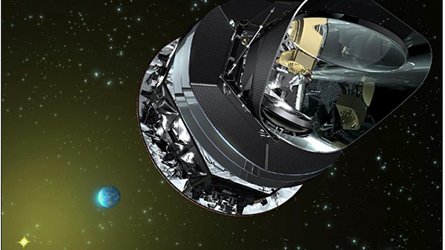
Herschel separation
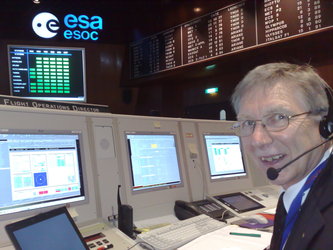
The mission control teams will continue to receive telemetry from Herschel via New Norcia, and for Planck via ESA’s antenna at Perth, also in Australia. Spacecraft Operations Engineers at the Mission Control Centre will use these data to assess the overall health of the satellites after launch.

Almost immediately after telemetry reception starts, engineers will determine the actual trajectory of each satellite so that it can be fine-tuned for planned trajectory correction manoeuvres.
 
 
Planck separation
For more information on the critical events following launch, see:

The Herschel and Planck launch timeline

The Herschel-Planck channel on Twitter


Herschel and Planck launch special
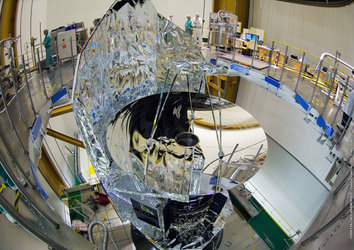
Herschel: ESA's giant infrared observatoryHerschel in space, close up on its mirror
Planck: looking back at the dawn of timePlanck cruises to L2
Related articles
Ariane 5 carrying Herschel and Planck lifts offESOC confirms: 'GO' for launchHerschel and Planck launcher declared fit for launchFairing lowered over satellites in KourouHerschel and Planck launch timeline
Read more
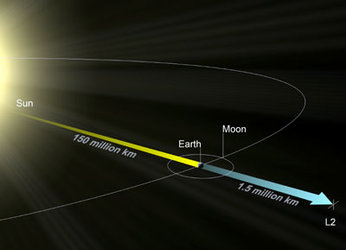
L2, the second Lagrangian Point
In depth
Herschel launch campaign journalPlanck launch campaign journalHerschel in depthPlanck in depth


   Copyright 2000 - 2012 © European Space Agency. All rights reserved.