Planck gears up for the ride
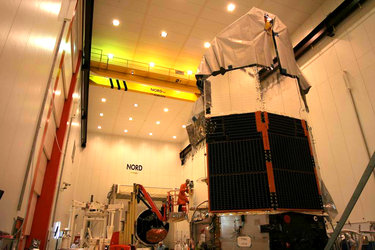
Over the past few weeks, the upper part of Planck’s outer solar array has been covered with multi-layer insulation, the satellite has been prepared for upcoming helium filling operations, several sub-system functional tests have been carried out and it has undergone final cleaning before launch.
Multiple layers of insulation

On Wednesday 4 March, multi-layer insulation (MLI) was fitted on the upper part of the outer solar array at the base of the service module. After this, both the insulation and the solar array underwent a final round of inspection.
Helium filling

Planck's Low Frequency Instrument (LFI) and the High Frequency Instrument (HFI) will operate at extremely low temperatures; 20K for LFI and 0.1K for HFI. To achieve these low temperatures, the satellite employs a three-stage active cryogenic cooler. The last cooling stage makes use of the cooling effect of mixing two isotopes of helium (helium 3 and helium 4) at low temperatures (around -272°C).
Both helium isotopes are stored under very high pressure in special tanks and the helium is depleted slowly during the mission. The supply cylinders containing the pressurised helium were inspected and filling activities started on Monday 9 March.
Functional tests
Engineers have also completed several system reference tests. The tests verified the health of the satellite's four major subsystems: power conditioning, thermal control, attitude measurement and control, command and data management, as well as telemetry and telecommand.
A final cleaning

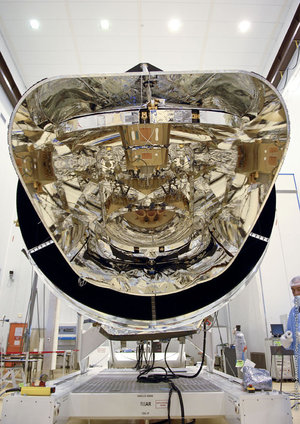
On 6 March, the satellite was given a final cleaning before launch using a special vacuum cleaner. The satellite’s surface was inspected under ultraviolet light to detect dust particles that fluoresce in the ultraviolet.