Lutetia asteroid in Rosetta’s spotlight
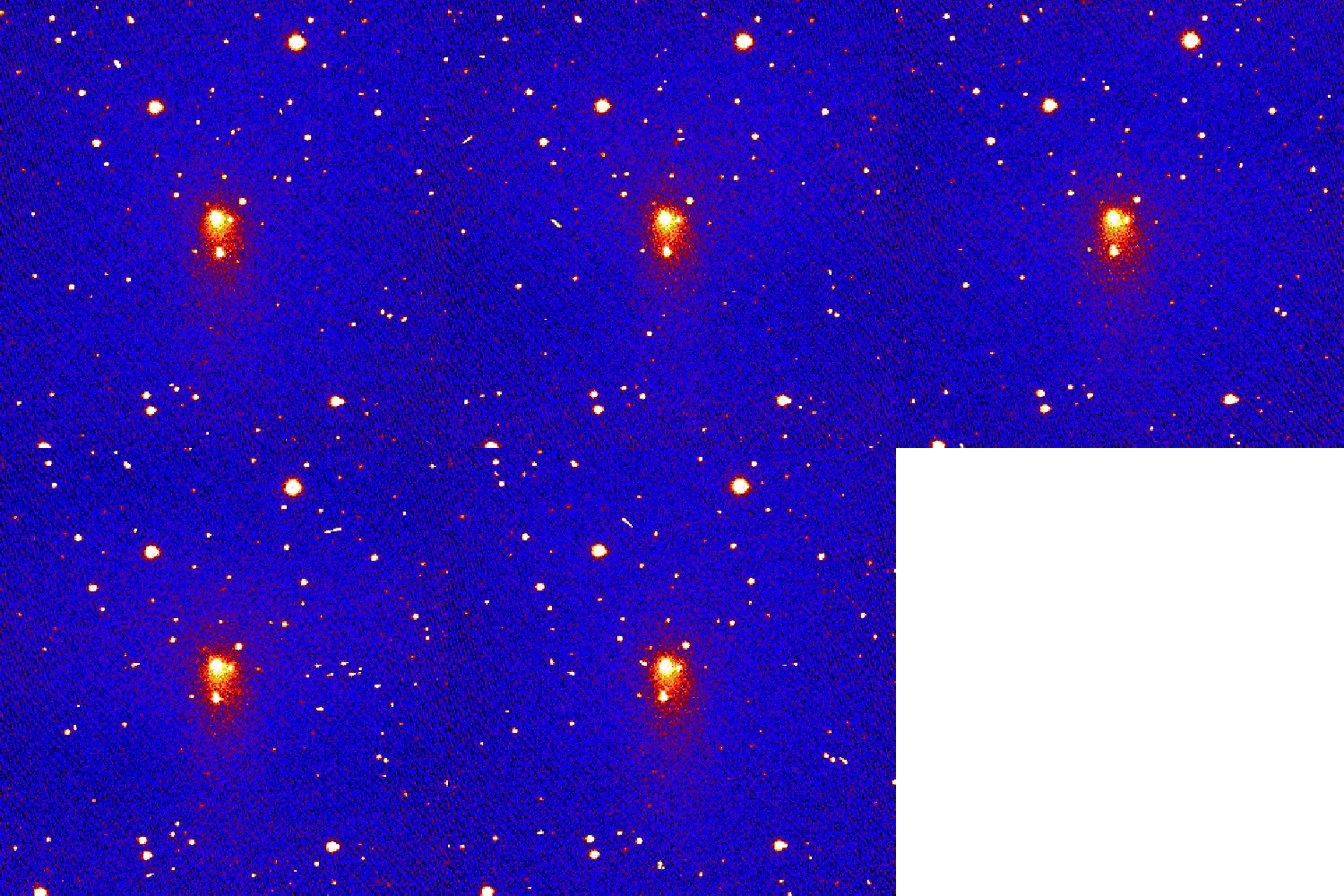
Earlier this month ESA's Rosetta had a first look at asteroid 21-Lutetia, one of the targets of its long mission. The onboard camera OSIRIS imaged the asteroid passing through its field of view during the spacecraft's gradual approach to Mars. The planet will be reached on 25 February 2007 for the mission's next gravity assist.
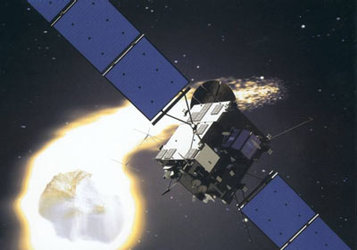
During its long trek to final destination (comet 67P Churyumov-Gerasimenko), Rosetta is planned to study two asteroids – 2867-Steins and 21-Lutetia, both lying in the asteroid belt between the orbits of Mars and Jupiter. Asteroids, as well as comets, carry important information about the origin of the Solar System – a better understanding of which is one of the primary goals of Rosetta.
The two asteroids will be visited at close range in September 2008 and July 2010, respectively, but the Rosetta scientists have already taken the opportunity to collect preliminary data about them. This opportunity will help scientists to better prepare for the broader observation campaigns of the two asteroids to come at later stage.
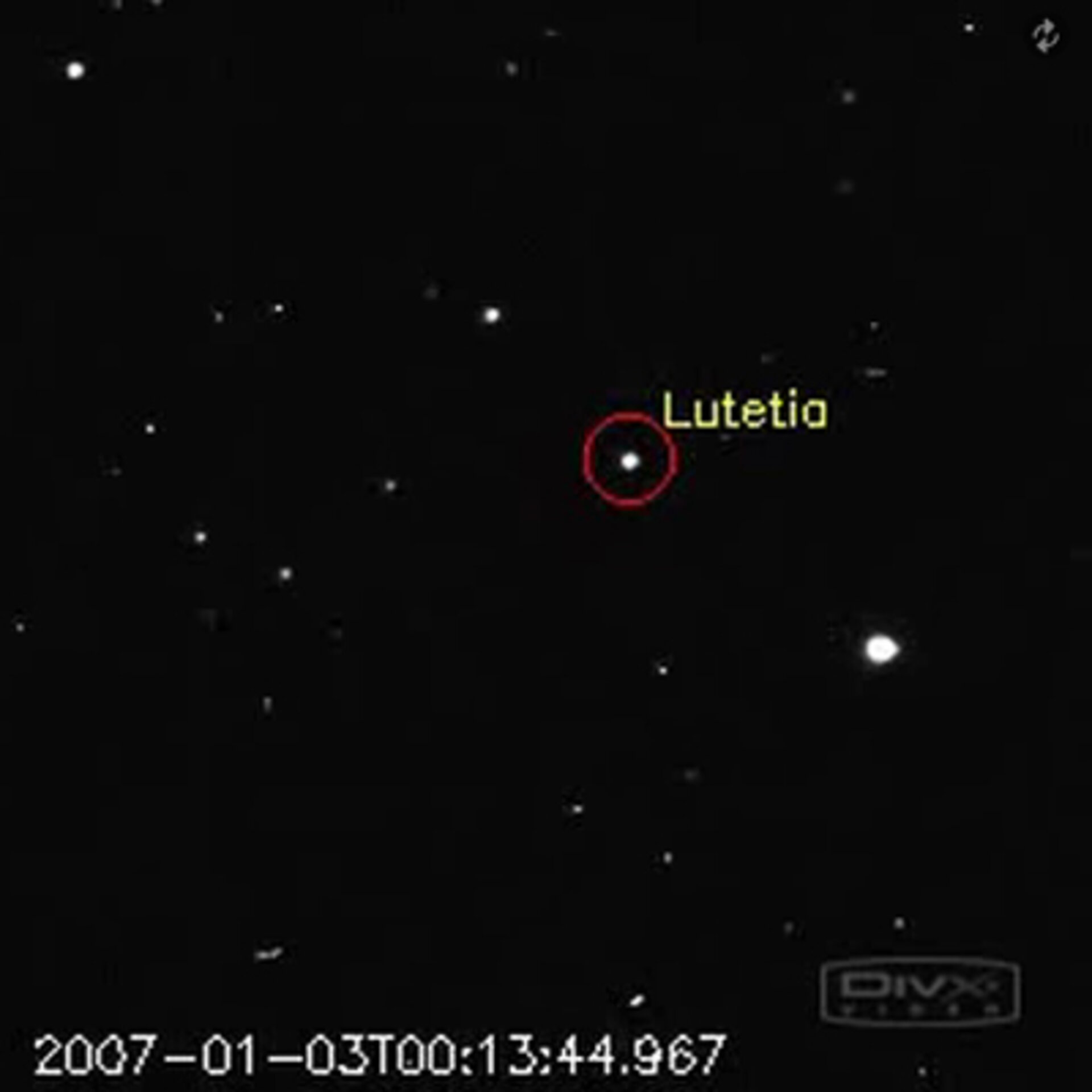
Steins was imaged by Rosetta on March 11 2006, while Lutetia was first imaged by Rosetta during a 36-hour observation campaign on 2 and 3 January 2007, when the spacecraft was flying at about 245 million kilometres from the asteroid. OSIRIS, the Optical, Spectroscopic, and Infrared Remote Imaging System mounted onboard the Rosetta orbiter, was switched on for this remote sensing observation.
Lutetia can be seen as the near-stationary spot visible at the centre of the animated sequence presented in this article. The scattered light spots seen in the movie are cosmic rays events, that is high-energy cosmic radiation hitting the detectors of the OSIRIS camera.
Little is known about Lutetia and Steins. Actually, very little is known about asteroids in general. Out of the many millions of asteroids that populate the Solar System, only a few have been observed so far from near-by.
According to what we know so far, Steins and Lutetia have rather different properties. Steins is relatively small, with a diameter of a few kilometres. Lutetia is a much bigger object, about 100 kilometres in diameter.
The Lutetia observation this month were aimed at pre-characterizing the rotation direction of the asteroid. This can be done by the study of the so-called 'light curve' of the asteroid – by analysing how the light emitted by the observed object changes intensity for the observer, one can deduce in what direction the object rotates. Scientists are now busy in analysing the OSIRIS data to build the light curve of Lutetia.
Having concluded the Lutetia observations, Rosetta is now getting ready for the next mission milestone: the swing-by of planet Mars. At the end of February, the gravitational energy of the Red Planet will be used by the spacecraft to get accelerated and then pushed, like a stone in a sling-shot, on a trajectory towards Earth for the following gravity assist manoeuvre in November 2007.
In the meantime Rosetta continues to provide new emotions as this incredible spacecraft, travelling through the Solar System as a cosmic 'billiard ball', collects data and images of the objects on its way.
Note to editors
Asteroid 2867-Steins will be visited again by Rosetta on 5 September 2008 from a distance of just over 1700 kilometres. This encounter will take place at a relatively low speed of about 9 kilometres per second during Rosetta's first excursion into the asteroid belt. On 10 July 2010 Rosetta will pay its second visit to asteroid 21-Lutetia, passing within about 3000 kilometres of it, at a speed of about 15 kilometres per second.
Rosetta will gather unprecedented data as it flies by these primordial rocks. Its onboard instruments will provide information on the mass and density of the asteroids, thus telling us more about their composition, and will also measure their subsurface temperature and look for gas and dust around them.
For more information
Rita Schulz, ESA Rosetta Project Scientist
Email: rita.schulz @ esa.int
Gerhard Schwehm, ESA Rosetta Mission Manager
Email: gerhard.schwehm @ esa.int
Uwe Keller, OSIRIS Principal Investigator, Max-Planck-Institut für Aeronomie
Email: KELLER @ linmpi.mpg.de