Rosetta bound for outer Solar System after final Earth swingby
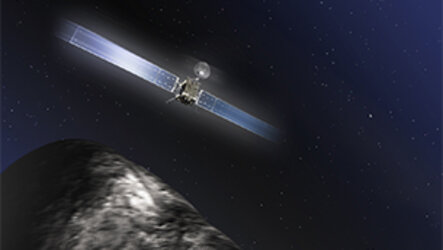
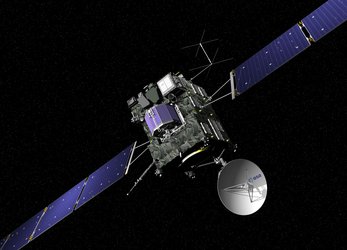
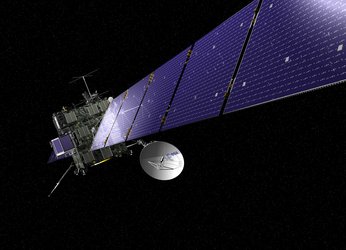
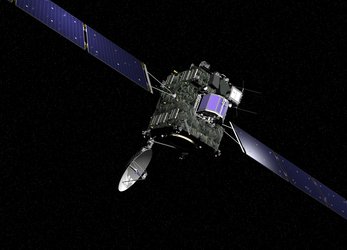
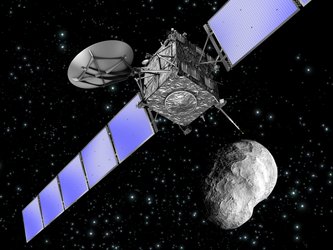
This morning, mission controllers confirmed that ESA’s comet chaser Rosetta had swung by Earth at 8:45 CET as planned, skimming past our planet to pick up a gravitational boost for an epic journey to rendezvous with comet 67P/Churyumov-Gerasimenko in 2014.
Rosetta passed over the ocean, just South of the Indonesian island of Java, at exactly 08:45:40 CET, at a speed of 13.34 km/s with respect to Earth at an altitude of 2481 km. The swingby was pre-planned and fully automated, and the spacecraft was in direct communication with Earth at the time, via the ESA New Norcia Station.

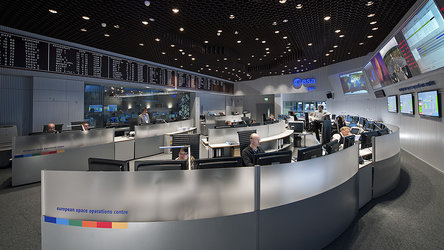
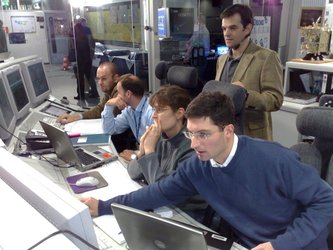
The successful swingby was confirmed at 09:05 CET when mission controllers re-established contact with Rosetta via ESA’s Maspalomas station in Spain. Although a detailed analyses is in progress, spacecraft operators have confirmed that the swingby provided a boost of 3.6 km/s.
Europe’s comet chaser has now flown a little over 4500 million km of its 7100 million km journey to its destination comet 67P/Churyumov-Gerasimenko. This was Rosetta’s fourth planetary swingby and the third and final swingby of Earth.
Science close to Earth

Some of Rosetta’s instruments have been on since early November, performing imaging, magnetospheric, and atmospheric observations, as well as looking for water on the Moon. The first round of images and data recorded just before and during the swingby will be downloaded later today.
Rosetta is now departing Earth to meet asteroid (21) Lutetia in July 2010. It has gained sufficient orbital energy to achieve its final goal: a rendezvous with comet 67P/Churyumov-Gerasimenko in 2014. The spacecraft is scheduled to enter deep-space hibernation by mid 2011 for the coldest leg of her journey to receive a wake up call only in spring 2014.
For additional details on today’s swingby access the Rosetta Blog (esa.int/blog)
For more information:
Andrea Accomazzo, ESA Rosetta Spacecraft Operations Manager
Email: Andrea.Accomazzo @ esa.int
Gerhard Schwehm, ESA Rosetta Mission Manager
Email: Gerhard.Schwehm @ esa.int
Rita Schulz, ESA Rosetta Project Scientist
Email: Rita.Schulz @ esa.int