Rosetta sees a living planet
Images and data taken just before closest approach were downloaded this morning, and they show the lights of North America in the night and a glowing Southern Hemisphere.
As Rosetta approached Earth, OSIRIS periodically imaged the Earth once every hour for 24 hours. The images from the green optical colour filter have been combined into a movie sequence. The images were taken beginning when Rosetta was 1.1 million km from Earth, until it came

The image above shows the illuminated crescent of Earth showing part of South America and Antarctica. This OSIRIS image was acquired with the the narrow-angle camera from a distance of

The lights of North American cities. Rosetta OSIRIS Imaging System's Narrow-Angle Camera image. The image was taken with a 10-s deep exposure at 05:44 CET. Some of the cities are clearly visible. Others like New York are covered by clouds, making the light diffuse.

A cloud-covered North America was captured at 14:03 UTC (15:03 CET), when Rosetta was at a distance of approximately 224 000 km from Earth's centre by Rosetta's navigation camera (navcam).
The navcam is used for precise determination of the orbit and optical visualisation. The output of the camera tells you where the centre of the object that is in the centre of the field of view is - it also gives physical parameters of the object.
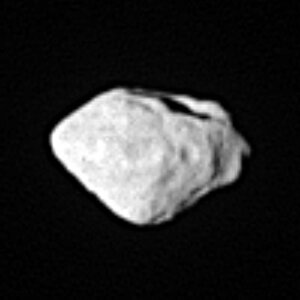
The photos were taken to test the camera's operation with a large physical object. Previously, Steins was also imaged, but it is rather small (about 5 km across). Next year, the camera will be used to view Lutetia, which is much larger (about 95 km across). In the camera's field of view, Lutetia should appear about as large as Earth looks in these images.