The puzzling 'eye of a hurricane' on Venus
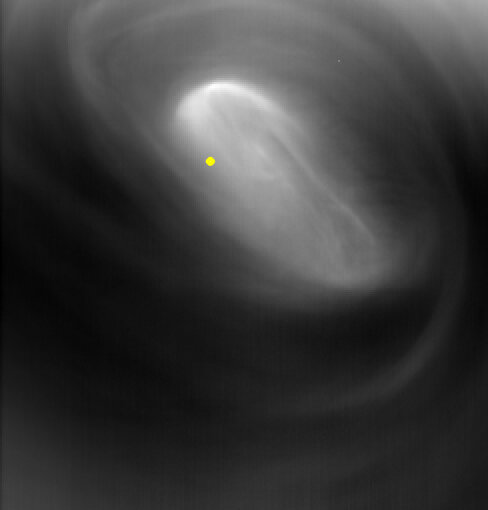
Venus Express has constantly been observing the south pole of Venus and has found it to be surprisingly fickle. An enormous structure with a central part that looks like the eye of a hurricane, morphs and changes shape within a matter of days, leaving scientists puzzled.
The eye of the hurricane is at the centre of a 2000 km-wide vortex. It was discovered in 1974 by the Mariner 10 spacecraft. There is a similar structure on the planet’s north pole, which was observed by the Pioneer Venus mission in 1979.
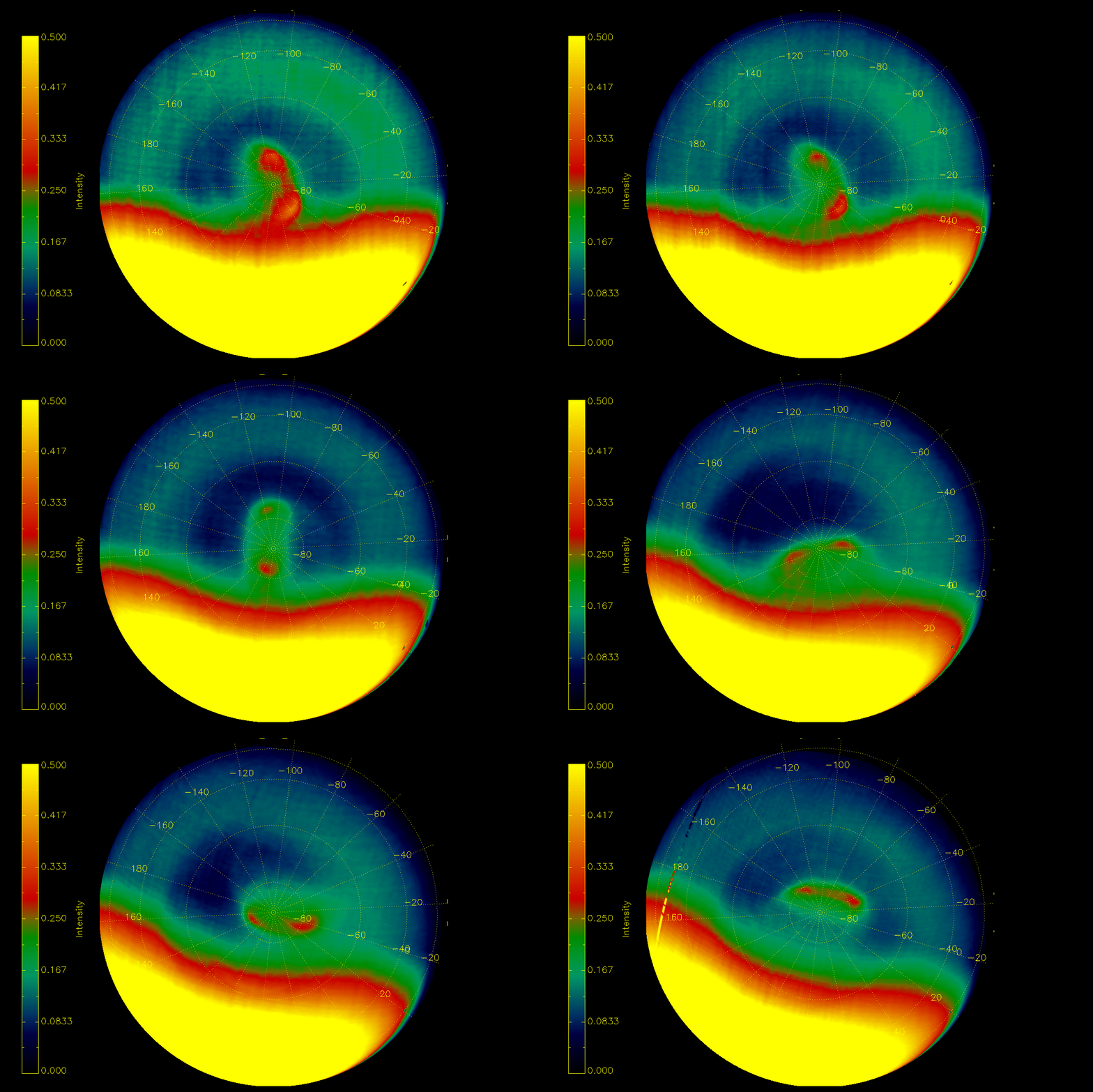
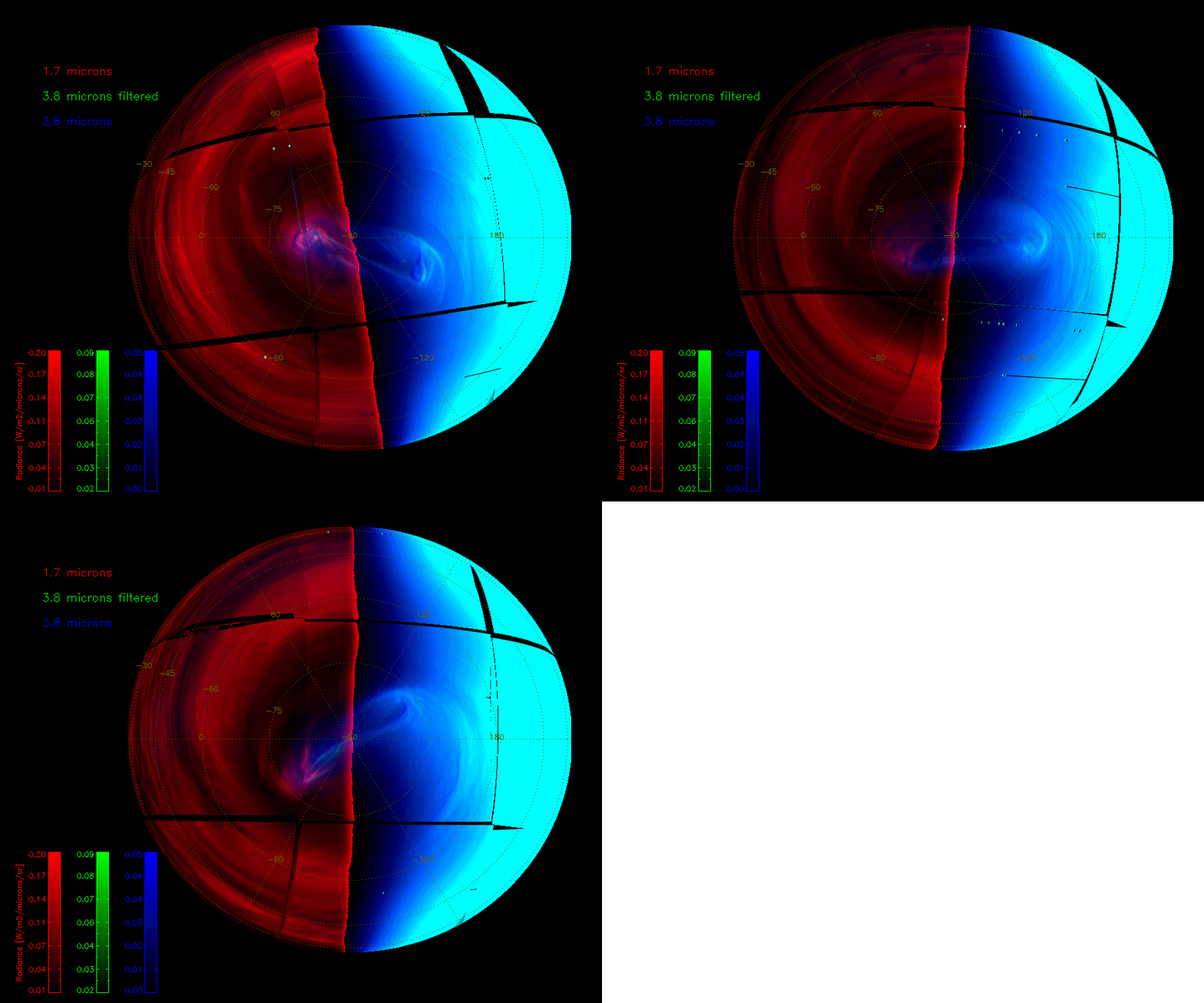
Venus Express scientists have been studying the structure in the thermal infrared, the wavelength range which reveals the temperature at the cloud-tops. Seen in this wavelength, the core of the vortex appears very bright, probably indicating that a lot of atmospheric gases are moving downward in the region, which creates a depression at the cloud-tops, making the region hotter.
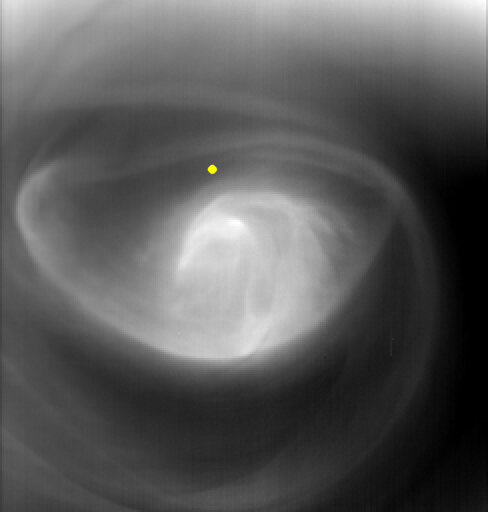
“Simply put, the enormous vortex is similar to what you might see in your bathtub once you have pulled out the plug” says Giuseppe Piccioni, co-Principal Investigator for the Visible and Infrared Thermal Imaging Spectrometer (VIRTIS) on Venus Express, at IASF-INAF, Rome, Italy.
The fickle puzzle

In June 2006, the vortex appeared hourglass-shaped, closely matching observations in the north polar region by Pioneer Venus. Now we know that it changes its shape within a matter of days, from orbit to orbit. The image taken on 26 February 2007 shows the 'classic' dipole shape at the centre of the vortex, similar to that which has been observed previously. But an image taken a mere 24 hours earlier shows the centre of the vortex to be almost circular, indicating that the shape of this feature can change very fast. At other times, it is typically oval.
The dynamic nature of the vortex can be seen clearly in the video. It shows that the vortex is very complex, with atmospheric gases flowing in different directions at different altitudes.
What creates the puzzle?

Scientists are not sure what actually creates the vortex. Colin Wilson, at the University of Oxford, says, “One explanation is that atmospheric gases heated by the Sun at the equator, rise and then move poleward. In the polar regions, they converge and sink again. As the gases move towards the poles, they are deflected sideways because of the planet’s rotation.”
The dynamic nature of this vortex is similar to behaviour observed in other vortices on Earth, including those observed at the centre of hurricanes.
Investigators will keep a close watch on the polar region and its variability, in order to gain a better understanding of how it works.
Notes for editors:

The discovery was reported in ‘South-polar features on Venus similar to those near the north pole’ by G. Piccioni et al. published in Nature on 29 November 2007.
For more information:
Giuseppe Piccioni, VIRTIS co-Principal Investigator, IASF-INAF, Rome, Italy
Email: Giuseppe.Piccioni @ iasf-roma.inaf.it
Pierre Drossart, VIRTIS co-Principal Investigator, Observatoire de Paris, France
Email: Pierre.Drossart @ obspm.fr
Håkan Svedhem, ESA Venus Express Project Scientist
Email: Hakan.Svedhem @ esa.int