Herschel révèle la face cachée de la naissance des étoiles
Herschel, observatoire dans l’infrarouge de l’ESA, nous dévoile des détails jusqu’alors inaccessibles sur la formation des étoiles. Les nouvelles images transmises par le télescope montrent que des milliers de galaxies lointaines sont le siège d’une intense activité de production d’étoiles, tandis que notre Voie lactée apparaît drapée dans de magnifiques voiles peuplés d’embryons stellaires. L’une des étoiles apparaissant sur ces images suscite tout particulièrement la curiosité des scientifiques.
Présentés aujourd’hui au cours d’un important symposium scientifique organisé à l’Agence spatiale européenne (ESA), ces résultats remettent en question les théories habituelles sur la formation des étoiles et ouvrent de nouvelles pistes pour la recherche scientifique.
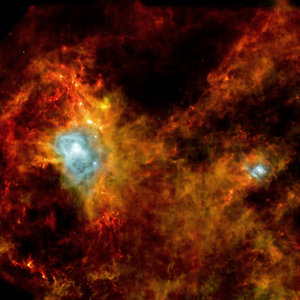
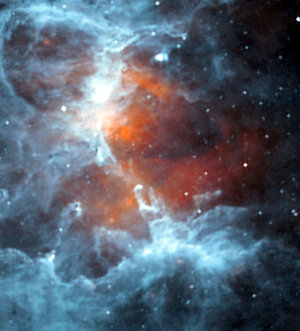
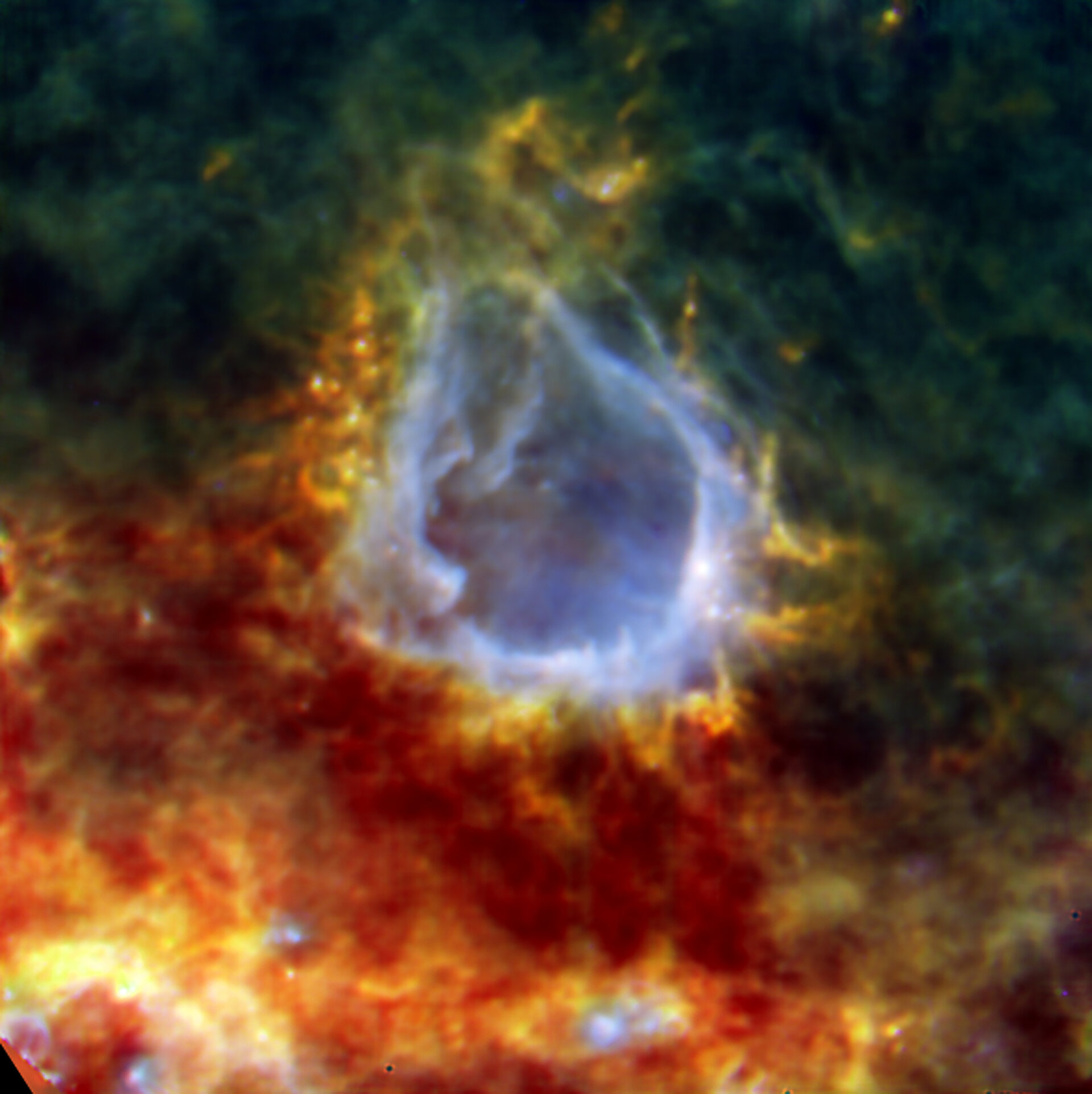
En observant la région de formation stellaire RCW 120, Herschel a mis en évidence une étoile embryonnaire qui pourrait devenir, d’ici quelques centaines de milliers d’années, l’une des plus massives et des plus brillantes de notre Galaxie. En effet, elle atteint déjà huit à dix fois la masse du Soleil et a encore largement de quoi s’alimenter, puisque le nuage qui l’entoure contient une masse de gaz et de poussière équivalant à 2 000 fois celle du Soleil !
« Cette étoile ne peut que continuer à grossir », constate Annie Zavagno, du Laboratoire d’Astrophysique de Marseille. Les étoiles massives sont rares et éphémères. Observer l’une d’elle au moment où elle est en train de se former représente pour les astronomes une fabuleuse occasion pour tenter de résoudre un paradoxe sur lequel ils s’interrogent de longue date. « D’après les connaissances actuelles, la formation d’étoiles d’une masse supérieure à huit fois celle du Soleil ne devrait pas être possible », indique Annie Zavagno.
En effet, la lumière émise par ces étoiles géantes est d’une telle intensité qu’elle devrait théoriquement pulvériser le cocon qui les entoure, les empêchant de continuer à accumuler de la matière. Pourtant, de telles étoiles parviennent à se former et nombre d’entre elles ont déjà été répertoriées, avec des masses pouvant atteindre jusqu’à 150 fois celle du Soleil. Maintenant que Herschel est parvenu à observer l’une de ces étoiles au tout début de son évolution, les astronomes vont pouvoir l’étudier pour tenter de comprendre comment ces astres défient leurs théories.
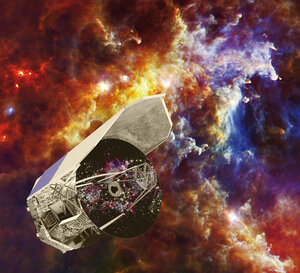
Herschel est le plus grand télescope astronomique qui ait jamais été lancé. Le diamètre de son miroir principal, quatre fois supérieur à celui des télescopes spatiaux infrarouge qui l’ont précédé, représente une fois et demie celui de Hubble. Au cours de la gestation des étoiles se produit un échauffement des poussières et du gaz environnants, qui atteignent une température de quelques dizaines de degrés au-dessus du zéro absolu et commencent alors à émettre dans le domaine de l’infrarouge lointain. L’atmosphère terrestre bloque la majeure partie de ce rayonnement, qui ne peut donc être observé que depuis l’espace.

Grâce à ses instruments d’une résolution et d’une sensibilité sans précédent, Herschel est en train de recenser toutes les régions de formation stellaire de notre Galaxie. « Avant Herschel, nous ne savions pas très bien comment la matière présente dans la Voie lactée parvenait à atteindre des densités suffisamment élevées et des températures suffisamment basses pour donner naissance à des étoiles », explique Sergio Molinari, de l’Institut de physique de l’espace interplanétaire à Rome.
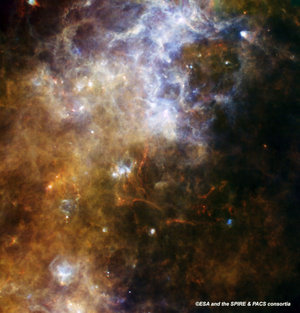
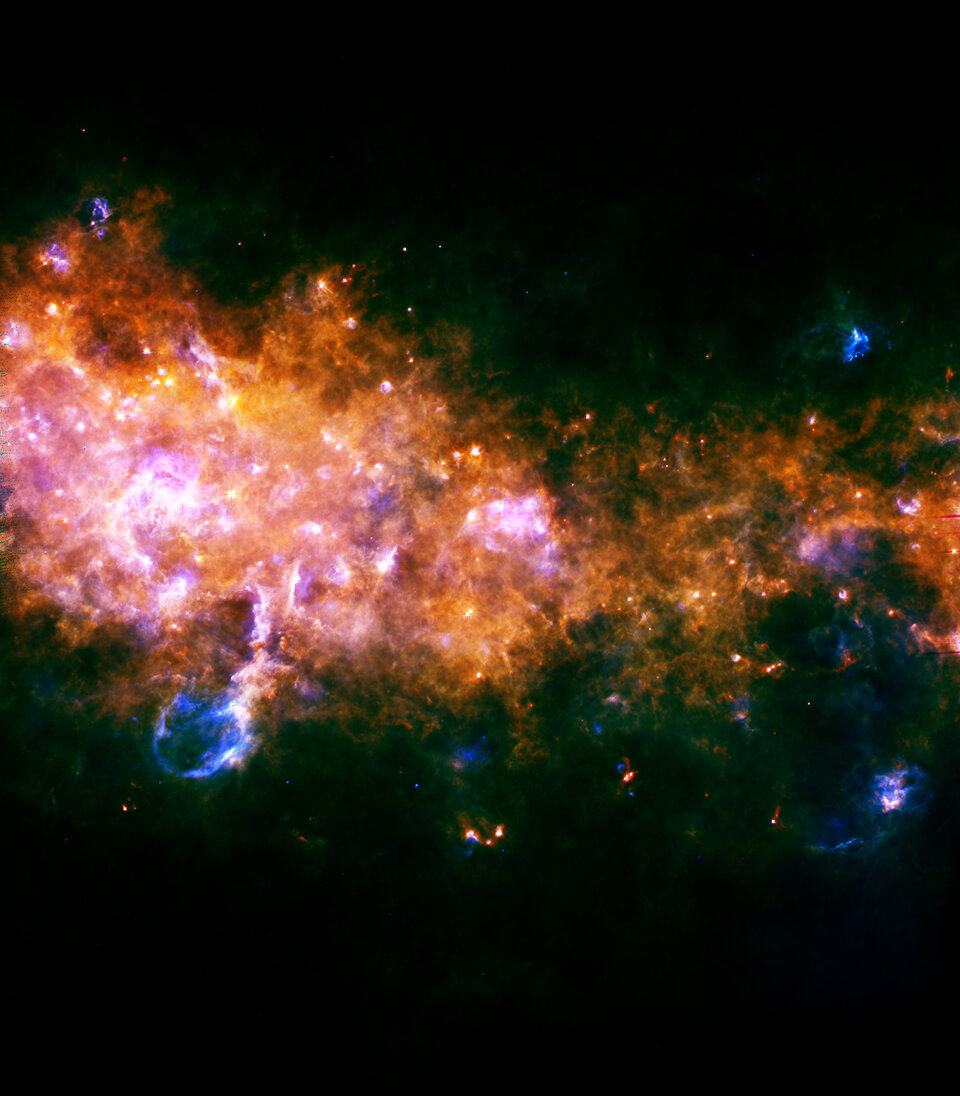
Une nouvelle image de Herschel diffusée aujourd’hui, sur laquelle apparaissent plusieurs pouponnières d’étoiles de la Voie lactée, permet de mieux comprendre comment les choses se déroulent. Les embryons stellaires apparaissent d’abord au sein de filaments de poussière et de gaz incandescents qui s’étirent à travers la Galaxie. Ceux-ci forment des chaînes de pouponnières d’étoiles qui s’étendent sur des distances de plusieurs dizaines d’années-lumière, enveloppant la Galaxie d’un réseau d’étoiles en gestation.
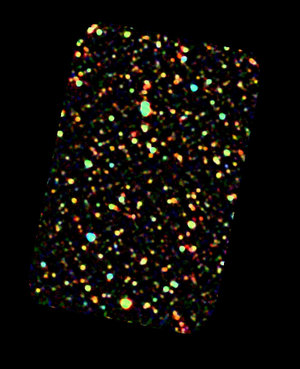
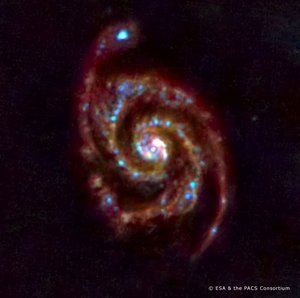
Herschel étudie aussi l’espace lointain au-delà de notre Galaxie et mesure le rayonnement infrarouge émis par des milliers d’autres galaxies éparpillées dans l’Univers à des milliards d’années-lumière. Ces galaxies apparaissent comme de simples points brillants, mais leur luminosité est telle que les astronomes peuvent en déduire le taux de formation stellaire en leur sein. En simplifiant, on peut dire que plus une galaxie est brillante, plus elle produit d’étoiles.
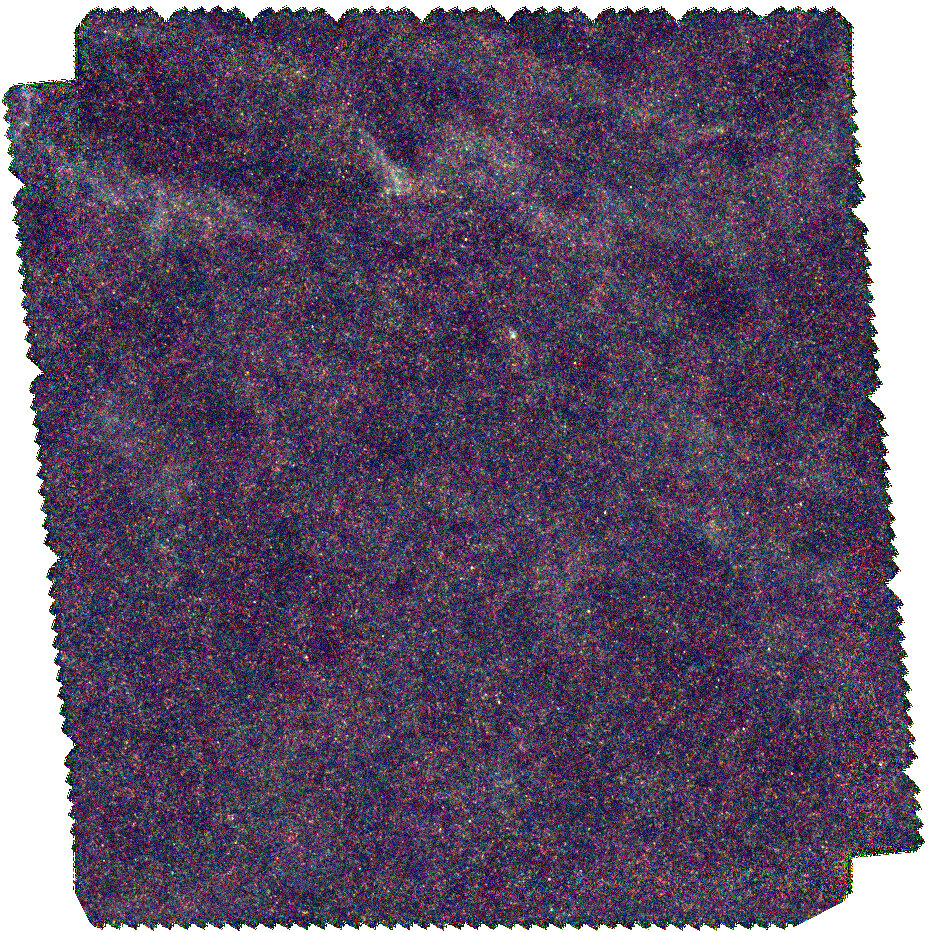
Dans ce domaine aussi, Herschel bouscule les schémas habituels en montrant qu’à l’échelle du temps cosmique, les galaxies évoluent beaucoup plus rapidement qu’on ne le pensait. Les astronomes étaient convaincus que le taux de formation stellaire des galaxies était à peu près identique depuis environ trois milliards d’années. Or Herschel dément cette théorie.
Dans le passé, les galaxies dites « à flambée d’étoiles », dans lesquelles le taux de formation stellaire est de dix à quinze fois plus élevé que celui observé actuellement dans la Voie lactée, étaient nettement plus nombreuses qu’aujourd’hui. On ignore cependant ce qui a déclenché cette activité frénétique. « Herschel va nous permettre d’étudier les causes de ce comportement », se réjouit Steve Eales, de l’Université de Cardiff, au Royaume-Uni.
Herschel est également un excellent instrument de détection des molécules, qui sont les plus petites particules de matière. Il a été le premier à identifier dans l’espace une nouvelle
« Cette découverte de vapeur d’eau ionisée a été une véritable surprise », reconnaît Arnold Benz, de l’Ecole polytechnique fédérale de Zurich (Suisse). « Elle montre que des réactions violentes se produisent durant les premiers stades de la formation des étoiles et propagent des rayonnements énergétiques à travers tout le nuage ».
Ces découvertes, dont le domaine s’étend des plus petites particules aux gigantesques galaxies, sont présentées cette semaine à la communauté scientifique, ainsi que d’autres résultats inédits, dans le cadre du Symposium ESLAB 2010, entièrement consacré à Herschel. Cette manifestation se déroule au Centre européen de Recherche et de Technologie spatiales (ESTEC) de l’ESA situé à Noordwijk (Pays-Bas).
« La mission Herschel ne fait que commencer et ces résultats nous donnent un avant-goût des importantes retombées scientifiques attendues au cours des années à venir », s’enthousiasme Göran Pilbratt, responsable scientifique du projet Herschel à l’ESA.
Notes aux rédactions :
Les observations de la région RCW 120 sont menées dans le cadre du programme HOBYS (Herschel imaging survey of OB Young Stellar objects), dirigé par Frédérique Motte, SAp/CEA, Saclay (France).
La « quatrième phase de l’eau » a été découverte dans le cadre du programme WISH (Water In Star-forming regions with Herschel), dirigé par Ewine van Dishoeck, Observatoire de Leyde (Pays-Bas).
L’étude des régions de formation d’étoiles dans la Voie lactée, dénommée hi-GAL (Herschel Infrared Galactic Plane survey), est conduite par Sergio Molinari, Institut de physique de l’espace interplanétaire, Rome (Italie).
Le projet de cartographie des galaxies ATLAS (Astrophysical Terahertz Large Area Survey) est piloté par Steve Eales, Université de Cardiff (Royaume-Uni) et Loretta Dunne, Université de Nottingham (Royaume-Uni).
Herschel est un observatoire spatial de l’ESA dont les instruments scientifiques ont été réalisés par des consortiums dirigés par des chercheurs européens, avec une importante participation de la NASA.
Contacts :
Annie Zavagno
Laboratoire d’Astrophysique de Marseille
Tél. : +33 4 95 04 41 55
Courriel : annie.zavagno @ oamp.fr
Sergio Molinari
Institut de physique de l’espace interplanétaire, Rome
Tél. : +39 06 49934396
Courriel : molinari @ ifsi-roma.inaf.it
Steve Eales
Université de Cardiff (Royaume-Uni)
Tél. : +44 7766 024 052
Courriel : Steve.Eales @ astro.cf.ac.uk
Arnold Benz
Ecole polytechnique fédérale de Zurich (Suisse)
Tél. : +41 44 632 42 23
Courriel : benz @ astro.phys.ethz.ch
Göran Pilbratt
ESA - Responsable scientifique du projet Herschel
Tél. : +31 71 565 3621
Courriel : gpilbratt @ rssd.esa.int