Rosetta darting across the night
During the night of 12/13 November, scientists working at ESA's Optical Ground Station in Tenerife, Spain, conducted observations to view Rosetta as the satellite approached Earth.
The animation above comprises images recorded 13 November, 03:05 to 03:25. It comprises 18 images with an exposure time of 15 s and a separation of 69 s. The field is located in the constellation of Cetus and has a size of 10 x 10 arcmin. The telescope was tracking Rosetta so that the spacecraft appears as a dot in the centre of the image while the stars appear as stripes.
Last view before closest approach
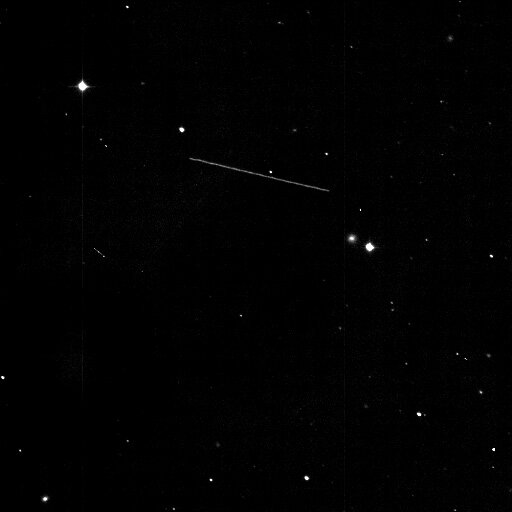
This image was captured at 03:59 CET, 13 November, with an exposure time of 2 minutes. The field is located in the constellation Cetus and spans 10 x 10 arcmin. The telescope was tracking the stars so that Rosetta appears as a stripe in the centre of the image while the stars appear as dots. Rosetta moves 3 arcminutes during the 2-minute exposure. Compare the movement with the image above, taken at 22:58 CET. The brightest star in the top left corner of the image has a magnitude of 12.
This is the last image taken before Rosetta's closest approach to Earth, immediately afterwards its elevation fell below 18 deg which is the limit of the telescope.
Rosetta: tiny dot in the centre
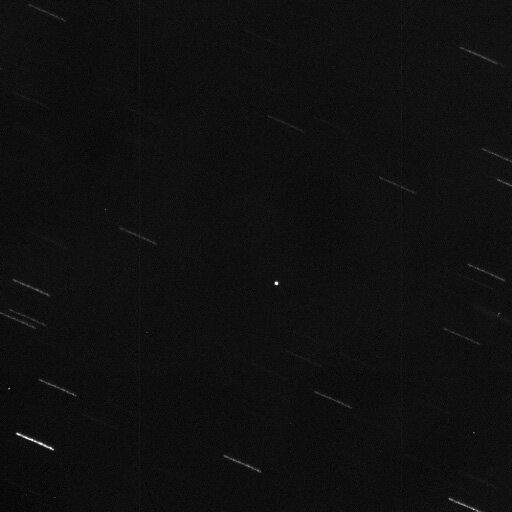
This still image was taken at 22:58 CET on 12 November. The total exposure time was 2 minutes. The field is located in the constellation of Cetus and has a size of 10 x 10 arcmin. Rosetta appears as a dot in the centre of the image while the stars appear as stripes. The stars move for almost 1 arcminute during the exposure. The brightest star in the bottom left corner of the images has a magnitude of 15.
Animation from 11/12 November

This excellent animation was created by stitching together a series of images captured 11/12 November.
The animation covers about 30 minutes and consists of images taken every 3 minutes, with an exposure time of 2 minutes. Rosetta moves roughly from East to West (North is up). The background stars are tracked, therefore Rosetta is seen as a short 'streak' line.
Additional observations 13/14 November
ESA scientists will be observing tonight as well, to see if they can detect detect Rosetta as it recedes. But the spacecraft will be much weaker in the sky than during the approach because an observer on ground will be looking at the unilluminated side of the solar arrays. Rosetta will have risen high enough for the telescope to point toward it at 04:30 CET. Its elevation will then increase; dawn starts shortly after 07:00 CET.