


Cassini-Huygens overview
Mission

Status
Completed (2017)
Objective
Conduct in-depth studies of Saturn, its moons, rings and magnetic environment, and land on the planet’s largest moon Titan.
Mission
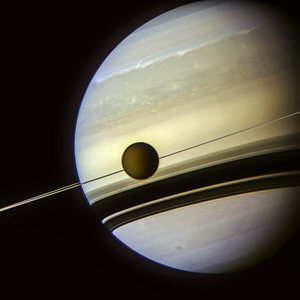
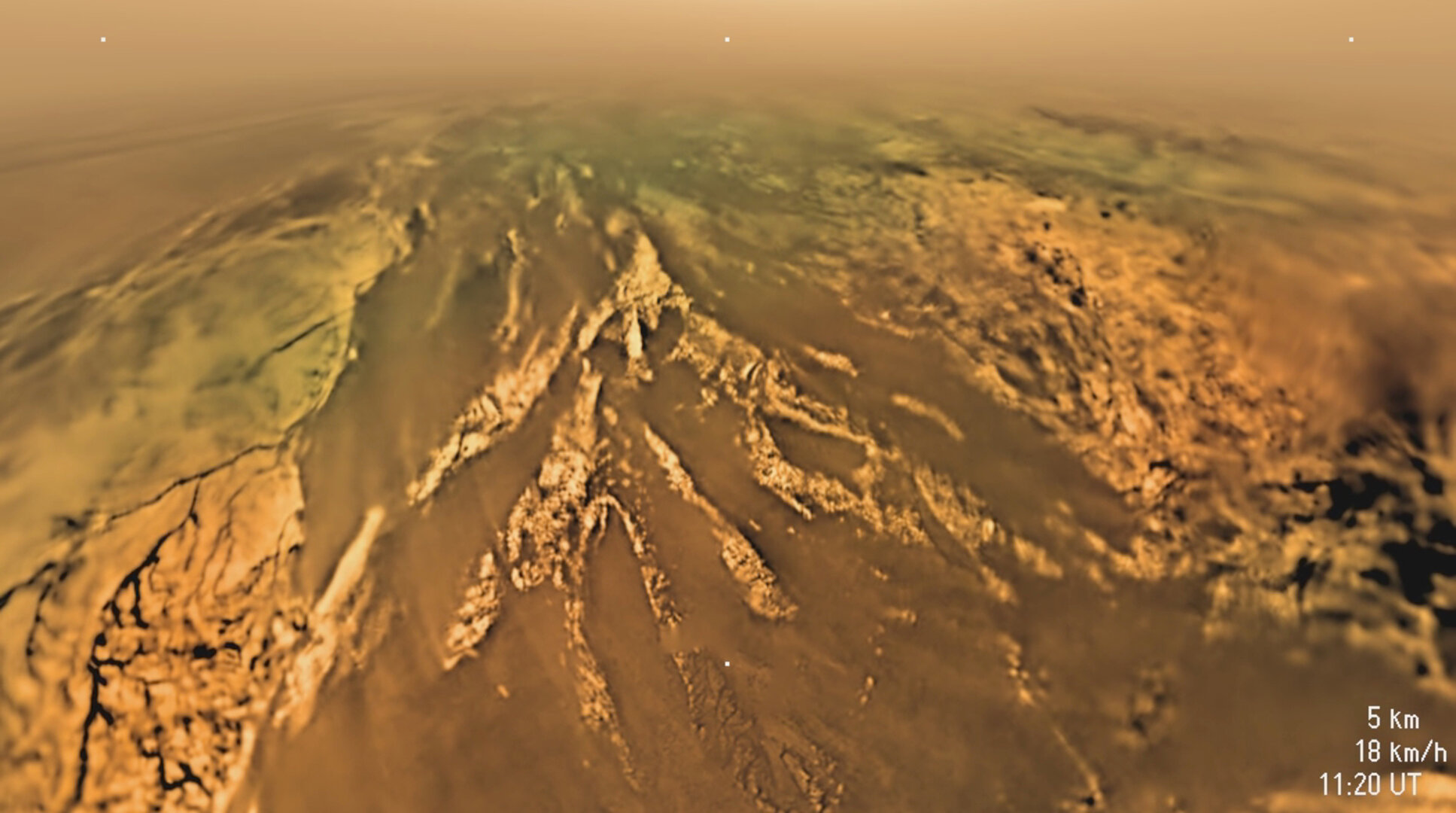
Since July 2004, the Cassini orbiter produced a string of remarkable discoveries about Saturn's magnificent rings, its amazing moons and its dynamic magnetosphere. In January 2005 the Huygens probe descended through Titan’s thick atmosphere and returned the first images of the enigmatic moon’s surface.
What's special?
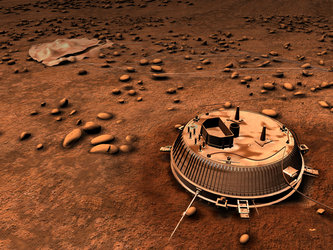
The ESA Huygens probe was the first to land on a world in the outer Solar System, revealing that Titan is an Earth-like world where methane plays the role of water. Its thick nitrogen atmosphere is very rich in organic compounds that are constantly reacting. If found on a planet with Earth-like conditions, the presence of these compounds would be a possible sign of the existence of life.
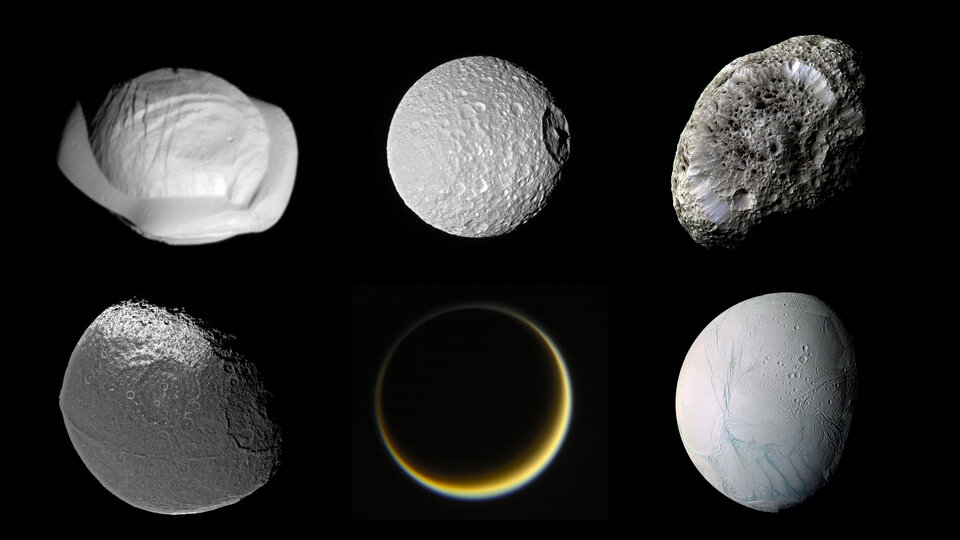
Elsewhere in the Saturnian system Cassini detected a salty ocean spray jetting from the geysers on icy moon Enceladus, and revealed unprecedented detail of the structures and ripples in the Saturn’s extensive ring system including never-before-seen interactions with the planet’s small moons. Cassini also monitored seasonal variations in the atmospheres of Saturn and Titan.
In August 2009 Cassini observed the unique ring geometry of the Saturn equinox when sunlight passed directly through the plane of the rings, and continued to explore the Saturnian system until September 2017.
Spacecraft
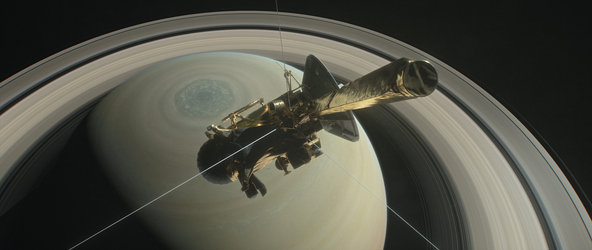
The Cassini-Huygens spacecraft was one of the largest, heaviest and most complex interplanetary spacecraft ever built, weighing in at 5.6 tonnes and measuring 6.7 m high and more than 4 m wide. Cassini’s 12 scientific instruments included imaging cameras, radar, spectrometers and magnetometers: the Imaging Science Subsystem (ISS), Cassini radar (RADAR), Radio Science Subsystem (RSS), Ion and Neutral Mass Spectrometer (INMS), Visible and Infrared Mapping Spectrometer (VIMS), Composite Infrared Spectrometer (CIRS), Cosmic Dust Analyser (CDA), Radio and Plasma Wave Spectrometer (RPWS), Cassini Plasma Spectrometer (CAPS), Ultraviolet Imaging Spectrograph (UVIS), Magnetospheric Imaging Instrument (MIMI) and Dual-technique Magnetometer (MAG).
The Huygens probe comprised six instrument packages: the Huygens Atmosphere Structure Instrument (HASI), Gas Chromatograph and Mass Spectrometer (GCMS), Aerosol Collector and Pyrolyser (ACP), Descent Imager/Spectral Radiometer (DISR), Doppler Wind Experiment (DWE) and the Surface Science Package (SSP).
Journey
Cassini-Huygens launched in 15 October 1997 on a Titan-IVB/Centaur from Cape Canaveral. The spacecraft made four gravity-assist swing-by manoeuvres; twice at Venus (April 1998 and June 1999), once at Earth (August 1999), and once at Jupiter (December 2000).
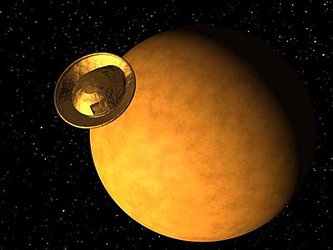
The spacecraft arrived at Saturn in July 2004 and in December 2004 the Huygens probe was ejected on a 22-day cruise to Titan. Huygens reached the surface of Titan on 14 January 2005. Cassini conducted science from orbit around Saturn until plunging into the giant planet's atmosphere on 15 September 2017.
Key dates:
- 11 June 2004 (19:32 UT) - Fly-by of the furthest moon orbiting Saturn, Phoebe, at an altitude of 2000 km
- 1 July 2004 - Crossing of Saturn's ring plane during the spacecraft's critical Saturn Orbit Insertion (SOI) sequence
- 25 December 2004 (02:00 UT) - Huygens probe separates from the Cassini orbiter and begins its 22-day journey to Titan
- 14 January 2005 (09:00 UT) - Huygens encountered the upper fringes of Titan's atmosphere, beginning its descent and landing on the surface about two and half hours later.
History
Cassini-Huygens is named after two famous scientists. Christiaan Huygens (1629-1695) was a Dutch scientist who discovered Saturn's rings and, in 1655, its largest moon, Titan. Italian Jean-Dominique Cassini (1625-1712) discovered the Saturnian satellites Iapetus, Rhea, Tethys and Dione. In 1675 he discovered what is known today as the 'Cassini Division', the narrow gap separating Saturn's rings.
The Cassini-Huygens mission was initially planned for a four-year period (mid-2004 to mid-2008). In April 2008, the mission was extended for another two years, until September 2010, and was named the Cassini Equinox Mission. A second extended mission, called the 'Cassini Solstice Mission' continued until September 2017.
Partnerships
Cassini-Huygens is a joint endeavour of ESA, NASA and the Italian space agency, Agenzia Spaziale Italiana (ASI).
The Jet Propulsion Laboratory (JPL), a division of the California Institute of Technology in Pasadena, manages the Cassini-Huygens mission for NASA's Science Mission Directorate, Washington DC, USA. JPL designed and assembled the Cassini orbiter. Development of the Huygens Titan lander was managed by ESA’s European Space Technology and Research Centre (ESTEC), the Netherlands. The prime contractor for the lander was Thales Alenia Space in France. The Italian Space Agency (ASI) managed the design and construction of the high-gain antenna and the other instruments of its participation. Equipment and instruments for the mission were supplied from many European countries and the USA.