ESA's cosmic explorers in flight: stunning images from ground and space
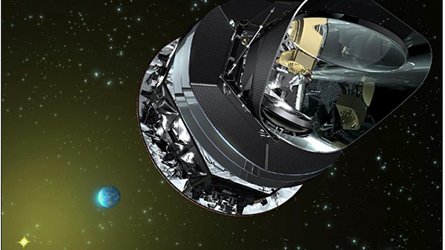
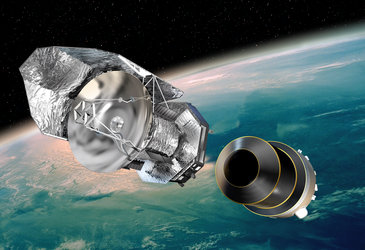
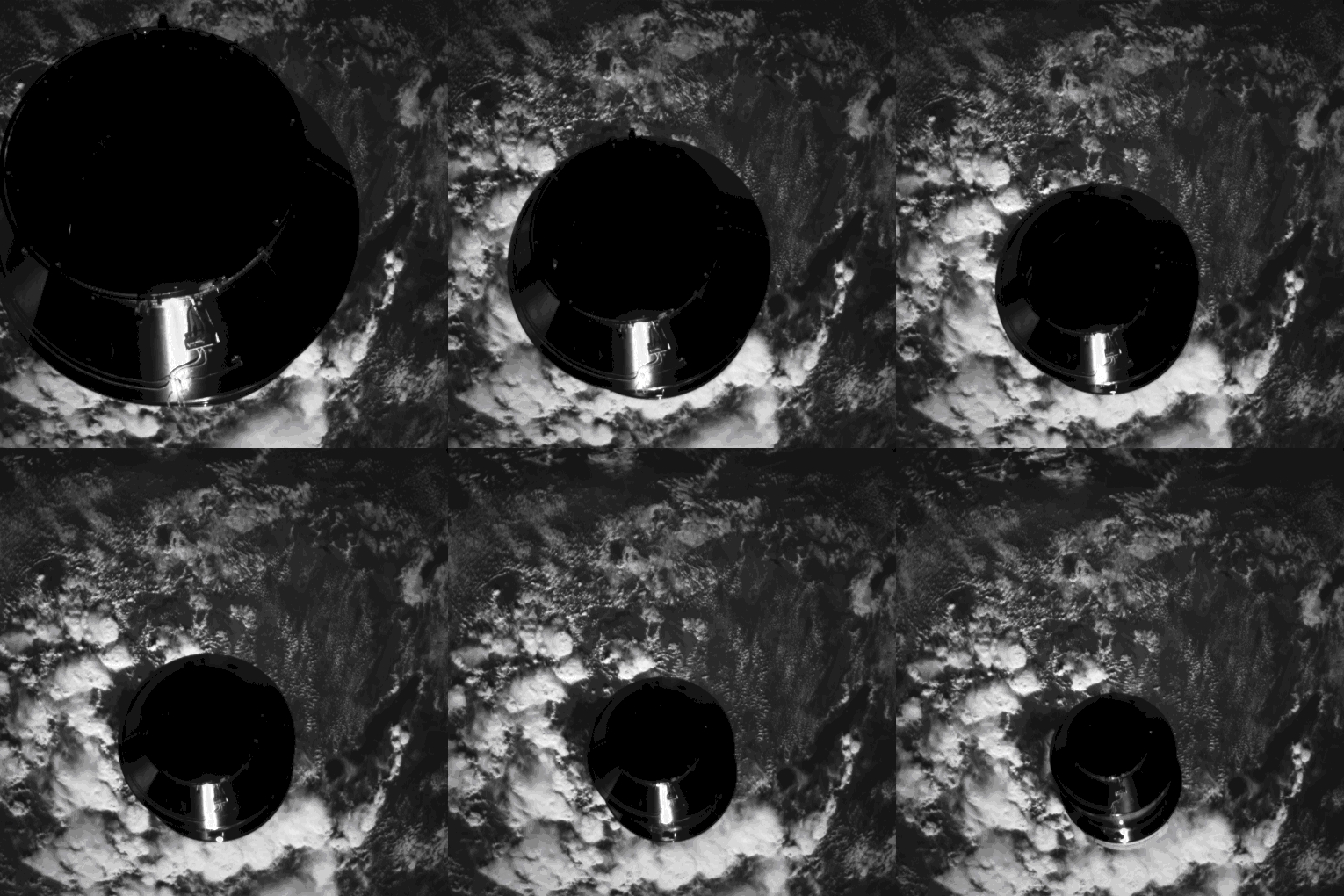
Stunning images taken from Earth and space show Herschel and Planck in flight on 14 May 2009. The first, taken from Herschel, show the Planck-Sylda composite just after Herschel's separation, about 1150 km above Africa.
A second set taken from ESA's Optical Ground Station, shows Herschel, Planck, Sylda and the launcher’s upper stage long after separation, travelling together at an altitude of about
This breath-taking animation comprises the first series of images taken by Herschel’s Visual Monitoring Camera (VMC) shortly after Herschel's separation at 15:38 CEST on 14 May.
The sequence clearly shows the Planck-Sylda composite receding behind Herschel, high above the surface of our planet; clouds, ocean and coastlines can be seen far below. The Sylda is a support structure that encapsulated Planck and supported Herschel during launch.
High above Africa
During this sequence, Herschel and the Planck-Sylda composite were travelling at an altitude of 1150 km above the East coast of Africa at a speed of almost 10 km/s. Planck separated from Sylda a few minutes later, at 15:40 CEST.
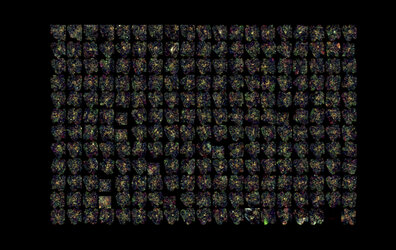
The second animation is composed of images taken by the telescope at ESA’s Optical Ground Station Station at Tenerife, Spain.
Satellites imaged by ESA's Optical Ground Station in Tenerife

The images were taken a few hours after separation starting at about 23:30 CEST. Four bright objects are clearly visible, three of them - Herschel, Planck and the Sylda - form a clear triplet moving in coordination in the centre. The fourth object is presumed to be the upper stage of the Ariane 5. They were travelling at an altitude of about
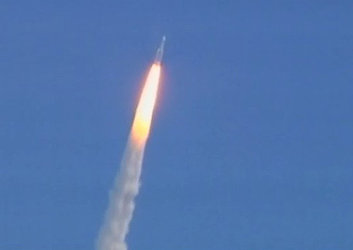
Both of these sophisticated satellites were lofted into space on an Ariane 5 from Europe's Spaceport in Kourou, French Guiana, at 15:12 CEST, Thursday, 14 May 2009.
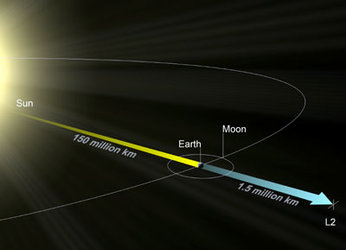
Almost 26 minutes later, about two minutes from each other, they set out on independent trajectories leading to their final orbit around the second Lagrange point of the Sun-Earth system, a virtual point in space, 1.5 million km from Earth in the direction opposite to the Sun. The Sylda will also travel to L2 on a separate trajectory.
Since the acquisition of the first radio signals from the two satellites at 15:49 CEST 14 May, they have been under control of ESA's European Space Operations Centre (ESOC), Darmstadt, Germany. Both satellites are operating in nominal condition on their way towards their final orbit around L2.