Cassini finds atmosphere on Enceladus
The two close fly-bys of Saturn's moon Enceladus by the NASA/ESA/ASI Cassini spacecraft have revealed that it has a significant atmosphere.
Scientists, using Cassini's MAG magnetometer instrument for their studies, say the source may be volcanism, geysers or gases escaping from the surface or the interior.
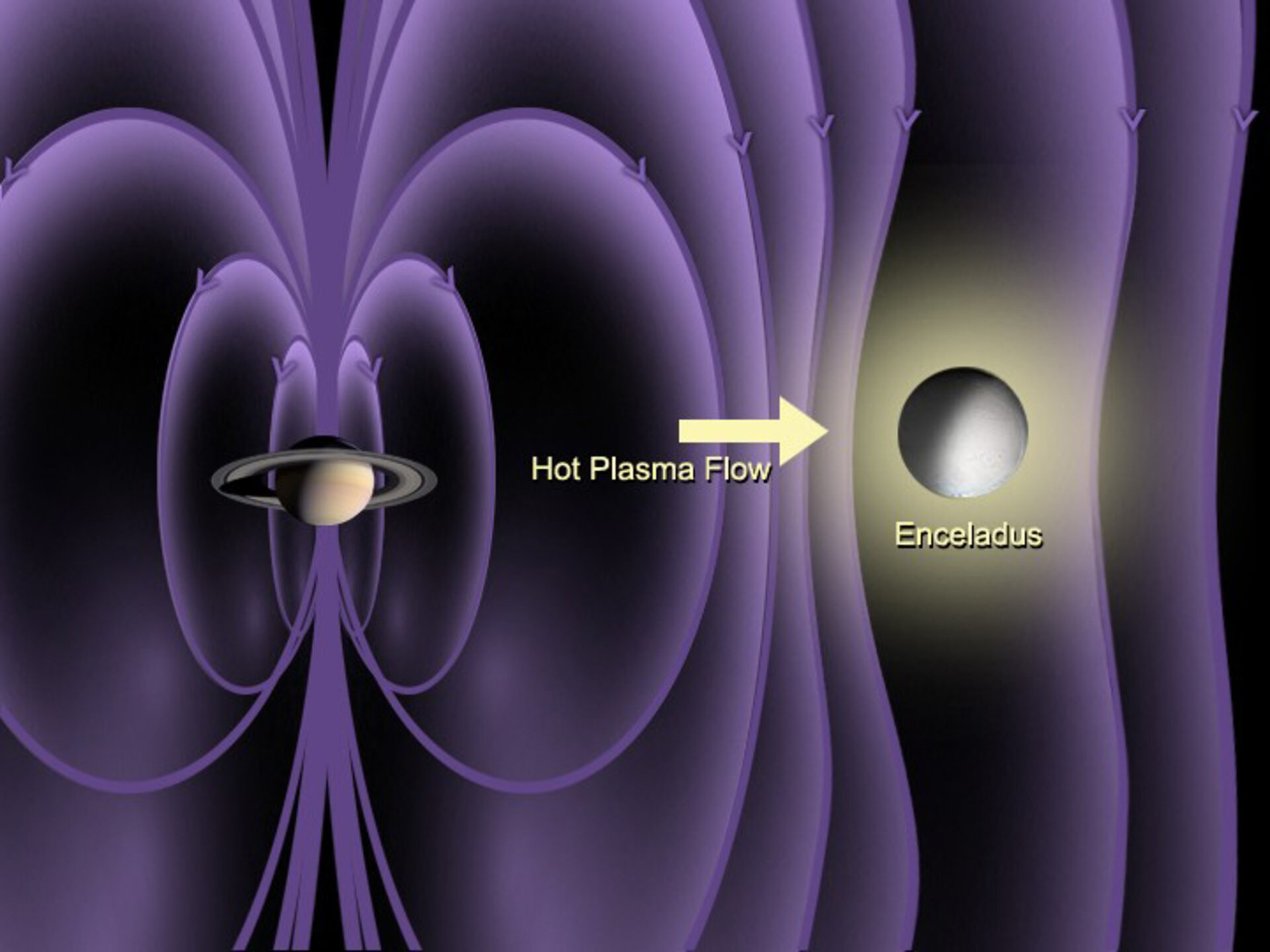
When Cassini had its first encounter with Enceladus on 17 February at an altitude of 1167 kilometres, the magnetometer saw a striking signature in the magnetic field. On 9 March, Cassini approached to within 500 kilometres of the surface of Enceladus and obtained additional evidence.
The observations showed a bending of the magnetic field, with the magnetospheric plasma being slowed and deflected by the moon. In addition, magnetic field oscillations were observed. These are caused when ionised (electrically charged) molecules interact with the magnetic field by spiraling around the field line. This interaction creates characteristic oscillations in the magnetic field at frequencies that can be used to identify the molecule. The observations from the Enceladus fly-bys are believed to be due to ionised water vapour.
"These new results from Cassini may be the first evidence of gases originating either from the surface or possibly from the interior of Enceladus," said Professor Michele Dougherty, Principal Investigator for MAG, from Imperial College, University of London.
In 1981, NASA's Voyager spacecraft flew by Enceladus at a distance of 90 000 kilometres without detecting an atmosphere. Its possible detection was beyond Voyager's capabilities, or something may have changed since that fly-by.
This is the first time since Cassini arrived in orbit around Saturn last summer that an atmosphere has been detected around a moon of Saturn other than its largest moon, Titan. Enceladus is a relatively small moon. The amount of gravity it exerts is not enough to hold an atmosphere very long. Therefore, a strong continuous source is required to maintain this atmosphere on Enceladus.
The need for such a strong source leads scientists to consider eruptions, such as volcanoes and geysers. If such eruptions are present, Enceladus would join two other such active moons, Io at Jupiter and Triton at Neptune.
"Enceladus could be Saturn's more benign counterpart to Jupiter's dramatic Io," said Professor Fritz Neubauer, Co-Investigator for MAG, University of Cologne, Germany.
Since the Voyager fly-by, scientists have suspected that this moon is geologically active and is the source of Saturn's icy E ring. Enceladus is the most reflective object in the Solar System, reflecting about 90 percent of the sunlight that hits it. If Enceladus does have ice volcanoes, the high reflectivity of the moon's surface might result from continuous deposition of icy particles originating from the volcanoes.
Enceladus measures about 500 kilometres in diameter. Yet despite its small size, Enceladus exhibits one of the most interesting surfaces of all the icy satellites.