Listen to Phoenix descend
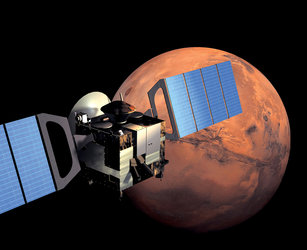
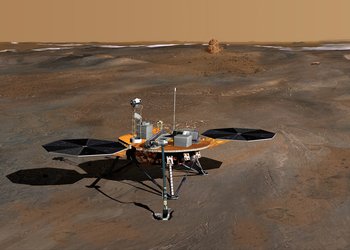
With data recorded on board Mars Express, you can hear Phoenix descend on to the surface of the Red Planet. After being processed by the Mars Express Flight Control Team, the sounds of Phoenix descending are audible, loud and clear.

The data from the Mars Express Lander Communication system (MELACOM) that tracked Phoenix was received on Earth soon after the Phoenix landing.
As Mars Express flew over
This animation shows the signal of Phoenix’s descent, recorded by MELACOM.
The spike in the animation, between frequencies of 7 and 8 kiloHertz, shows the transmission from Phoenix itself.
The lander can be seen in the animation starting from about 342 s after the start time and disappears at about 1085 s. This shows Mars Express picking up on the Phoenix signal and tracking it while closing in on the lander; the closest Mars Express got to Phoenix was 1550 km.
As Mars Express flew away, the lander deployed its parachute, separated from it and landed, the signal from the lander was cut off.
The shift of the spike seen in the animation, is due to the so-called Doppler effect, which is very similar to what we hear when listening to the whistle of a passing train.
The signal was tracked successfully, even during the expected transmission blackout window of the descent, until the lander was out of Mars Express’s view. The transmission blackout window is caused because of ionisation around the probe, which builds up as the lander descends through the atmosphere and only very weak signals come through.
The rest of the recording, the start and the end, contains background noise generated by Mars Express itself.
Science observations
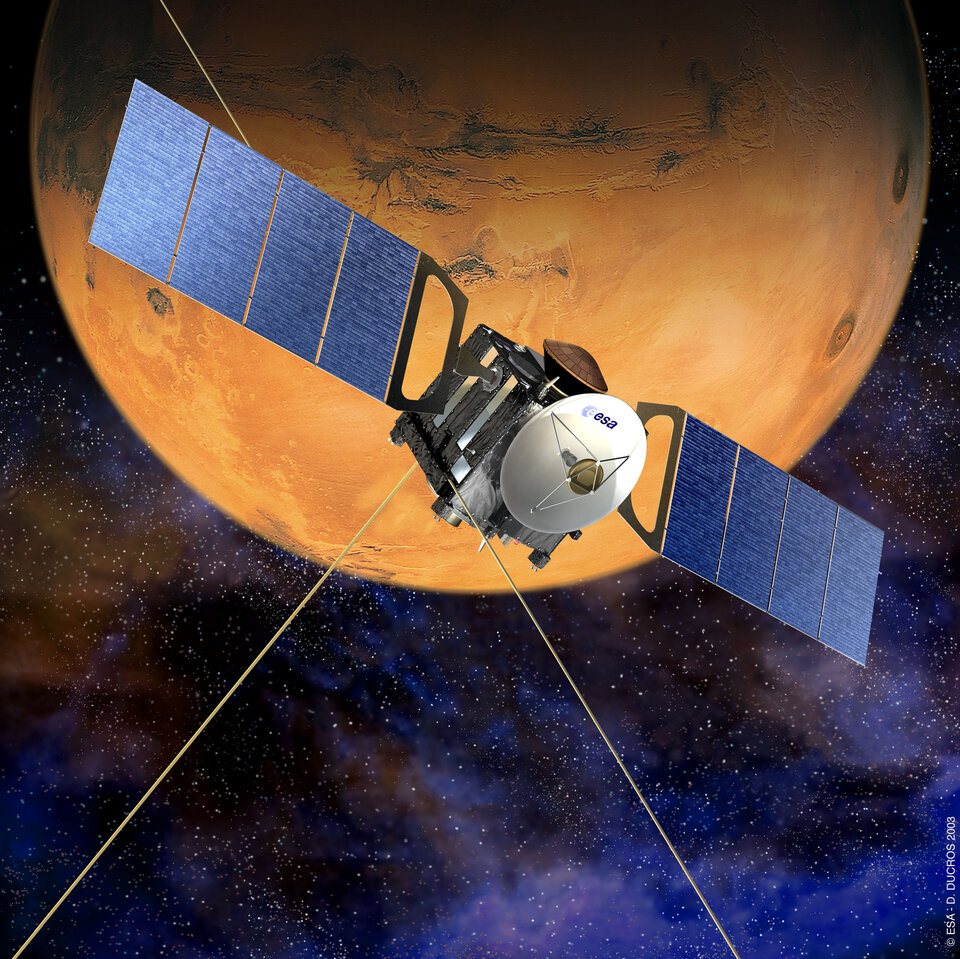
During the descent, all of the capabilities of Mars Express were focussed on tracking Phoenix with MELACOM. Unfortunately, the science observations carried out during the descent did not lead to the anticipated results.
Apart from these observations, the Planetary Fourier Spectrometer (PFS) on board Mars Express has been collecting relevant data since 8 May this year in anticipation of the Phoenix landing. This includes information on the physical conditions of the Martian atmosphere (temperature, pressure and density) above the expected the landing site. This data was provided to NASA in support of their observations of the physical conditions in the atmosphere prior to landing.
Over the next few days, Mars Express will monitor Phoenix using MELACOM 15 more times; at least one of these will be used to demonstrate and confirm that the ESA spacecraft can be used as a data relay station for NASA, receiving data from the surface and transmitting test commands to the lander.
Detailed information about the descent and landing will be available once the data from all the fly-overs is processed and analysed over the next few weeks.
Notes for editors:
The processing and interpretation of the data by the Mars Express Flight Control Team is the result of the joint work of the signal processing team of ESA’s Ground Stations Systems division and with the Flight Dynamics team at ESA's European Space Operations Centre.