Spectacular star birth pictures on Hubble’s 17th birthday
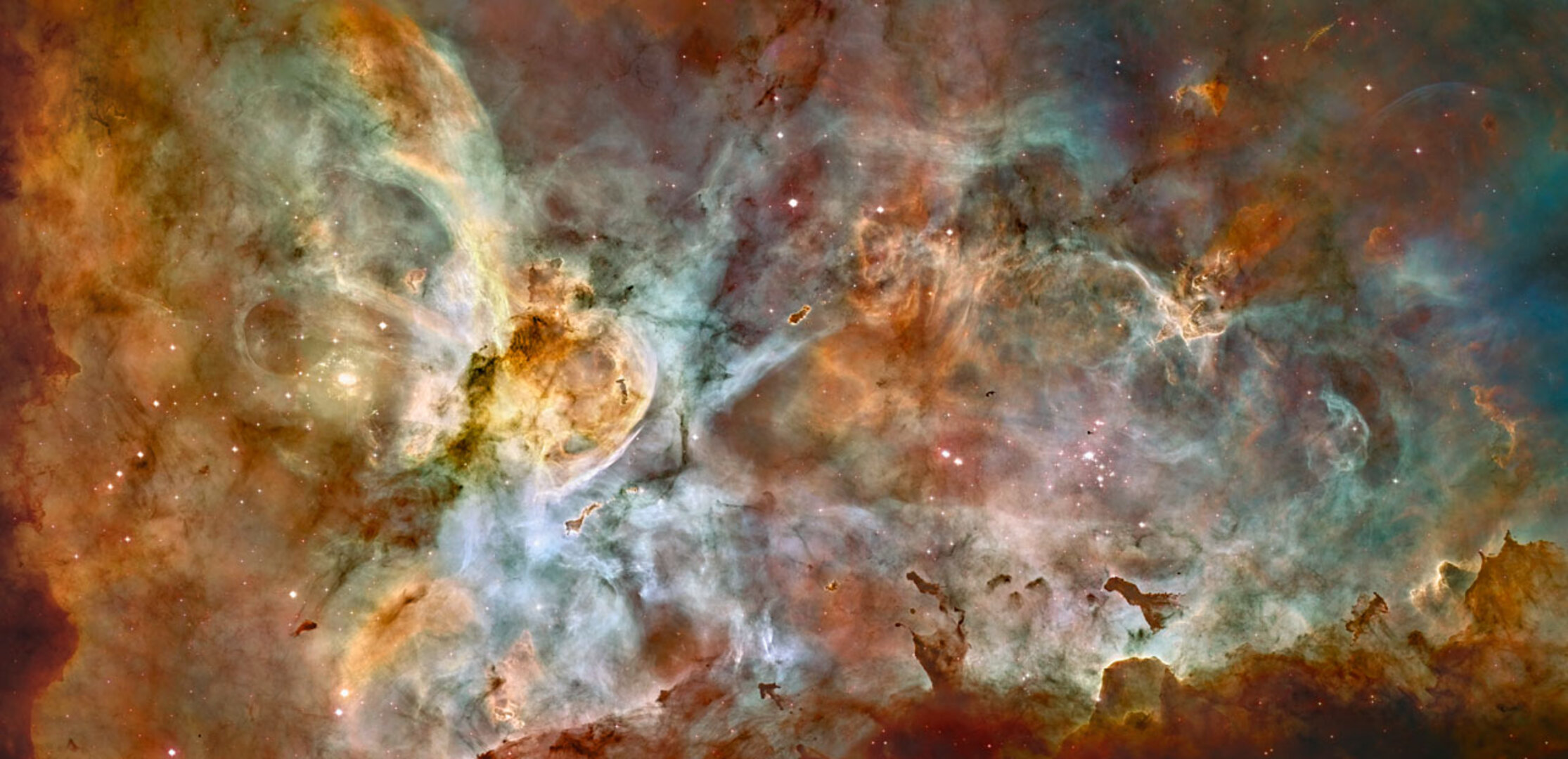
A 50 light-year-wide view of the Carina Nebula has been released to celebrate the 17th anniversary of the NASA/ESA Hubble Space Telescope.
Carina is an immense nebula situated at an estimated 7 500 light years away in the southern constellation Carina, at the keel of the ship Argo Navis. This panoramic image of the nebula gives us a peek into star formation as it commonly occurs along the dense spiral arms of a galaxy.

A mosaic of 48 images taken by Hubble’s Advanced Camera for Surveys, it is overlaid with information in colour obtained from the Cerro Tololo Inter-American Observatory in Chile. It shows the process of star birth at a new level of detail.
The landscape of the nebula is sculpted by the action of outflowing winds and ultraviolet radiation from the monster stars that inhabit it. These stars are now acting on the surrounding material leftover after their birth to produce a second generation of stars.
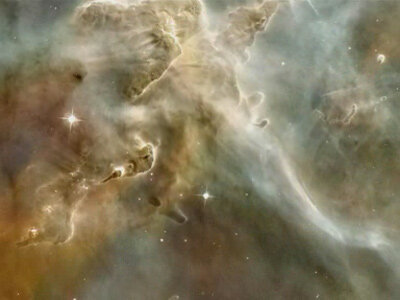
The nebula contains a dozen or more brilliant stars each estimated to be at least 50 to 100 times the mass of our Sun. Eta Carinae, the most luminous star, will sooner or later end its life through a gigantic supernova explosion. Signs for this are the two lobes of dust and gas surrounding the star that indicate the end of its relatively brief eruptive phase.
Approximately three million years ago, the nebula’s first generation of newborn stars condensed and ignited in the middle of a huge cloud of cold molecular hydrogen. The radiation from the stars carved out an expanding bubble of hot gas.

The black clouds seen in the picture are nodules of dust and gas across the nebula that have survived ‘photoionisation’ - a process in which electromagnetic radiation (photons) rips away electrons from neutral atoms and molecules.
The strong stellar winds and ultraviolet radiation within the cavity of hot gas are compressing the surrounding walls of cold hydrogen, triggering the birth of a new generation of stars.
Our Sun and Solar System may have been born inside such a cosmic crucible 4.6 thousand million years ago.
Notes for editors:
The Hubble Space Telescope is a project of international cooperation between NASA and ESA.
During its 17-year lifetime, the telescope has carried out nearly
To date, the orbiting observatory has produced more than 30 terabytes of data. Approximately 10 gigabytes of data is produced daily, enough information to fill the hard drive of a typical home computer in two weeks.
The Hubble archive sends about 66 gigabytes of data each day to astronomers throughout the world. This data has contributed to nearly 7 000 scientific papers, making it one of the most productive scientific instruments ever built.
For more information:
Nathan Smith, University of California, Berkeley, USA
nathans @ astro.berkeley.edu
Nolan Walborn, Space Telescope Science Institute, Baltimore, USA
walborn @ stsci.edu
Keith Noll, Space Telescope Science Institute, Baltimore,USA
noll @ stsci.edu
Lars Lindberg Christensen, Hubble/ESA, Garching, Germany
lars @ eso.org