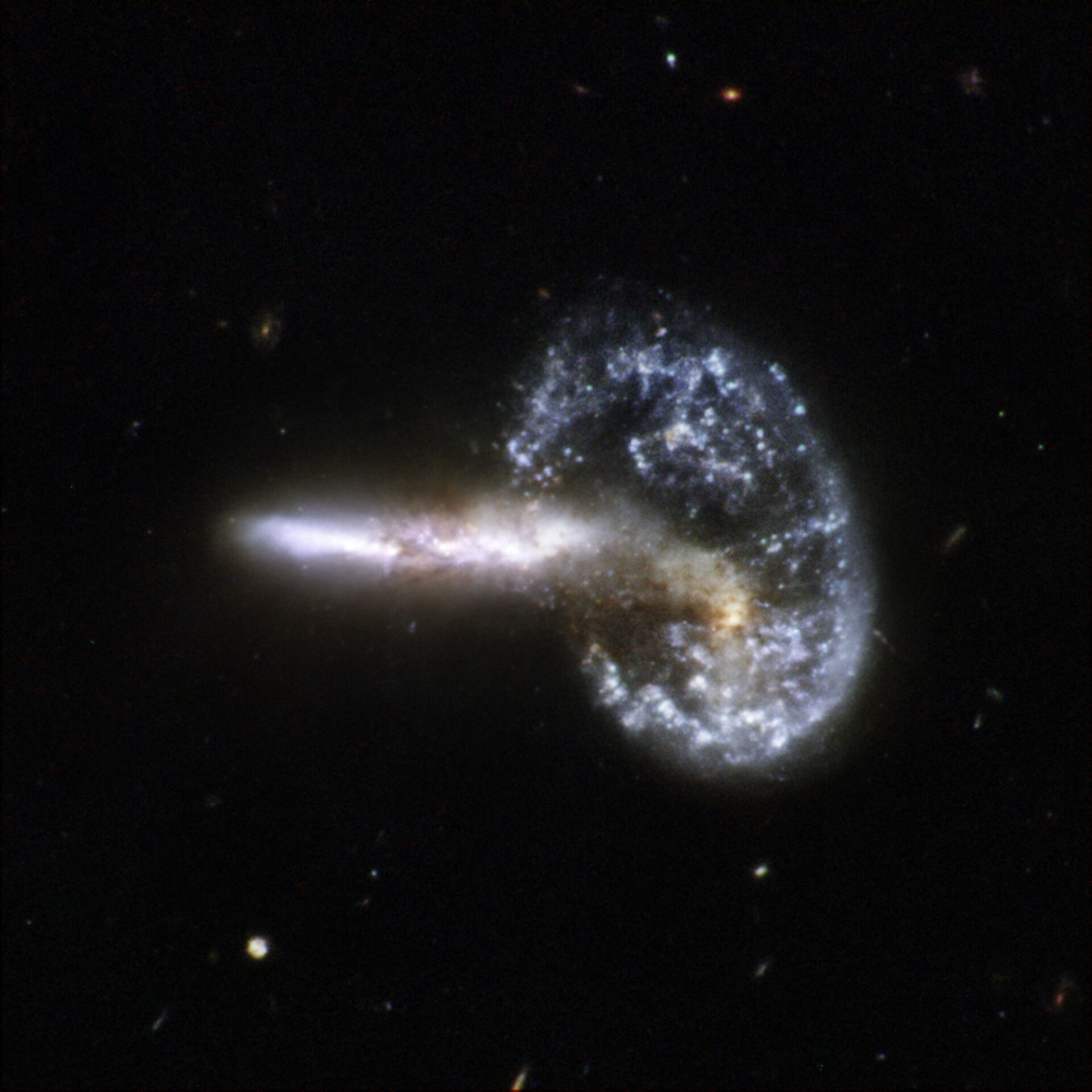
Plethora of interacting galaxies on Hubble’s birthday
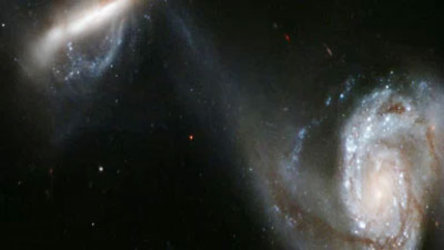
Galaxy collisions produce a remarkable variety of intricate structures, as 59 new images from the NASA/ESA Hubble space telescope show.

Interacting galaxies are found throughout the universe, sometimes dramatic collisions that trigger bursts of star formation, on other occasions as stealthy mergers that form new galaxies.
A series of 59 new images of colliding galaxies, the largest collection ever published simultaneously, has been released from archived raw Hubble images to mark the 18th anniversary of the telescope’s launch.

Galaxy mergers, which were more common in the early universe than they are today, are thought to be one of the main driving forces for cosmic evolution, turning on quasars, sparking frenetic star births and explosive stellar deaths.
Even apparently isolated galaxies will show signs in their internal structure that they have experienced one or more mergers in their past. Each of the various merging galaxies in this series of images is a snapshot of a different instant in the long interaction process.
The full release is available on ESA's Science and Technology pages along with the Hubble atlas of interacting galaxies.
Notes for editors:
The Hubble Space Telescope is a project of international cooperation between NASA and ESA.
Acknowledgements for the entire photo release:
- Project lead: Lars Lindberg Christensen
- Image processing: Davide de Martin (ESA/Hubble) and Zolt Levay (STScI)
- Cosmetic cleaning: Amit Kapadia, Nuno Marques, Maximilian Kaufl (ESA/Hubble)
- Colour correction and cosmetic adjustments: Zolt Levay (STScI) & Martin Kornmesser (ESA/Hubble)
- HST Principle Investigator: A. Evans (University of Virginia, Charlottesville/NRAO/Stony Brook), and the PIs of Hubble Proposals 9735, 11091, 6276, 10575, 7129, 7467, 6438.
- Astronomical processing pipeline: The STScI ACS team
- Data Archiving and pipeline implementation: The ESO/ST-ECF Archive and the STScI Archive
- Textual information: Ana Margarida Lopes, Will Gater, Anne Rhodes, Raquel Yumi Shida & Lars Lindberg Christensen (ESA/Hubble)
- Web products: Raquel Yumi Shida (ESA/Hubble) & Stratis Kakadelis (STScI)
For more information:
Aaron Evans, Department of Astronomy, University of Virginia, Charlottesville, USA
E-mail: Aaron.Evans @ stonybrook.edu
Lars Lindberg Christensen, Hubble/ESA, Garching, Germany
E-mail: Lars @ eso.org
Ray Villard, Space Telescope Science Institute, Baltimore, USA
E-mail: Villard @ stsci.edu