Pioneering images of both martian moons
For the very first time, the martian moons Phobos and Deimos have been caught on camera together. ESA's Mars Express orbiter took these pioneering images last month. Apart from their ‘wow’ factor, these unique images will help the HRSC team validate and refine existing orbit models of the two moons.

The images were acquired with the Super Resolution Channel (SRC) of the High Resolution Stereo Camera (HRSC). The camera took 130 images of the moons on 5 November at 9:14 CET over period of 1.5 minutes at intervals of 1s, speeding up to 0.5-s intervals toward the end. The image resolution is 110 m/pixel for Phobos and 240 m/pixel for Deimos — Deimos was more than twice as far from the camera.
The Super Resolution Channel of the HRSC uses an additional lens, which has a very narrow field of view of just 0.5°, providing four times the resolution of the HRSC colour stereo channel.

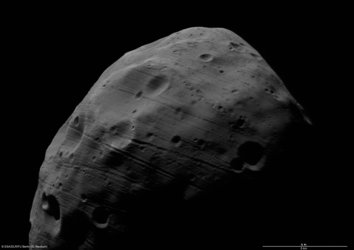
Phobos, the larger of the two moons, orbits closer to the Red Planet, circling it every 7 hours and 39 minutes. It travels faster relative to Mars than the Moon relative to Earth. It was
It is not often that both martian moons are located directly in front of the camera, lined up one behind the other. The chance to image both moons together came on 5 November 2009 when the viewing geometry was especially favourable.
The plan to image both moons at once was years in the making and was made possible by the unique elliptical orbit of Mars Express, precise knowledge of the orbits of the planet, the moons and the spacecraft, as well as fortuitous viewing geometry, and perfect planning by the ESA and HRSC teams.
Exploration of Phobos: a scientific priority for Mars Express

In addition to producing high-resolution maps of the surface of Mars in colour and in 3D, the exploration of Phobos is a scientific priority for the HRSC team. The potato-shaped, 27 × 22 × 18 km moon has already been photographed 127 times by the HRSC, improving our knowledge of the topography of the moon, and providing insight into its origins and development.
For more information:
Gerhard Neukum, HRSC Principal Investigator, FU Berlin, Germany
Email: Gneukum @ zedat.fu-berlin.de
Ralf Jaumann, HRSC Co-Investigator
Email: Ralf.Jaumann @ dlr.de
Agustin Chicarro, ESA
Email: Agustin.Chicarro @ esa.int
Olivier Witasse, ESA Mars Express Project Scientist
Email: Olivier.Witasse @ esa.int
Fred Jansen, ESA Mars Express Mission Manager
Email: Fred.Jansen @ esa.int