Spacecraft
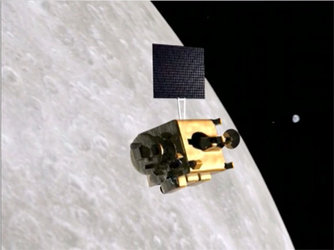
Chandrayaan-1 is a cuboid of approximately 1.50-m side length. At launch, it will weigh 1304 kg, including 814 kg of fuel needed by the spacecraft for its journey and in-orbit adjustments. A canted, single-sided solar array will provide the electrical power needed during all mission phases. The fully-deployed solar array generates up to 700 Watts of power.
The spacecraft hosts 11 science instruments. They include:
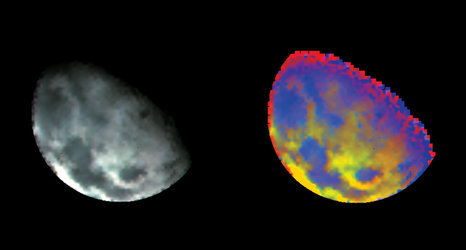
- A Hyper Spectral Imaging camera, HySI, a spectral imager for mineralogical mapping
- The Chandrayaan-1 X-ray Spectrometer (C1XS), an X-ray fluorescence spectrometer for mapping elements
- High-energy X-ray spectrometer, HEX, to map the distribution of radioactive elements
- A near-infrared spectrometer, SIR-2
- Moon Mineralogy mapper (M3)
- Terrain Mapping Camera (TMC)
- Lunar Laser Ranging Instrument (LLRI)
- Miniature Synthetic Aperture Radar (Mini-SAR)
- Radiation Dose Monitor Experiment (Radom)
- Sub KeV Atom Reflecting Analyser (SARA)
The instrument suite also includes a 29-kg landing probe (MIP), to be dropped on the lunar surface at the beginning of the mission for near-surface studies. The probe carries a mass spectrometer, a camera and an altimeter.