Star eats companion
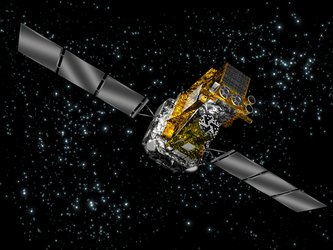
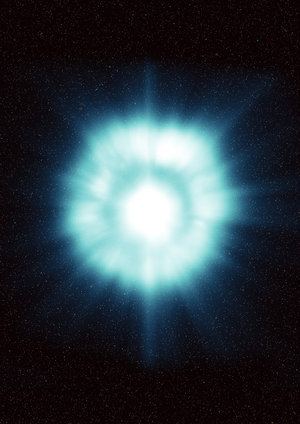
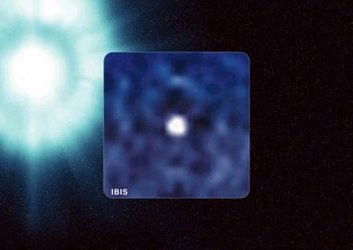
ESA's Integral space observatory, together with NASA's Rossi X-ray Timing Explorer spacecraft, has found a fast-spinning pulsar in the process of devouring its companion.
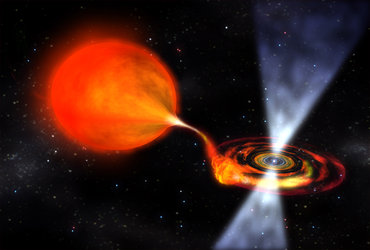
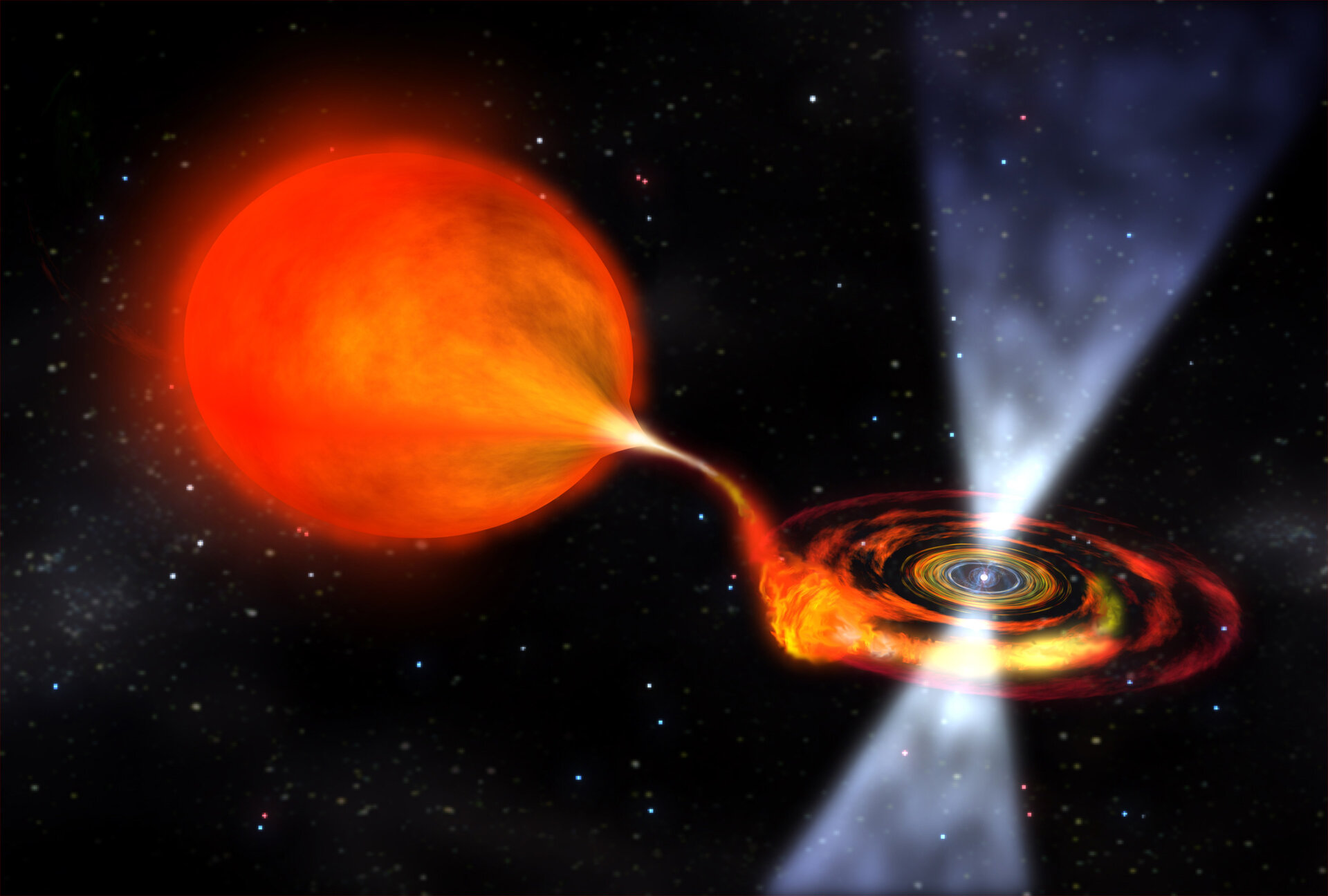
This finding supports the theory that the fastest-spinning isolated pulsars get that fast by cannibalising a nearby star. Gas ripped from the companion fuels the pulsar's acceleration. This is the sixth pulsar known in such an arrangement, and it represents a 'stepping stone' in the evolution of slower-spinning binary pulsars into faster-spinning isolated pulsars.
"We're getting to the point where we can look at any fast-spinning, isolated pulsar and say, 'That guy used to have a companion'," said Dr Maurizio Falanga, who led the Integral observations, at the Commissariat à l'Energie Atomique (CEA) in Saclay, France.

'Pulsars' are rotating neutron stars, which are created in stellar explosions. They are the remnants of stars that were once at least eight times more massive than the Sun. These stars still contain about the mass of our Sun compactified into a sphere of only about 20 kilometres across.
This pulsar, called IGR J00291+5934, belongs to a category of 'X-ray millisecond pulsars', which pulse with the X-ray light several hundred times a second, one of the fastest known. It has a period of 1.67 milliseconds which is much smaller that most other pulsars that rotate once every few seconds.
Neutron stars are born rapidly spinning in collapses of massive stars. They gradually slow down after a few hundred thousand years. Neutron stars in binary star systems, however, can reverse this trend and speed up with the help from the companion star.
For the first time ever, this speeding-up has been observed in the act. "We now have direct evidence for the star spinning faster whilst cannibalising its companion, something which no one had ever seen before for such a system," said Dr Lucien Kuiper from the Netherlands Institute for Space Research (SRON), in Utrecht.
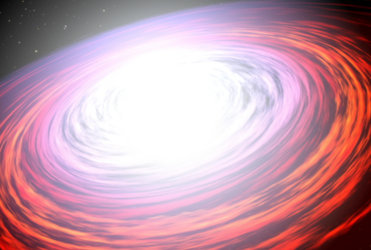
A neutron star can remove gas from its companion star in a process called 'accretion'. The flow of gas onto the neutron star makes the star spin faster and faster. Both the flow of gas and its crashing upon the neutron star surface releases much energy in the form of X-ray and gamma radiation.
Neutron stars have such a strong gravitational field that light passing by the star changes its direction by almost 100 degrees (in comparison light passing by the Sun is deflected by an angle which is 200 thousands times smaller). "This 'gravitational bending' allows us to see the back side of the star," points out Prof. Juri Poutanen from the University of Oulu, Finland.
"This object was about ten times more energetic than what is usually observed for similar sources," said Falanga. "Only some kind of monster emits at these energies, which corresponds to a temperature of almost a billion degrees."

From a previous Integral result, scientists deduced that because the neutron star has a strong magnetic field, charged particles from its companion are channeled along the magnetic field lines until they slam into the neutron star surface at one of its magnetic poles, forming 'hot spots'. The very high temperatures seen by Integral arise from this very hot plasma over the accretion spots.
IGR J00291+5934 was discovered by Integral during a routine scan of the sky on 2 December 2004, in the outer reaches of our Milky Way galaxy, when it suddenly flared. On the day after, scientists accurately clocked the neutron star with the Rossi X-ray Timing Explorer.
Rossi observations revealed that the companion is already a fraction the size of our Sun, perhaps as small as 40 Jupiter masses. The binary orbit is 2.5 hours long (as opposed to the year long Earth-Sun orbit). The full system is very tight; both stars are so close that they will fit into the radius of the Sun. These details support the theory that the two stars are close enough for accretion to take place and that the companion star is being cannibalised.
"Accretion is expected to cease after a billion of years or so," said Dr Duncan Galloway of the Massachusetts Institute of Technology, USA, responsible for the Rossi observations. "This Integral-Rossi discovery provides more evidence of how pulsars evolve from one phase to another - from an initially slowly spinning binary neutron star emitting high energies, to a rapidly spinning isolated pulsar emitting in radio wavelengths."
The discovery is the first of its kind for Integral (four of the first five rapidly spinning X-ray pulsars were discovered by Rossi). This bodes well in the combined search for these rare objects. Integrals's sensitive detectors can identify relatively dim and distant sources and so, knowing where to look, Rossi can provide timing information through a dedicated observation extending over the entire two-week period of the typical outburst.
For more information:
Maurizio Falanga, lead author of the results, CEA-Saclay, France
E-mail: mfalanga @ cea.fr
Chris Winkler, ESA Integral Project Scientist
E-mail: christoph.winkler @ esa.int
These findings will appear in an upcoming issue of the Astronomy and Astrophysics Journal and also at http://www.arxiv.org/abs/astro-ph/0508613