Report of the 2025 ESA/ECSL Executive Course on Space Law and Regulations
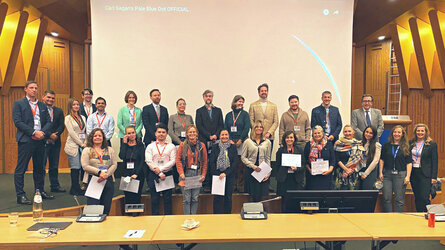
The 2025 edition of the ESA/ECSL Executive Course on Space Law and Regulations was organised at ESA European Space Operations Centre (ESOC, Germany) from 23 - 25 June, and had 17 participants from Europe and beyond. Participants were government officials, industry representatives, ESA delegates and more.
Due to the space sector becoming increasingly commercialised, both national governments and private companies have a need for knowledge about the legal and regulatory dimensions related to space activities. The ESA Legal Services Department acting through the European Centre for Space Law recognise these changes and therefore offer a structured introduction, as well as in depth lectures on space law and regulations to government representatives and industry professionals through this annual three-day course.
An intensive three days course
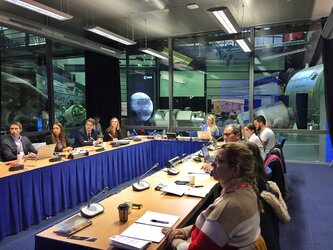
The course began with welcome remarks from Dr. Holger Krag (Head of the Space Safety Programme Office, ESA), followed by opening comments from Dr. Gisela Süss (Head of the Legal Services Department, ESA), who highlighted the significance of space law in today’s space activities.
Participants were then introduced to the fundamentals of International Space Law by Dorota Englender (Legal Officer, ESA), covering its core principles and concepts. Dr. Gisela Süss also presented on ESA-EU cooperation, focusing on the implications of the newly released EU Space Act.
Next, Thomas Weissenberg (Administrator, ESA’s External Relations Department) addressed emerging challenges in the space sector, particularly the current geopolitical instability and the growing need for international cooperation.
The first day concluded with Dorota Englender’s session on national space legislation, outlining its purpose, scope, and other key elements.
Day two featured a series of in-depth lectures, especially on international space transactions and planning issues, led by Professor Joanne Wheeler MBE (Managing Partner, Alden Legal; Director, Earth and Space Sustainability Initiative). These sessions explored contracts, financial matters, and regulatory aspects of space transactions. A high-level panel provided an overview of national space legislation and regulations in four leading spacefaring countries: France (Cécile Gaubert, General Counsel, Exotrail), the Netherlands (Dr. Dimitra Stefoudi, Assistant Professor, Leiden University), Austria (Julia Pleiel, Federal Ministry of Innovation, Mobility and Infrastructure), and the United Kingdom (Professor Joanne Wheeler MBE).
In the afternoon, Cécile Gaubert discussed insurance for space missions, followed by Jan Siminski (Space Debris Analyst, ESA), who explained non-legally binding instruments and their role in space activities, with a focus on space debris mitigation.
Participants then applied their new knowledge in the Legalis Exercise, designing their own space missions (more information below).
The day concluded with a dinner at Da Mario’s Little Italy Restaurant in Darmstadt, offering participants and speakers an opportunity to network and relax ahead of the final day.
The third day opened with a session on State Responsibility and Liability by Dorota Englender, followed by a practical lecture on ITU and spectrum management from Véronique Glaude (Expert Engineer, ITU). Tim Flohrer (Head of the Space Debris Office, ESA) then presented ESA’s efforts on space debris mitigation, including the Zero Debris Charter and Space Safety initiatives. The morning ended with a lecture on Strategic Trade Control by Cales Hansen (Legal Officer, ESA), addressing export controls, international sanctions, and their impact on the space sector.
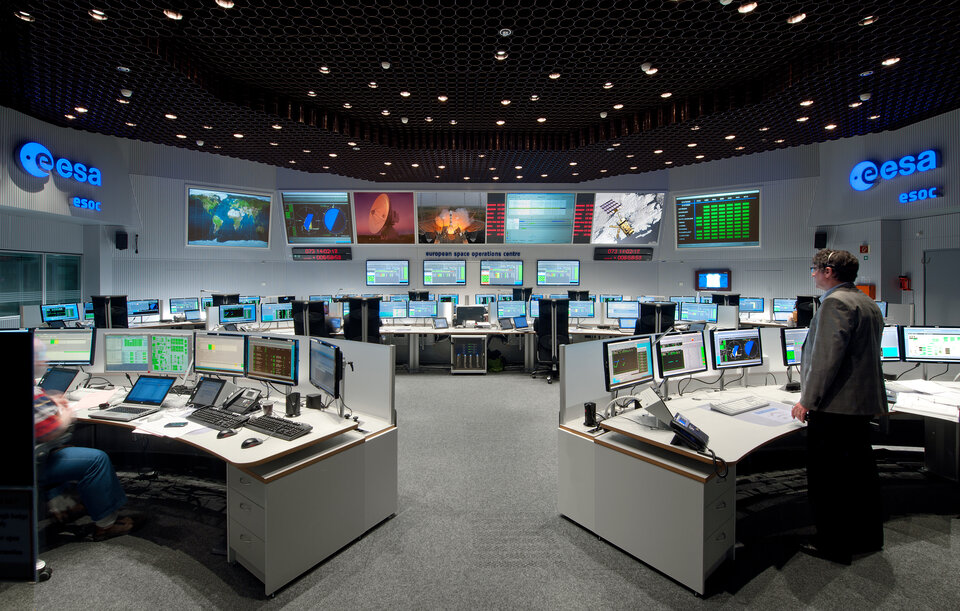
Finally, participants enjoyed a guided tour of ESOC led by Frank Zimmermann (Navigation Engineer, ESA), who explained ESA’s satellite monitoring and launch operations in the centre’s main control room.
The Legalis Exercise: Create your own space mission

At the end of the second day of the course, participants were able to apply the knowledge they gained during the first two days by analysing the legal requirements for their own space mission.
Three teams of four people and one team of five presented their concept for a space mission. The goal was for each team to design a space mission and emphasise its legal requirements. Teams selected from several different space mission categories including Earth Observation, Communications or Space mining.
Each team delivered a structured 10-minute presentation covering their mission’s name, logo, chosen category, and a detailed legal analysis. Presentations were delivered to the other teams as well as to a jury consisting of Safwene El khaira (ECSL Executive Officer, ESA) and Véronique Glaude (Expert Engineer, Radio Regulations for space services from the International Telecommunication Union (ITU)). Various types of missions were presented, covering Communications, Space mining or even Space tourism.
Teams were evaluated and given a grade by the jury. The winning team members received a special digital certificate as well as a small prize and presented the mission HeLP (Helium 3 Lunar Programme), a mission dedicated to mining operations on the Moon. Congratulations to Carlos Garcia Sacristan, Andrew Faiola, Laura Vega Fernandez and Teresa Rudolph for their thorough legal analysis and to all other participants for their creative and exciting space missions!


The European Centre for Space Law received great feedback from participants and would like to thank both the participants for their attention and energy and speakers for their high level courses and their time.
Finally, the ECSL would like to thank the ESOC organisation team for their assistance in the preparation of the course, in particular Sabrina Borner (Event manager, ESA).