Flying missions
Flying missions
The ideal place to test new space technologies is actually in space.
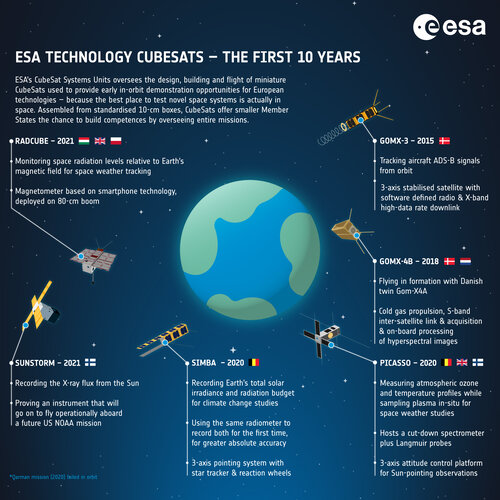
For some technologies and techniques and some new applications, it is necessary to continue the development cycle up to in-orbit demonstration. New practices, techniques and tools for design, development, verification and mission operations need to be exercised in small, yet representative, missions to orbit. To reach this goal, ESA has been developing small satellite In-Orbit Demonstration missions since the turn of the century, supplemented by CubeSat missions since 2013. These are funded under the General Support Technology Programme (GSTP).
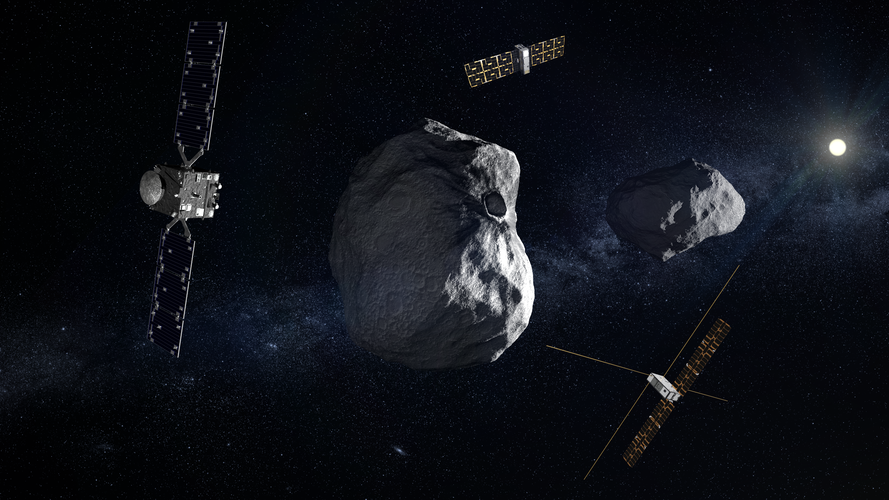
Hera is Europe’s contribution to an international planetary defence experiment. Following the NASA DART mission’s impact with the Dimorphos asteroid last year, Hera will return to Dimorphos to perform a close-up survey of the crater left by DART. Due to launch in 2024, Hera will carry two CubeSats – Juventas and Milani. These are Europe’s first deep-space CubeSats; they will get closer to Didymos’s companion, Dimorphos, gathering additional data on the asteroid whilst testing new intersatellite link technology. ESA engineers are working hard to finalise and test the various spacecraft subsystems – including the two CubeSats. Once all elements of the Hera flight model will be integrated, a full campaign of environmental testing on the spacecraft will be performed at ESA’s ESTEC Test Centre in the Netherlands.
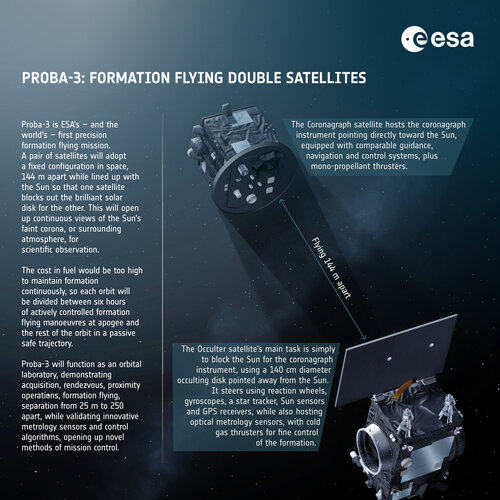
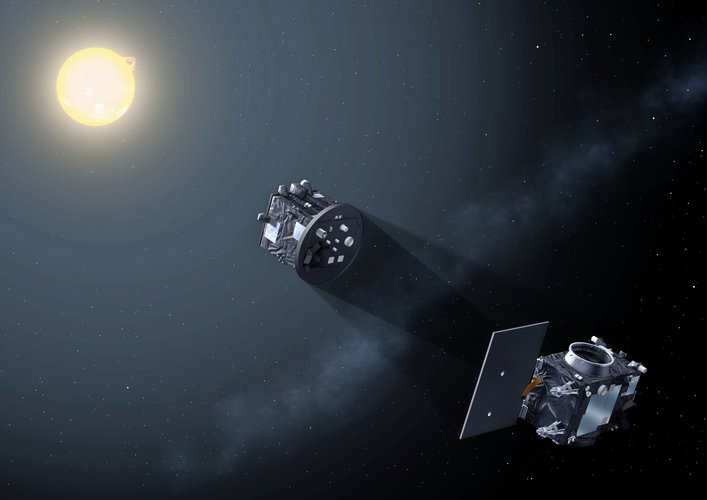
Due to launch in 2024, Proba-3 is ESA’s – and the world’s – first precision formation flying mission. A broad range of novel technologies will be essential to make Proba-3 a success.