Sentinel-2 explores night vision
After more than 10 years in orbit, the first Copernicus Sentinel-2 satellite, Sentinel-2A, is still finding new ways to contribute to Earth observation. With its younger siblings, Sentinel-2B and Sentinel-2C, now leading the mission’s core task of delivering high-resolution, ‘camera-like’ images of Earth’s surface, the European Space Agency is pushing Sentinel-2A beyond its original remit.
In recent trials, this elderly satellite was even switched on at night to see how it would perform in the dark – and the results have been strikingly positive, offering encouraging news for the follow-on Copernicus Sentinel-2 Next Generation mission, currently in development.
Copernicus is the Earth observation component of the European Union’s Space programme.
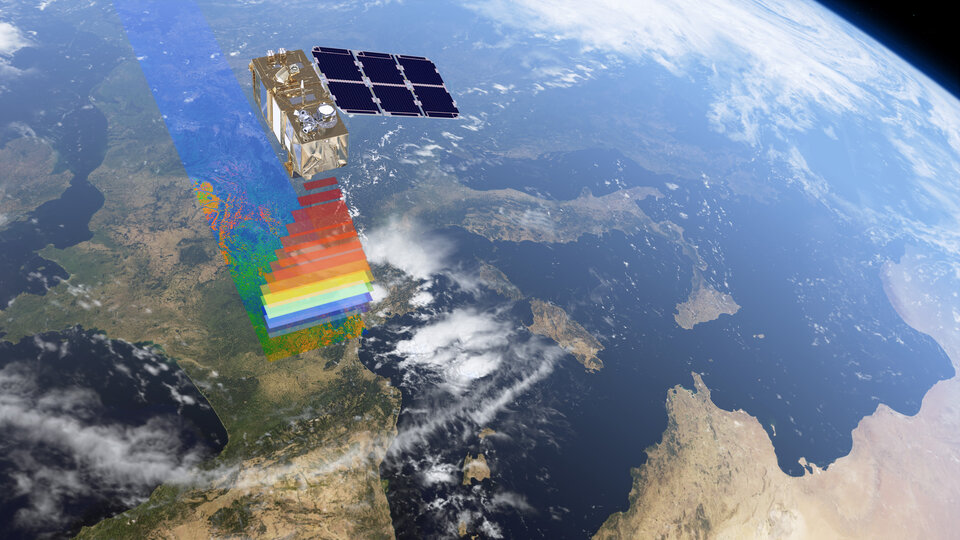
When Sentinel-2A was launched in 2015, it marked a major milestone – combining a high-resolution multispectral optical imager with a 290 km-wide swath, to return spectacular views of Earth’s changing lands for a new perspective of our land and coastal areas for agriculture, and forest and water management – in particular for the Copernicus Land Monitoring Service.
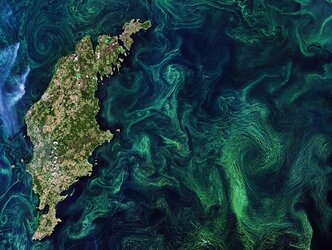
The satellite, however, has gone above and beyond – also returning new information about our marine biology, methane emissions and changing polar ice.
Since the Sentinel-2 mission is based on two identical satellites in the same orbit, 180° apart for optimal coverage and data delivery, Sentinel-2B was launched in 2017. Sentinel-2C followed in 2024 to replace Sentinel-2A.
The satellites all carry a 13-band multispectral imager, which, like a camera, relies on light to capture images – in this case, using sunlight reflected by Earth’s surface and the atmosphere to observe the planet.
However, the satellites experience darkness during night-time passes. Under normal operations, the imagers are switched off when the satellites passes over night-shrouded parts of the planet.

In essence, the current generation of Sentinel-2 satellites, which will also include Sentinel-2D in the future, were never designed to image at night – but the plan is that the follow-on Sentinel-2 Next Generation mission will indeed do so over certain regions.
As Sentinel-2A approaches the end of its operational life, it continues to support the operational Sentinel-2 mission – but, in addition, engineers and scientists are using some its remaining time in orbit to test new ideas for the future and to prepare for the Next Generation mission. One such experiment has been to see how it would fare when switching it on at night.
As these test images featured in this article show, it did remarkably well.

ESA’s Sentinel-2 Next Generation Mission Scientist, Simon Proud, said, “We are extremely pleased with these results, which help pave the way for the Sentinel-2 Next Generation mission.
“Not only has Sentinel-2A been able to capture images of gas flares from oil production in the Middle East, which are of course pretty bright, but also more subtle characteristics such as a wildfire in India and fishing boats off the coast of South Korea – all during the night-time.
“The current Sentinel-2 mission remains outstanding, delivering a wealth of data for Copernicus operational services, the commercial sector and for science, but we are now further pushing the boundaries of what an optical mission can do.

“These experiments are providing invaluable insight as we design Sentinel-2 Next Generation, which is being developed with the ambitious goal of delivering even higher resolution imagery and imaging some parts of the planet even when the Sun is down.
“Right now, we are establishing key features that the next generation mission should see at night, and we are assessing the technical feasibility of night imaging.
“The results from Sentinel-2A show that for all of our night-time targets, including city lights, gas flares and fishing monitoring, the Sentinel-2 Next Generation mission will contribute a significant amount of useful information to the community.
“Night-time imagery, for example, is extremely useful for security and for monitoring city lights, which are an indication of urban growth.”

ESA’s Sentinel-2 Mission Manager, Ferran Gascon, added, “This experiment was carefully prepared by the mission teams, and it has naturally put strain on the Sentinel-2A satellite, but it has been well worth exploring what this ageing satellite can do to help prepare for the future. Switching on the satellite to image at night required a great deal of energy, but Sentinel-2A did very well.
“Even after 10 years in orbit and this demanding experiment, the satellite is still in remarkably good health and continues to deliver a wealth of data to many users that benefit from the satellite for a wide range of everyday applications.”