


Introducing NovaMoon
The European Space Agency’s (ESA) NovaMoon mission will improve positioning, navigation and timing (PNT) services on the Moon. It will help rovers, landers and astronauts navigate on the Moon like cars, planes and pedestrians navigate on Earth.
With an increasing number of lunar missions planned in the coming years, dedicated communications and navigation infrastructure on the Moon is needed. ESA is already developing PNT services on and around the Moon through missions such as Lunar Pathfinder and Moonlight.

Lunar Pathfinder, planned to launch in 2027, will include experiments to demonstrate the use of Global Navigation Satellite Systems (GNSS) signals from Earth for lunar transfer. Moonlight will establish dedicated infrastructure for lunar navigation and connectivity services, which will enable precise, autonomous landings and lunar surface mobility with a dedicated constellation of satellites around the Moon.
Building on these missions, NovaMoon will improve Moonlight’s positioning accuracy, enabling sub-metre positioning on the Moon by providing differential corrections and the first ever lunar time reference laboratory and selenodetic (Moon measuring) reference station on the lunar surface. NovaMoon is planned to fly on various lunar landers, carrying a suite of instruments that will:
- Augment Moonlight and other lunar navigation services by generating correction messages similar to the way correction messages are generated for Galileo by stations on Earth. These correction messages will enable sub-metre positioning across the Moon’s south pole.
- Support the establishment of a Lunar Reference Frame, which is key for navigation on and around the Moon. It will do this by co-locating four ranging instruments, which will allow NovaMoon’s reference station location to be calculated within a few centimetres.
- Integrate the first atomic clocks on the Moon’s surface. These atomic clocks will contribute to the realisation of Lunar Reference Time on the Moon’s surface.
- Enable scientific research on the Moon’s composition and interior structure as well as new experiments on general relativity and fundamental physics.
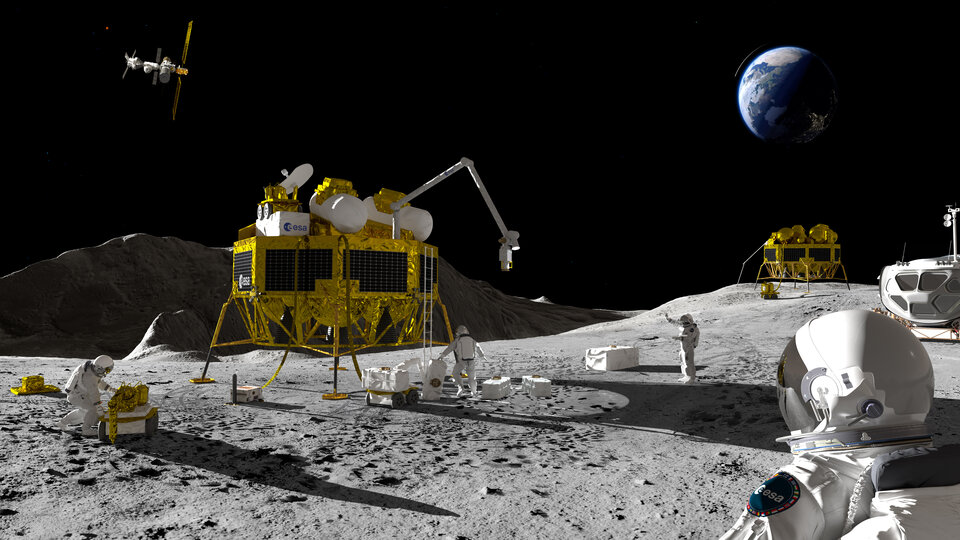
NovaMoon will consist of three incremental versions, with the third version reaching the full configuration, able to achieve all the NovaMoon mission objectives. This third version is aimed to fly on Argonaut 2. Breaking NovaMoon into three incremental payloads will allow ESA to demonstrate and test new technologies before the full NovaMoon system is deployed, increasing the reliability of the mission.
The full NovaMoon payload configuration will include the full suite of instruments for enhancing PNT on the Moon, namely:
- a combined GNSS and Lunar Augmented Navigation Service (LANS) navigation user terminal,
- a navigation processor,
- atomic clocks, such as MiniRAFS and high-performance (optical) clocks,
- a synchronisation unit,
- a laser retroreflector,
- a Very Long Baseline Interferometry (VLBI) subsystem,
- active laser ranging (optional),
- a LunaNet communications user terminal (optional).
While most lunar missions last only one lunar day (14 Earth days), the NovaMoon payload will support two years operation with the possibility to extend to five years. This will give ample time for the full exploitation of the mission for both PNT services and scientific research.