Tierra del Fuego by Sentinel-1D
This image is one of the first to be captured by the Copernicus Sentinel-1D satellite, which carries a 12 m-long synthetic aperture radar (SAR) instrument. It was captured on the night of 6 November (European time) and the data was then transmitted from the satellite to the Matera ground station, in Italy. All this was done within 50 hours of launch, which is likely to be the shortest time from launch to data delivery for a radar-based Earth observation satellite.
Radar instruments are particularly useful for imaging Earth’s surface through rain and cloud, as well as in darkness, making radar an ideal remote-sensing tool for observing polar regions. The satellite also carries an Automatic Identification System (AIS) instrument – enabling the mission to improve detection and tracking of ships over maritime zones.
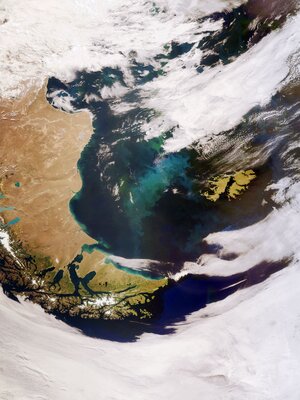
Tierra del Fuego is an archipelago on the most southerly tip of the mainland South American continent. It covers territory in both Argentina to the east and in Chile to the west and is separated from the mainland by the Magellan Strait. The most southerly point of Tierra del Fuego is Cape Horn.
The bright contrasting colours in this false-colour image are created with Sentinel-1D’s polarimetric capacity – using multiple types of radar wave, known polarisations. Radar polarisation refers to the orientation of the radar wave’s electric field, which often moves either horizontally or vertically in relation to the ground. This affects how the radar signal interacts with the surface and therefore determines the data that can be collected about the physical characteristics of the surface. Using multiple polarisations helps analysts to study and better distinguish surface features. When several polarisation signals are combined, each can be assigned to either a red, green or blue light channel, producing a colourful image that highlights different surface features far beyond what is possible with single polarisation data alone. We see that here with the ocean and snowy peaks in shades of blue, while the land appears yellow.
Read full story: Sentinel-1D delivers first images: from Antarctica to Bremen