


About Design Booster
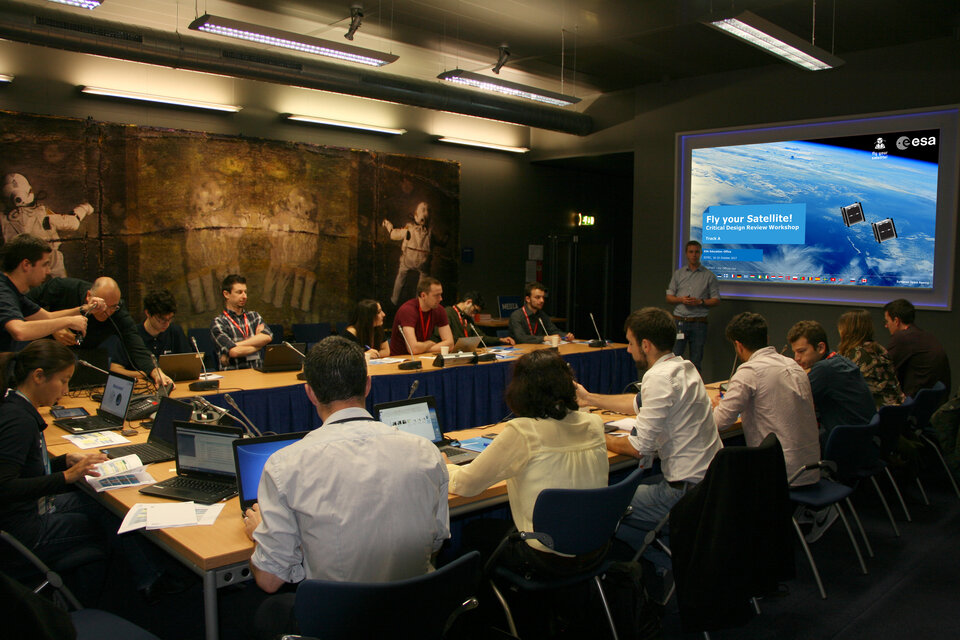
The Design Booster programme is for satellite teams with a preliminary design who want to benefit from ESA support for the consolidation of their detailed design. The programme is open for university or other tertiary education institution student teams from an eligible state, working on a pico- or nanosatellite (CubeSat or PocketQube).
As part of this programme, the design of the student satellite is reviewed by ESA specialists, who identify potential improvements or issues with design and assist in solving them, allowing teams to maximise their chances of success with the continuation of their missions. In addition, students will benefit from training opportunities and webinars and will be introduced to common practices in the space domain.
The opportunity aims at helping less-experienced teams to go through the early phases of the project, which is when important design choices are made. Students will learn to conduct trade-offs, run analysis, and evaluate options while balancing the scope and resources of the mission. Receiving support from ESA experts at this stage may facilitate future development activities, since performing modifications is still relatively easy and cheap when compared to later phases of the project. As such, participating in the programme can contribute to easing the learning curve for inexperienced teams developing a satellite mission for the first time.

Students will learn to consider the full project lifecycle at the design stage, in terms of engineering, resources and expertise, which will translate into smoother planning and execution of verification activities as well as more robust in-flight operations. Special emphasis will be placed on the importance of early testing, and teams will be invited to work on prototypes and development models to demonstrate that functionalities and performances are adequate. For more advanced missions at the detailed design stage, teams may perform environmental test campaigns on their subsystems, making use of the dedicated CubeSat Support Facility in ESA ESEC (Belgium).
Design Booster, as part of ESA Academy, makes use of dedicated facilities located at ESA’s Education Centre in ESA ESEC-Galaxia. In particular, the Training and Learning Facility, which is used to deliver training courses, and the CubeSat Support Facility, a cleanroom laboratory with test facilities, are used throughout the programme.
The programme follows a fixed schedule spanning one and a half years. Information on its timeline, activities, and milestones is captured in the Design Booster phases page.
Want to apply?
A call for proposals is opened regularly, and the specific details of the application will be presented in the call. Teams are welcome to start looking at the Proposal Instructions page to get a first idea of what is expected from the application.
Furthermore, to address the different needs of educational satellite projects, the programme is flanked by two other opportunities:
- Fly Your Satellite! is aimed at more advanced teams that want to benefit from ESA guidance during the later phases of the missions, from verification up to operations, with the possibility of receiving a sponsored launch opportunity.
- Test Opportunities is for teams who would like to test their item (e.g. satellite, subsystem, payload, or component) through an environmental test campaign, while receiving dedicated support and training on it.
Complementary to the hands-on programme, the ESA Education Office offers training courses in collaboration with the ESA Academy’s Training Programme. The training weeks particularly aim at students and teams in early phases of satellite projects and include a CubeSats Concurrent Engineering Workshop and a CubeSat Hands-On Training Week. More information about these sessions can be found on the ESA Academy’s training sessions in the Current and Future opportunities website.
ESA is committed to promoting diversity and fostering an inclusive professional environment. We therefore welcome proposals and applications from all eligible candidates irrespective of gender, sexual orientation, ethnicity, religious beliefs, age, disability, or other characteristics. At the Agency, we value diversity and we welcome people with disabilities.
Whenever possible, we seek to accommodate individuals with disabilities by providing the necessary support at any programme event. Should you have any questions or if you would like to discuss this further, please contact us via email at esa.academy@esa.int.
Are you interested in participating in the next Design Booster cycle? You can access all the information about this programme in the Educational Satellites website.
To stay updated on the latest news, keep an eye on the ESA Education website and subscribe to the ESA Academy newsletter. For further information please contact us at cubesats@esa.int.
Return to the Educational Satellites page.