

Apply for the first Space Policy in Action training course
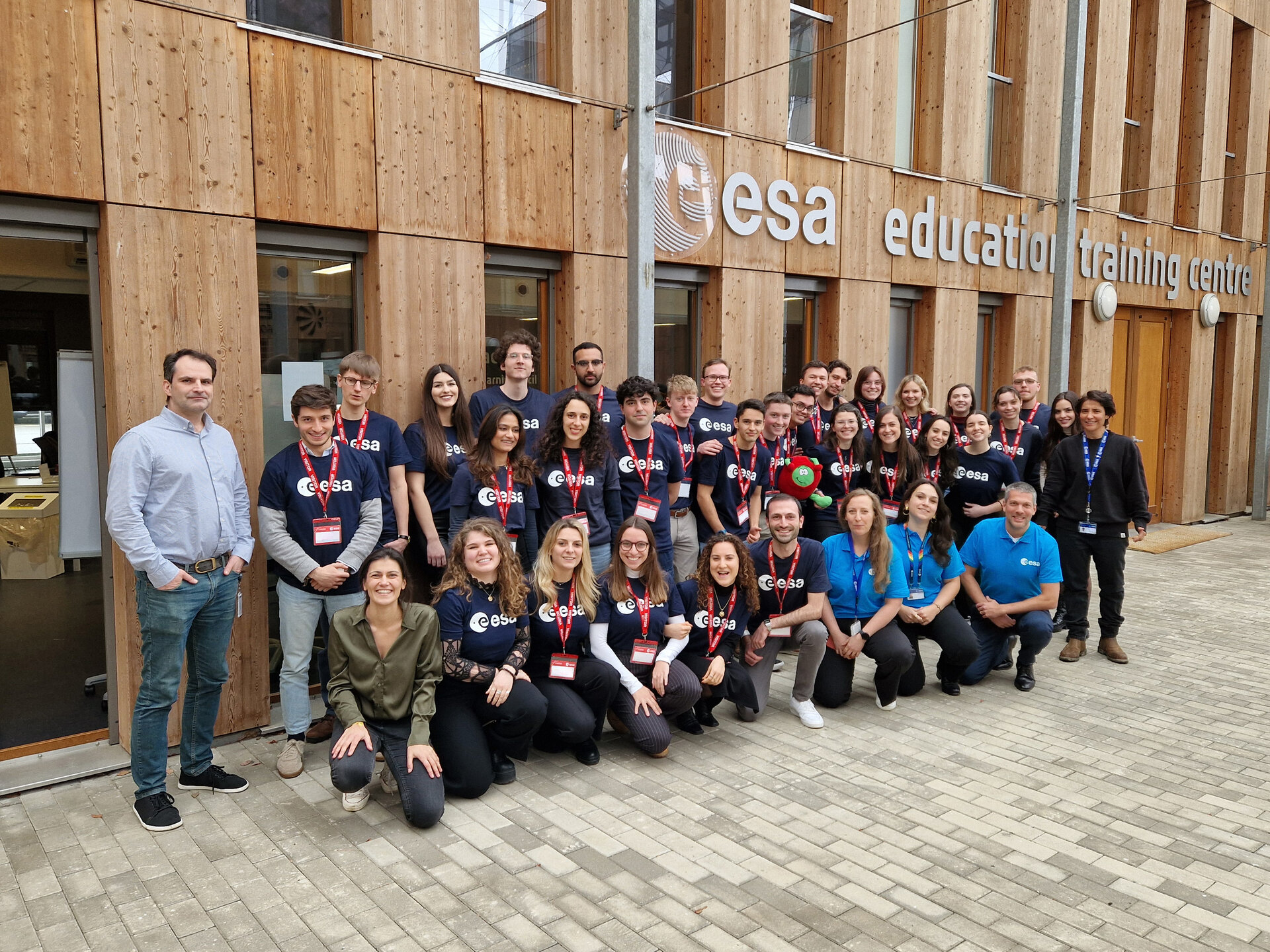
ESA Academy is now accepting applications from university students for the pilot edition of Space Policy in Action. Developed through a collaboration between the ESA Education Office, the DG Cabinet and the Directorate of Strategy, Legal and External Affairs, the course will take place at the ESA Academy Training and Learning Facility at ESA ESEC, Belgium, from 7 to 11 December 2026. Through interactive lectures, case studies and a simulated ministerial negotiation, students will gain a practical understanding of the policies, governance and international cooperation that shape space activities.
The experience

Space exploration depends on much more than scientific and technological advances. Behind every major mission are decisions, international partnerships, legal frameworks, and engagement with society. Understanding how these different dimensions come together is essential to understanding Europe’s role in space and the challenges and opportunities that lie ahead.
The profound impact ESA’s contributions have had, and will continue to have, on society and the economy underlines the importance of understanding how space activities are governed and how the responsible exploration and utilisation of space can be ensured.
This five-day course will provide comprehensive insights into ESA’s history, from its foundations with ESRO and ELDO to its current role in space exploration, education and international cooperation. Participants will explore key topics such as the evolution of European space policy, the legal implications of space exploration, the importance of ESA's role in public communication, and the future challenges and opportunities for space.
The course will also feature a mock ministerial exercise, giving students a hands-on understanding of space policy discussions at the highest levels.

The launch of the Soviet satellite Sputnik in 1957, followed by the United States' Apollo missions, culminating in the historic Moon landing in 1969, marked the dawn of the space age. Meanwhile, in Europe, in 1964, two organisations were established to ensure Europe’s role as a strong joint player in the emerging sector: the European Space Research Organisation (ESRO) and the European Launcher Development Organisation (ELDO).
ESRO was responsible for developing scientific satellites and conducting space research, while ELDO focused on creating launch vehicles to propel these satellites into orbit. These organisations laid the groundwork for Europe's collaborative approach to space exploration and utilisation, which ultimately led to the formation of the European Space Agency (ESA) in 1975.
Since its creation, ESA has achieved remarkable milestones. Notable missions such as Rosetta, which successfully landed a probe on a comet, and Gaia, which created the largest and most precise three-dimensional map of the Milky Way, have not only advanced scientific knowledge but also inspired generations. ESA covers the full spectrum of space activities, from launchers and scientific and exploration missions to space applications and technology development. Today, it is a model for regional integration of space activities and policies.
At the end of the course, students will be assessed based on their participation and will receive a certificate of participation along with a course transcript. These documents may be used to request ECTS credit(s) from their respective universities.
Week schedule
| Day 1 |
Towards a space-faring civilisation – A brief history ESRO and ELDO: Foundations of ESA governance 50 years of ESA's impact: international cooperation and technological innovations ESA’s milestone missions: case study analysis |
| Day 2 |
European space policy – The role of ESA ESA today and tomorrow: policies and strategic goals Terrae Novae – ESA’s long-term roadmap for space exploration |
| Day 3 |
ESA’s policy framework and governance: a legal perspective Legal implications of space exploration Unity in orbit: the International Space Station’s role in forging cooperation |
| Day 4 |
ESA’s public communication Practicalities of council meetings at ministerial level (workshop) Preparation for mock ministerial with instructor feedback |
| Day 5 |
Space scepticism, misinformation and conspiracies The next 50 years: challenges and opportunities Mock ministerial (assessed exercise) |
Who can apply?
Eligibility criteria
To participate, students must fulfil the following criteria at the time of application:
- aged minimum 18 years old. ESA Academy and relevant partners will only appraise applications from students who have no or limited professional experience in relevant engineering or space-related topics;
- be a national of an ESA Member State, Canada* or Associate Member;
- be enrolled as a Bachelor, Master or PhD student in a university for the academic years 2026-2027;
- be studying any relevant subject: Sociology, Economics, Business, Political Sciences, International Relations, History, Law, Engineering, Sciences, etc.
Sponsorship & attendance
Sponsorship
Selected students will be required to attend the entire training course at ESEC. They will be sponsored by ESA to cover accommodation and meals, as well as up to 350 Euros for travelling to Belgium.
Canadian students
* Canadian students enrolled in a Canadian post-secondary institution may apply for additional support from the Canadian Space Agency through this Announcement of Opportunity (grant applications must be submitted at least 7 weeks before the event start date – create an account as soon as possible!). This additional support is to cover costs that are not already covered by ESA for selected Canadian post-secondary students.
Diversity & inclusion statement
ESA is committed to achieving diversity and creating an inclusive professional environment. To this end, we welcome proposals and applications from all eligible candidates irrespective of gender, sexual orientation, ethnicity, beliefs, age, disability, or other characteristics. The ESA Academy strongly encourages inclusiveness within its programmes and within participating teams, which contributes to the enrichment of our programme.
Whenever possible, we seek to accommodate individuals with disabilities by providing the necessary support, either digitally or at the location of the training. In case of any questions or specific needs, please reach out to academy.training@esa.int to get assistance or advice during the application process.
How to apply?
- Apply through ESA Learn, the ESA Education and Community Platform;
- Upload a motivation letter (PDF, maximum 1 page, no images);
- Upload a CV (Europass format, PDF, maximum 2 pages);
- Upload a formal recommendation letter (PDF, maximum 1 page, including signature, no images) from a university professor or academic supervisor of the current university (if it is not possible to receive the recommendation letter from your referee, please ask them to send a recommendation email to academy.training@esa.int before the application deadline);
- Upload a Transcript of Grades from the two previous semesters, or from the previous graded academic year if not available (PDF). May be submitted in the university's language if an English version is unavailable.
All answers and documents must be in English, except the Transcript of Grades.
Deadlines
Application deadline: 27 September 2026, 23:55 CEST.
Selection announcement: 12 October 2026.
Before you apply — logistics
Accommodation
- Participants will stay at Mercure hotel in Han-sur-Lesse.
- The hotel will be provided and paid for by ESA.
- Students will be assigned shared rooms with participants of the same gender.
Arrival and departure
Arrival:
- Students are expected to arrive at Rochefort-Jemelle train station on Sunday, 6 December 2026.
Departure:
- Either Friday, 11 December 2026 after 17:30 CET (from Rochefort-Jemelle train station), or
- Saturday, 12 December 2026 before 11:00 CET
Important:
- Selected students are required to attend the entire workshop from start to finish.
Transportation during the workshop
A bus service will be provided and paid for participants by ESA:
- Morning: Hotel → ESA ESEC-Galaxia
- Evening: ESA ESEC-Galaxia → Hotel
Contact & further information
For more information, please contact academy.training@esa.int.