


Highlights from ESA Academy training courses
In the last few months, ESA Academy has delivered an extraordinary range of training courses and workshops, immersing over three hundred university students from across ESA Member States, Associate Members and Canada in the technical, collaborative, and innovative processes that define modern space missions. From interplanetary exploration and spacecraft testing to CubeSat assembly and space cybersecurity, students gained first-hand experience under the guidance of ESA experts.
Jump to: Concurrent Engineering Challenge, Space Systems Engineering Training Course, Robotics Workshop, CubeSat Hands-On Training Week, Spacecraft Testing Workshop, ESA-ELGRA Gravity Related Research Summer School, Navigation Training Course, Space Cybersecurity Training Course, Earth Observation Remote Sensing Workshop
CONCURRENT ENGINEERING CHALLENGE
A total of 30 university students from across Europe joined the Concurrent Engineering Challenge 2025, held from 7 to 11 April at ESA Education Training and Learning Facility in ESEC-Galaxia, Belgium. Students collaborated on designing a spacecraft to collect and return comet samples to Earth. Inspired by missions like Rosetta and OSIRIS-REx, participants worked in subsystem teams covering propulsion, power, thermal, payload, and communications, coordinating across sites to align designs.
Following ESA’s Concurrent Design Facility methodology, students progressed from concept definition to feasibility studies, weighing objectives against technical constraints. While using Ansys Systems Tool Kit (STK) software (licenses were kindly donated by Ansys for the purpose of this training), they simulated spacecraft trajectories and orbital dynamics to evaluate the feasibility of a sample return mission from a comet. The week concluded with presentations of consolidated designs, CAD models, and cost estimates to ESA engineers, offering a real-world experience in international mission planning
SPACE SYSTEMS ENGINEERING TRAINING COURSE
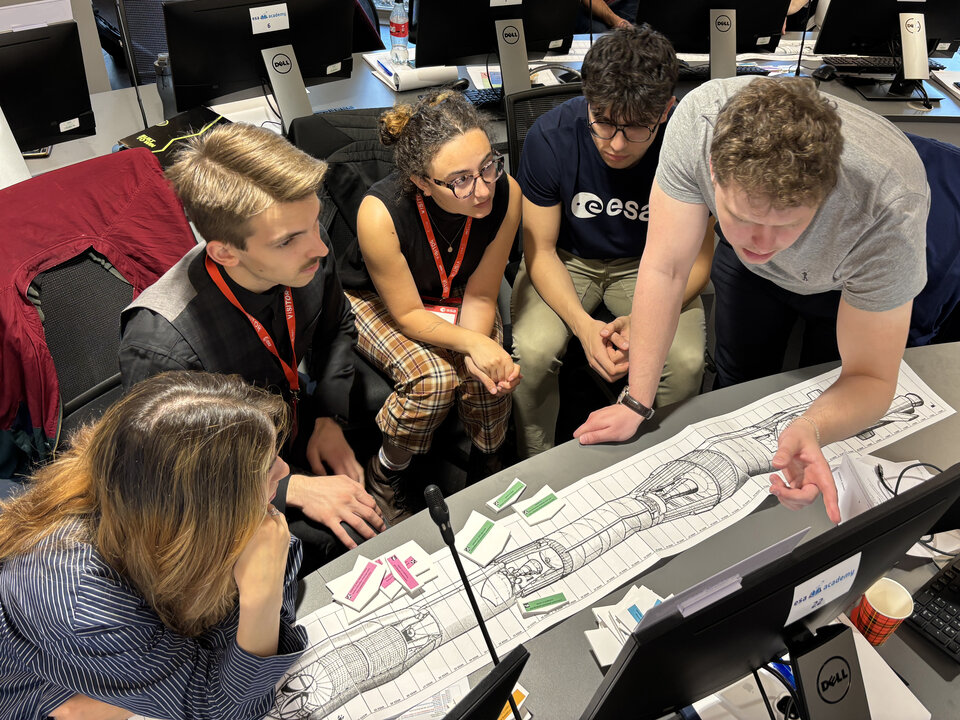
Later on, from 6 to 9 May, ESA Academy brought space mission design to life with the Space Systems Engineering Training Course at ESEC-Galaxia. Over four days, 30 students from 13 nationalities explored the multifaceted role of systems engineers, tackling everything from defining mission objectives to designing architectures, managing requirements, and assessing risks.
The course combined interactive discussions, real-world case studies, and hands-on exercises, giving participants a clear understanding of how complex space systems are planned, coordinated, and delivered. A highlight was the “Project Schedule Game” simulation that put students in the shoes of mission planners, challenging them to make decisions under realistic time and resource constraints while balancing risk. By the end of the week, participants had strengthened their technical foundations and gained invaluable experience in collaboration and problem-solving.

The spotlight then turned to robotics during the first 2025 edition of the ESA Academy Robotics Workshop, held at ESA’s European Space Research and Technology Centre (ESTEC) in the Netherlands from 20 to 23 May. Using ExoMy, a 6×6 educational rover inspired by the Rosalind Franklin rover, students delved into locomotion and control, sensing and calibration, as well as perception and decision-making.
The capstone challenge saw the student teams deploy a vision-in-the-loop controller to autonomously approach a blue target across Mars analogue terrain, testing perception, navigation, and actuation end-to-end. Facility visits to ESTEC’s planetary robotics areas and environmental test infrastructure linked classroom theory with operational ESA hardware testing.

CUBESAT HANDS-ON TRAINING WEEK
May concluded with the CubeSat Hands-On Training Week 2025, held from 26 to 30 at ESEC-Galaxia, offering an immersive experience in small satellite development. A total of 30 students from 15 nationalities built and operated a complete 1U CubeSat based on Theia Space’s design from Universidad Politécnica de Madrid.
The week blended theoretical lectures on systems engineering principles, ESA’s Fly Your Satellite! programme, and the ESAT model with practical lab sessions covering programming the on-board computer and payload, assembling and integrating subsystems including EPS, ADCS, COM, and a heater-and-thermometer payload, and testing the satellite before running a simulated mission. By working through all stages of a CubeSat mission, students gained both technical skills and insight into teamwork, planning, and problem-solving in a real mission context
June began with the 7th Space Standards Training Course, held from 2 to 6 at ESEC-Galaxia that introduced 30 students from 19 nationalities to the European Cooperation for Space Standardization (ECSS) system. Through lectures, case studies, and hands-on exercises, participants explored the role of standards across systems engineering, product assurance, and space engineering domains such as thermal, electrical, and structural systems.
A particularly engaging session invited students to design future standards for a Lunar Orbital Platform mission, encouraging innovative thinking and collaborative problem-solving. By the end of the week, participants had gained a deeper understanding of space standards and practical experience that will support their careers in complex mission environments.

From 9 to 13 June, the Spacecraft Testing Workshop at ESEC-Galaxia guided students through the processes used to validate spacecraft hardware. A total of 30 participants from 15 nationalities attended lectures on environmental testing methods, systems engineering, and product assurance, before moving to hands-on sessions where they planned and executed vibration, thermal vacuum, and EMC tests on representative hardware at the CubeSat Support Facility.
Working in teams, students defined test requirements, assembled hardware, conducted campaigns, and analyzed results under the supervision of ESA experts. This practical experience allowed students to apply classroom theory to real-world spacecraft validation processes, consolidating learning through final presentations and expert feedback.
ESA-ELGRA GRAVITY RELATED RESEARCH SUMMER SCHOOL
Then, the 10th ESA–ELGRA Gravity-Related Research Summer School brought together 30 students from 13 nationalities to study gravity science at ESEC-Galaxia from 16 to 27 June. This special anniversary edition marked a decade of collaboration between the ESA Academy Training Programme and ELGRA, empowering the next generation of scientists and engineers in the field of gravity-related science.
Over two weeks, participants explored space neuroscience, robotics, fluid dynamics, and plant biology through lectures. Experiments ranged from investigating fungi as radiation shielding to manipulating particles electromagnetically, with students gaining practical insight into research under space conditions. A highlight of the programme was a session with ESA astronaut Dr. Meganne Christian, who shared first-hand experiences of working in space, inspiring participants to pursue scientific and engineering challenges in microgravity.
NAVIGATION TRAINING COURSE
Lastly, from 23 to 27 June, the Navigation Training Course offered students a comprehensive introduction to Global Navigation Satellite Systems (GNSS) and the Galileo system. 30 participants studied GNSS fundamentals, Galileo’s space and ground segments, and mission design exercises.
Students designed navigation constellations, processed Galileo signals, and explored applications in positioning, navigation, and timing. A visit to ESEC-Redu’s Galileo In-Orbit Testing facilities provided a first-hand look at satellite operations, combining theoretical knowledge with practical insight into navigation systems.

SPACE CYBERSECURITY TRAINING COURSE
Hosted in early July, the 2nd Space Cybersecurity Training Course welcomed 30 students from 18 countries to ESEC-Galaxia. Participants studied cybersecurity fundamentals, risk analysis, cryptography, and RF communications in the context of space systems. Group projects challenged students to identify threats and design mitigation strategies for secure space missions. Visits to ESA’s Cyber Security Operation Centre (CSOC) and the Security Cyber Centre of Excellence (SCCoE) provided an operational perspective on cybersecurity, giving students hands-on experience securing complex space systems.
EARTH OBSERVATION REMOTE SENSING WORKSHOP
Finally, from 14 to 18 July, the Earth Observation Remote Sensing Workshop offered 30 Master’s and Ph.D. students an intensive week of hands-on learning at ESEC-Galaxia. Participants explored ESA Earth Observation missions, cloud-based EO computing, thermal infrared sensing, and data fusion techniques. Using ESA SNAP and ENVI software (licences were kindly donated by NV5 for the purpose of this training), students analyzed real satellite imagery to monitor environmental changes, track land use, and study thermal patterns on Earth’s surface. By the end of the week, participants had strengthened their skills in EO data analysis, developed problem-solving abilities, and left inspired to pursue further studies or careers in the rapidly evolving field of Earth Observation
Across all workshops and training courses, ESA Academy’s 2025 programme has emphasised hands‑on learning, cross‑disciplinary collaboration and problem‑solving. During the courses, students not only gained practical insights and professional inspiration, but also experienced first‑hand the technologies, processes and teamwork that are shaping the future of space exploration.