


Learn the fundamentals of space weather with ESA
University students are invited to apply for the fourth edition of the Space Weather Training Course, taking place from 23 to 27 March 2026 at ESA Academy’s Training and Learning Facility in ESEC-Galaxia, Belgium. Developed by ESA’s Education and Space Weather offices, the course combines lectures, tours of key facilities, and hands-on activities to provide a comprehensive introduction to space weather, from modelling techniques to future developments to mitigate its impact on Earth and in space.
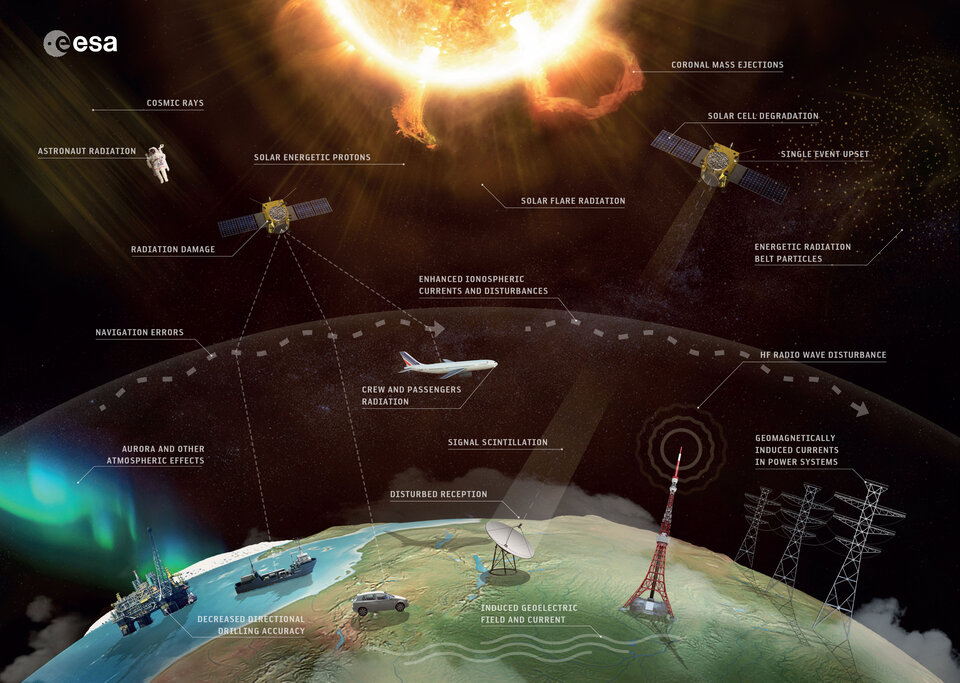
Did you know that weather isn’t just an Earthly phenomenon? The Sun can generate 'storms’ and its activity affects the entire Solar System. For example, in early November 2025, two intense solar flares were observed, followed by two coronal mass ejections. When these reached Earth, they triggered a geomagnetic disturbance that peaked as a strong global storm on 13 November, before decreasing to moderate levels.
The near-Earth environment is influenced by solar and interplanetary activity. This can disrupt satellite electronics, alter spacecraft trajectories, and even threaten astronaut safety. Geomagnetic storms can interfere with power grids, communications, navigation systems like GNSS, and aviation—technologies we rely on every day.

That’s why space weather research, monitoring and services are critical. Observing these events and forecasting their impacts play a key role in protecting astronauts and safeguard vital infrastructure both on Earth and in space. The field of space weather encompasses both the dynamic state of the space environment and its interaction with technologies as well as spacecraft hardware in orbit to power distribution networks on the ground. Space weather services aim to transform knowledge of the phenomena and their potential impacts into actionable information for system operators in the affected sectors.
ESA’s Space Safety Programme Office works to detect, predict and assess threats from space and their potential risk to life, property, and infrastructure. In particular, ESA’s Space Weather Office is addressing those risks associated with the activity of the Sun to provide owners and operators of critical spaceborne and ground-based infrastructure with timely and accurate information to mitigate the adverse impacts of space weather.
Training course description

With the Space Weather Training Course, ESA aims to offer students a comprehensive introduction to the space weather domain, addressing it from scientific, technical, and operational perspectives. This course will cover core principles, monitoring and forecasting techniques, modelling approaches, assessments of technological impacts, and prospects for future developments in the field. The programme will include lectures and hands-on practical work, including the use of the Space Weather Portal. The participants will also visit key facilities that form part of the current European space weather landscape: ESA’s Space Weather Coordination Centre and the Solar-Terrestrial Centre of Excellence at the Space Pole in Brussels, along with ESA’s Proba-2 and Proba-3 Operations Centre at ESEC-Redu.
Upon completion of the workshop, students will be evaluated based on their group project and will receive a certificate of participation and course transcript, allowing them to request ECTS credit(s) from their respective universities.
Preliminary schedule
| Day 1 |
Welcome and Introduction Space Weather Introduction: From Physics to Impacts Space Weather Physics Fundamentals I: The Sun and Heliosphere Space Weather Physics Fundamentals II: The Geospace Environment From Physics to Forecasting |
| Day 2 |
Space Weather Modelling Space Weather Modelling Tutorial Space Weather Impact on Space Surveillance and Tracking Data Resources for Space Weather Monitoring and Forecasting Space Weather Impact on Spacecraft Operations Space Environment Impacts on Space-Based Systems |
| Day 3 |
Space Weather Impact on Navigation & Communication Systems Space Weather Impact on Ground-based Systems Visit the Solar-Terrestrial Centre of Excellence and ESA’s Space Weather Coordination Centre |
| Day 4 |
Space Weather Impact on Aviation Space Weather & Society: The Road to Operational Service Provision in Europe Group Project session |
| Day 5 |
Visit of ESEC-Redu Group Project presentations Wrap-up and Conclusion |
Who can apply?
To participate, students must fulfil the following criteria:
- aged minimum 18 years old. ESA Academy and relevant partners will only appraise applications from students who have no or limited professional experience in relevant engineering or space-related topics;
- be a citizen of an ESA Member States, Canada* or Associate Members;
- be enrolled as a university student for the year 2025-2026 in a master (i.e., MSc or equivalent) or a doctoral (i.e., PhD or equivalent) degree programme;
- be studying an engineering subject, science, or business administration/communication with a science or engineering background.
Selected students will be requested to attend the entire 5-day training course at ESEC-Galaxia. They will be sponsored by ESA to cover accommodation and meals, as well as up to 350 Euros for travelling to Belgium.
ESA is committed to achieving diversity and creating an inclusive professional environment. To this end, we welcome proposals and applications from all eligible candidates irrespective of gender, sexual orientation, ethnicity, beliefs, age, disability, or other characteristics. ESA Academy strongly encourages inclusiveness within its programmes and within participating teams, which contributes to the enrichment of our programme.
Whenever possible, we seek to accommodate individuals with disabilities by providing the necessary support, either digitally or at the location of the training. In case of any questions or specific needs, please reach out to academy.training@esa.int to get assistance or advice during the application process.
How to apply
- Fill in the application form via our platform;
- Upload a motivation letter (PDF, maximum 1 page, no images);
- Upload a CV (PDF, Europass format, maximum 2 pages, no images);
- Upload a formal recommendation letter (PDF, maximum 1 page, including signature, no images) from a university professor or academic supervisor of the current university (if it is not possible to receive the recommendation letter from your referee, please ask them to send a recommendation email to academy.training@esa.int before the application deadline);
- Upload a copy of your Transcript of Grades from the two previous semesters, or, if not available, the previous graded academic year (PDF).
All answers and documents should be in English (Transcript of Grades can be submitted in the language of the hosting university, if unavailable in English).
*Canadian students enrolled in a Canadian post-secondary institution may apply for additional support from the Canadian Space Agency through this Announcement of Opportunity (grant applications must be submitted at least 7 weeks before the course delivery and account creation 3 weeks before the submission deadline – create an account soon!). This additional support is to cover costs that are not already covered by ESA for selected Canadian post-secondary students.
The deadline for applications is 4 January 2026, 23:55 CET.
The selection announcement is on 26 January 2026.
For more information, please contact academy.training@esa.int.