

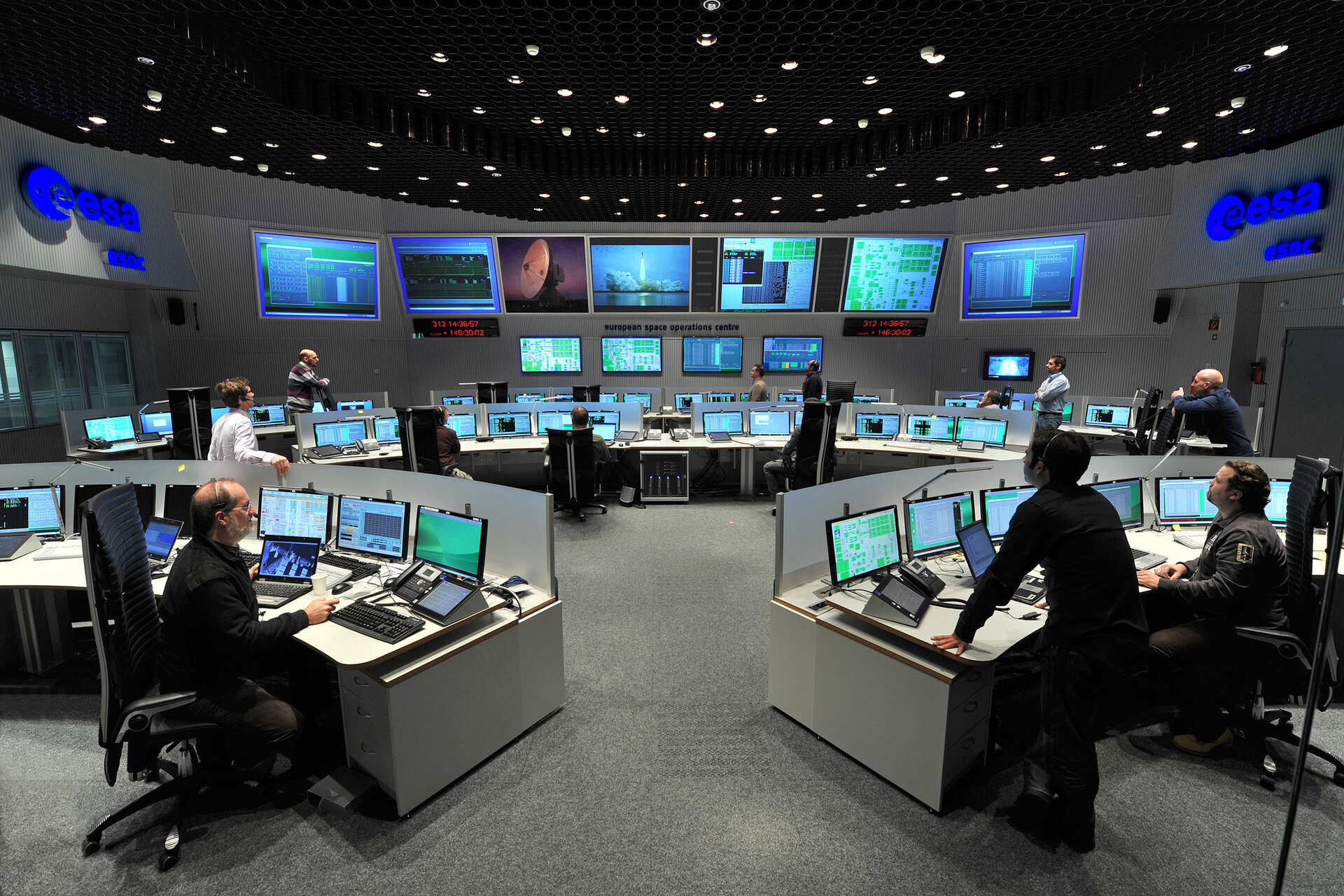
The Ladybird Guide to Spacecraft Operations Training Course returns for its 10th anniversary
In October 2025, for its 10th edition, ESA Academy’s popular Ladybird Guide to Spacecraft Operations Training Course is returning, at the ESA Education Training Centre in ESEC-Galaxia, Belgium. This training course offers university students the opportunity to learn about the fascinating world of spacecraft operations.

ESA Academy is once again hosting the Ladybird Guide to Spacecraft Operations Training Course from the 13th to 17th of October 2025. Tailored for university students exploring careers in the space sector, the course offers an engaging introduction to spacecraft operations without excessive mathematics or technical jargon.
This course shows students how ‘driving’ a spacecraft is different to designing it. When it comes to spacecraft, it is the launch itself that grabs all the headlines. Once in orbit, we only tend to hear about the satellite again when it returns a great result or a spectacular image. But spacecraft do not take care of themselves on their own. The unsung heroes of any space mission are the people working in operations. They are the ones who work 24/7 to ensure that the spacecraft is healthy, returning the most data, and functioning at peak efficiency. In addition, these are the operators who diagnose problems with satellites and work out how to make them function properly again.
The course is suitable for BSc, MSc and PhD students who want to quickly acquire a feeling for the broad spectrum of disciplines that are part of spacecraft operations.
Taught by an experienced engineer who works for the Operations Department of ESOC, the European Space Operations Centre in Darmstadt, Germany, the course will be delivered through formal lectures but with a heavy emphasis placed on the interaction with the students. Participants will also form operations teams and be trained by the OPS-SAT Space Lab team in preparation for an exciting realistic mission anomaly simulation.

The way specific subsystems of a spacecraft like Attitude, Determination and Control Subsystem (ADCS), Orbit Control System (OCS), Power, On Board Data Handling (OBDH), Telemetry, Telecommunication & Control (TT&C), Thermal and On Board Software (OBS), have been designed has a bearing on the way operations are carried out, and this will be highlighted and discussed. The course will include a session on the physiological traps to be avoided during operations and testing. Real stories of operational staff battling with wayward spacecraft – sometimes winning and sometimes losing – will be used whenever appropriate.
The course will be delivered at ESA Education Training Centre in Belgium. The students will visit ESA’s European Space Security and Education Centre (ESEC) and learn about its on-site activities, including Galileo and PROBA spacecraft’s operations.
Preliminary schedule
| Day 1 | Introduction Attitude Determination and Control Subsystems Group Project Introduction |
| Day 2 | Orbit Control System Telemetry, Telecommunication & Command On Board Data Handling Simulation Practice |
| Day 3 | On Board Software Power Simulation Practice |
| Day 4 | Thermal Wrap-up Group Project Presentation Visit of ESEC-Redu |
| Day 5 | Final Simulation Conclusion |
Who can apply?
To participate, students must fulfil the following criteria at the time of application:
- aged minimum 18 years old. ESA Academy and relevant partners will only appraise applications from students who have no - or limited - professional experience in relevant engineering or space-related topics;
- be a citizen of an ESA Member State, an ESA Associate Member (Latvia, Lithuania, or Slovakia), or Canada*;
- be studying for an engineering degree or physics (with basic knowledge in space technology) at Bachelor, Masters, or PhD level;
- be enrolled as a university student for the academic year 2025-2026.
Selected students will be required to attend the entire 5-day workshop. They will be sponsored by ESA to cover accommodation, meals as well as up to 350 Euros for travelling to Belgium.

ESA is committed to achieving diversity and creating an inclusive professional environment. To this end, we welcome proposals and applications from all eligible candidates irrespective of gender, sexual orientation, ethnicity, beliefs, age, disability, or other characteristics. The ESA Academy strongly encourages inclusiveness within its programmes and within participating teams, which contributes to the enrichment of our programme.
Whenever possible, we seek to accommodate individuals with disabilities by providing the necessary support, either digitally or at the location of the training. In case of any questions or specific needs, please reach out to academy.training@esa.int to get assistance or advice during the application process.
How to apply?
- Fill in the application form;
- Upload a motivation letter (PDF, maximum 1 page, no images);
- Upload a CV (PDF, in Europass format, maximum 2 pages, no images);
- Upload a formal recommendation letter (PDF, maximum 1 page, including signature, no images) from a university professor or academic supervisor of current university (if it is not possible to receive the recommendation letter from your referee, please ask them to send a recommendation email to academy.training@esa.int. before the application deadline);
- Upload a copy of your Transcript of Grades from the two previous semesters, or, if not available, the previous graded academic year (PDF).
All answers and documents should be in English (Transcript of Grades can be submitted in language of hosting university, if unavailable in English).
*Canadian students enrolled in a Canadian post-secondary institution may apply for additional support from the Canadian Space Agency through this Announcement of Opportunity (grant applications must be submitted at least 7 weeks before the course delivery and account creation 3 weeks before the deadline). This additional support is to cover costs that are not already covered by ESA for selected Canadian post-secondary students.
The deadline for applications is 20 July 2025 23:59 CEST.
For more information, please contact academy.training@esa.int.