


AcubeSAT calibrates flight radiation dosimeter at ESA ESTEC
The SpaceDot team from the Aristotle University of Thessaloniki, Greece, visited ESA’s European Space Research and Technology Centre (ESTEC) in the Netherlands on 2–3 June 2026 to calibrate the flight model dosimeter on board AcubeSAT, a student-built CubeSat for space biology developed within ESA’s Fly Your Satellite! programme.
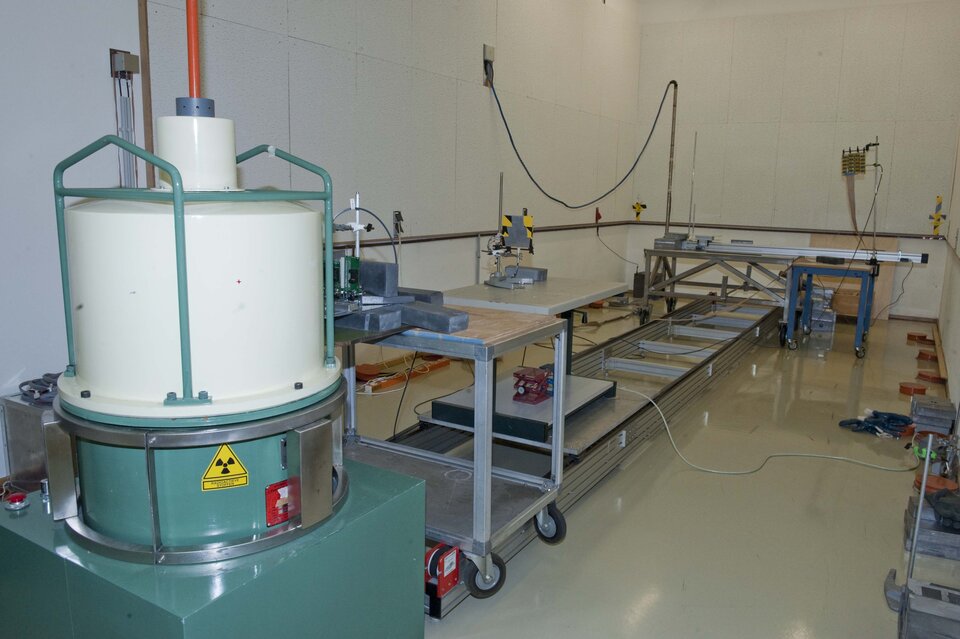
The campaign followed an earlier test campaign in December 2025, during which the team successfully developed and validated their calibration procedure. Returning to ESA ESTEC, the team repeated the same process using the flight model dosimeter that will fly on board the satellite.
The activities were carried out with the support of ESA’s Radiation & Components Reliability Section using the Cobalt-60 irradiation facility.

Accurate calibration of the dosimeter is essential to ensure reliable measurements of the radiation environment in orbit. The purpose of this calibration was to enable a robust correlation between measured radiation levels and the biological responses to be observed in the payload’s cells during the in-orbit experiment.
By exposing the instrument to known radiation levels, the team characterised and corrected its response, ensuring it is properly calibrated and ready for flight.
The dosimeter is now ready for integration as the team continues preparations for the assembly and integration of the complete satellite system, with the goal of achieving a fully functional spacecraft by the end of the year.
About AcubeSAT mission
AcubeSAT aims to investigate how space conditions affect living cells, with a focus on changes in gene expression in low Earth orbit. The mission combines synthetic biology and miniaturised technologies to advance space biology research on CubeSats.