Journey to Mercury
BepiColombo was launched on 20 October 2018 at 01:45 GMT, on an Ariane 5 from Europe’s Spaceport in Kourou, French Guiana. To reach Mercury in 2026, it has used the gravity of Earth, Venus and Mercury in combination with the thrust provided by electric propulsion.
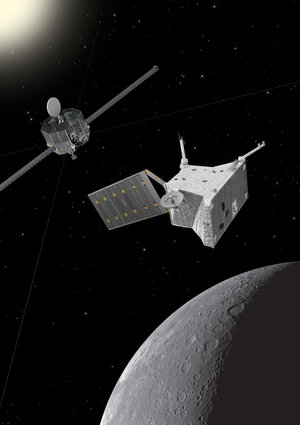
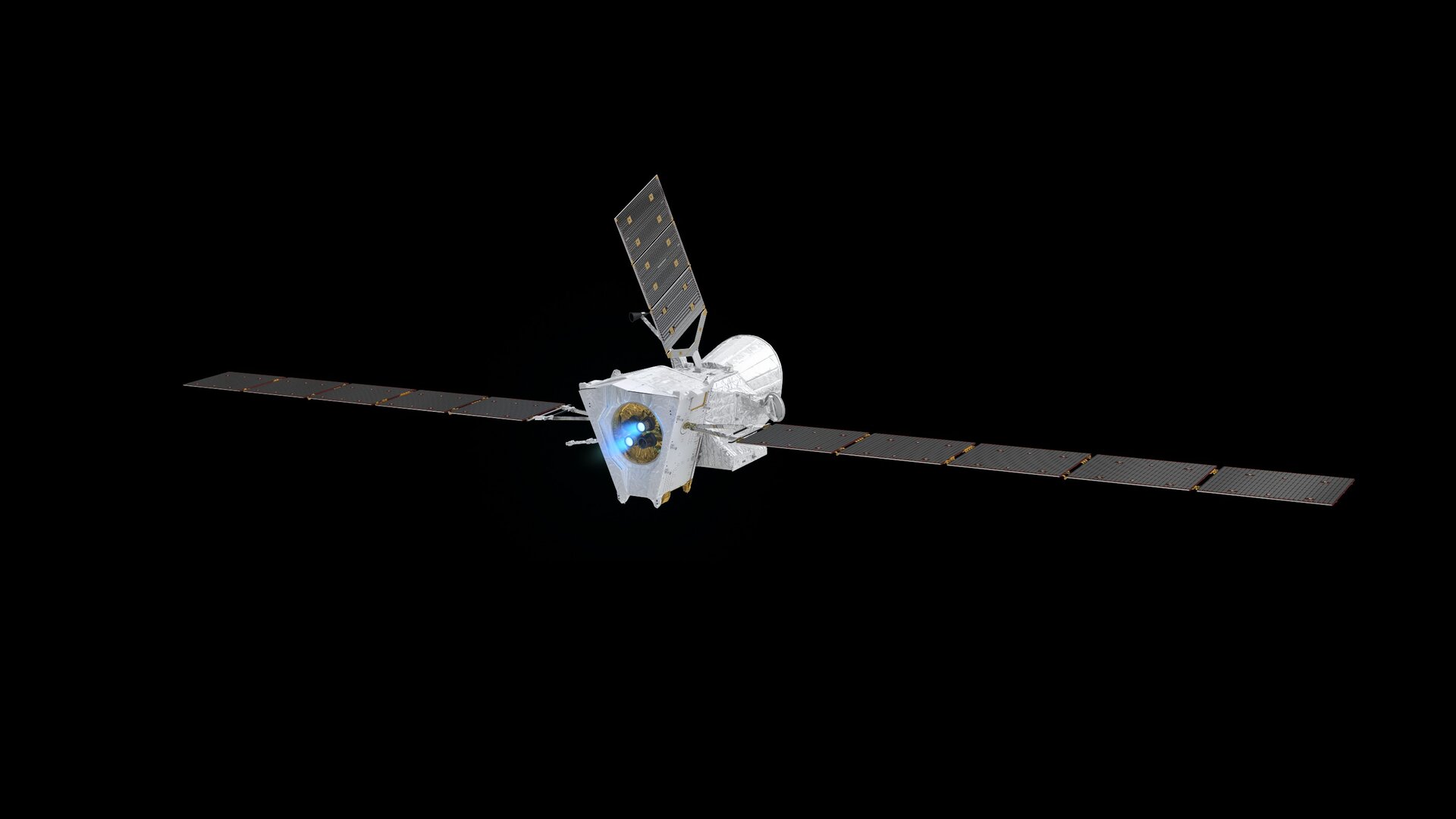
The Mercury Planetary Orbiter (MPO) and the Mercury Magnetospheric Orbiter (Mio) travel to Mercury together as a single composite spacecraft, with the Mercury Transfer Module (MTM) providing power and propulsion.
A big challenge for the mission is the Sun’s enormous gravity, which makes it difficult to place a spacecraft into a stable orbit around Mercury – even more energy is needed than sending a mission to Pluto. After launch, and having escaped the ‘gravity well’ of Earth, BepiColombo has had to brake against the gravitational pull of the Sun. Ion thrusters on the MTM provide the needed low thrust over long durations of the cruise phase.
The solar electric propulsion is mission-enabling for the trip to Mercury. Without it, it would not be possible to bring two spacecraft of the mass of MPO and Mio to Mercury using a conventional launcher. Normal chemical propulsion would have required way too much fuel for such a long journey. The ion thrusters will accumulate the highest total impulse (thrust level multiplied by hours of operation) ever achieved in a space mission.

Launched in October 2018, the spacecraft is on an eight-year journey to Mercury, with one Earth flyby (April 2020), two Venus flybys (October 2020 and August 2021) and six Mercury flybys between October 2021 and January 2025 before arriving at Mercury in late 2026.
When approaching Mercury, the transfer module will separate and the two spacecraft, still together, will be captured into a polar orbit around the planet. Their altitude will be adjusted using MPO’s thrusters until Mio’s desired elliptical polar orbit of 590 x 11 640 km above the planet is reached. Then MPO will separate and descend to its own 480 x 1500 km orbit using its thrusters. The fine-tuning of the orbits is then expected to take three months, after which the main science mission will begin.
The interactive ‘Where is Bepi’ tool below allows you to explore BepiColombo’s trajectory, including its flybys, and follow the position of the spacecraft on every single day of its journey.