

What is Webb?
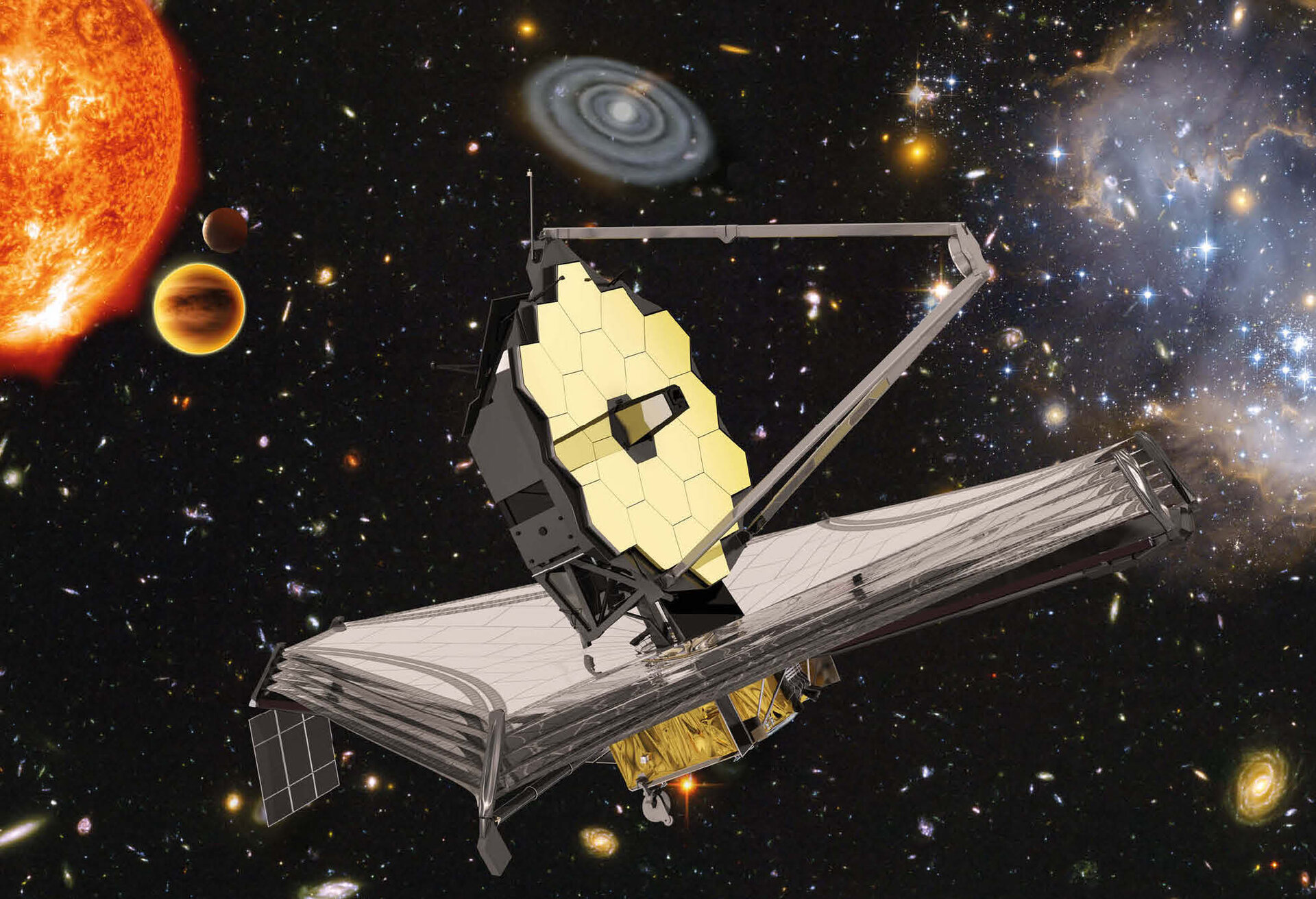
The James Webb Space Telescope (Webb) follows in the footsteps of the Hubble Space Telescope as the next great space science observatory, designed to answer outstanding questions about the Universe and to make breakthrough discoveries in all fields of astronomy. Webb is pushing the frontiers of knowledge of our own Solar System, of the formation of stars and planets, including exoplanets, and of galaxy assembly and evolution, in ways never before possible.
Webb is observing the Universe in the near-infrared and mid-infrared — at wavelengths longer than visible light with a suite of state-of-the-art astronomical instruments.
The telescope launched on an Ariane 5 rocket from Europe's Spaceport in French Guiana. It then embarked on a month-long journey to its final orbit about one and a half million kilometres from Earth, at the Lagrange point 2. In the first three weeks after launch, Webb unfolded its sunshield, which is the size of a tennis court, and then deployed its 6.5-metre primary mirror that detected the faint light of distant stars and galaxies with a sensitivity a hundred times greater than that of Hubble.
What’s in a name?
The James Webb Space Telescope’s name honours NASA's second administrator, James E. Webb, who headed the agency from February 1961 to October 1968, and directed the Apollo programme.